What it is
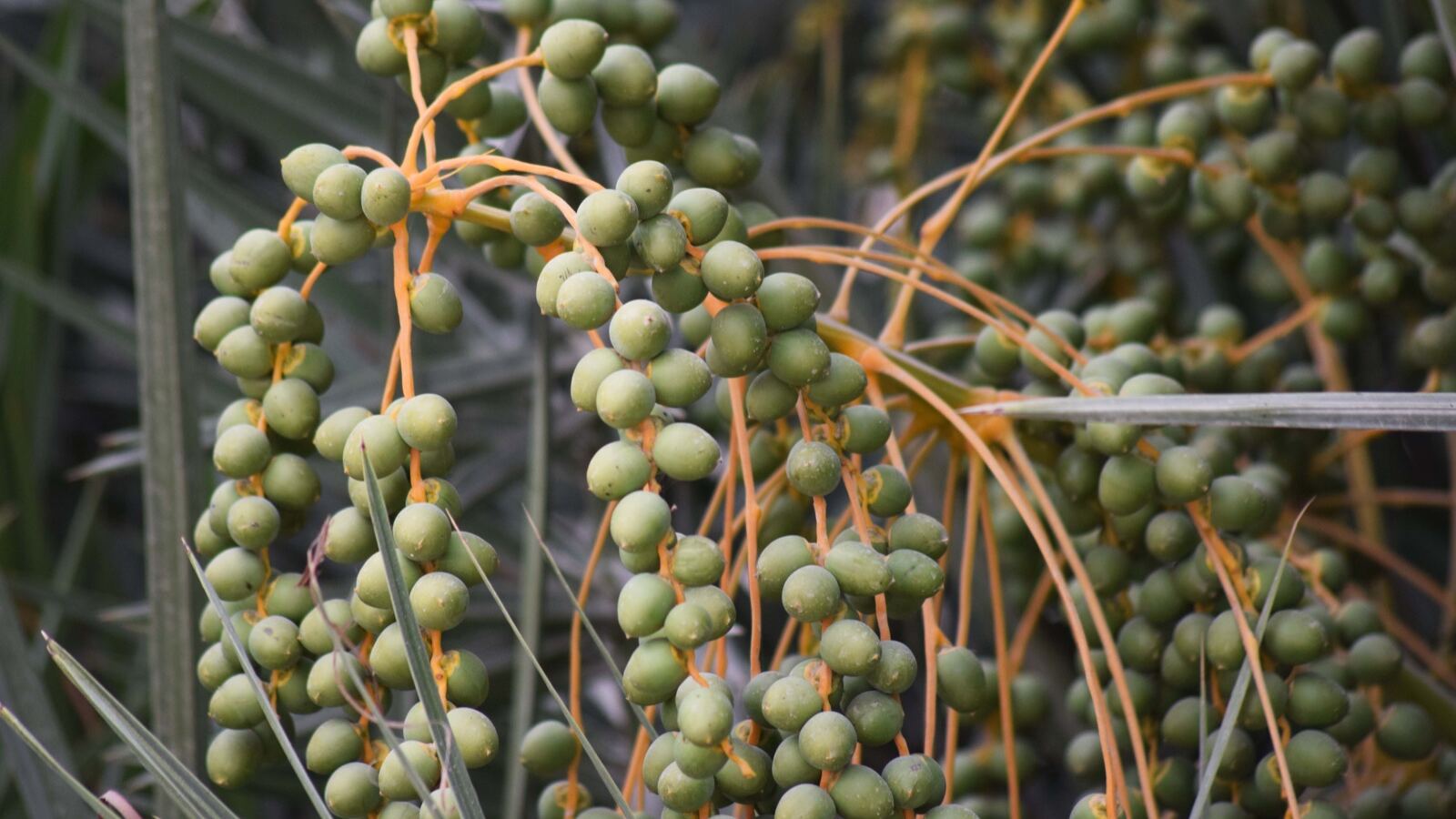
Phoenix dactylifera, a palm of the hot deserts of North Africa and the Middle East, and one of the oldest cultivated fruit crops — grown for at least 6,000 years, and central to the civilisations of Mesopotamia, Egypt, and Arabia.
Like the coconut, it is a monocot palm rather than a true tree: a single unbranched trunk topped by a crown, growing from one point, with no bark or rings and no capacity to resprout if the crown is destroyed.
The date is the crop that made oasis agriculture possible, and the whole three-layer oasis system is built around it.
The three-layer oasis
The classic oasis is a deliberate stack, and the date palm is what enables it.
The palms form the top layer, tall enough to catch full desert sun, their crowns casting broken shade.
Fruit trees grow beneath — pomegranate, fig, citrus, apricot — in the moderated microclimate the palms create.
Vegetables, fodder, and cereals grow at ground level, in the deepest shade and highest humidity.
The Arab agricultural saying captures it: the date palm must have its feet in water and its head in the fire — its roots in the oasis water table, its crown in full sun. In that position it shades and shelters everything below, cutting temperature and evaporation for crops that could not otherwise survive the open desert.
It is one of the oldest documented food forest designs, and a direct ancestor of the multi-strata thinking in permaculture design. See shade management.
Heat, drought, and salt
The date palm's tolerances are what let it grow where almost nothing else fruits.
Heat. It thrives in the extreme heat of the desert summer and needs it — dates require long, very hot, dry conditions to ripen, and fail in cool or humid climates even where the palm survives.
Drought. Deep roots reach the water table, and an established palm survives on groundwater with little or no rain.
Salt. The date palm is among the most salt-tolerant of all fruit crops, growing and fruiting on water and soil that would kill most trees. That is why it persists in the salinised lower Mesopotamian landscapes where, as described in salinity, cereal agriculture failed thousands of years ago.
Its water source, though, is the vulnerability: oasis agriculture depends entirely on the water table, and falling aquifers threaten date cultivation across the region. See wells and boreholes, aquifer recharge, and dryland restoration.
Dioecious, and hand-pollinated for millennia
Date palms are dioecious — separate male and female trees — and only females bear fruit.
Because a stand grown from seed is roughly half unproductive males, and because seedlings do not come true, date growing has depended on two practices since antiquity:
Hand pollination. Growers cut male flower clusters and tie or dust them onto the female flowers. Depictions of date pollination appear in Assyrian reliefs, making it one of the oldest recorded agricultural techniques, and it means a single male can pollinate many females — so orchards keep only a few males.
Offshoot propagation. A named variety is propagated only by removing offshoots — suckers that grow from the base of a female palm — each a clone of the mother. Seed is used only for breeding. Offshoots are slow to produce, limited in number, and slow to establish, which is why superior date varieties spread slowly and are valuable. Tissue culture now supplements this.
The whole reproductive setup is a good illustration of why so many tree crops are clonally propagated, the same logic as grafting in apples and pears reached by a different route.
Bayoud disease
Fusarium oxysporum f. sp. albedinis, bayoud, is a soil-borne wilt that has destroyed a very large share of the date palms of Morocco and Algeria over the past century, spreading eastward.
There is no cure. It moves in soil, water, and infected offshoots, and it kills palms over months to a couple of years.
The catastrophe has a familiar shape: the best commercial varieties are the most susceptible, and resistant varieties tend to produce poorer fruit, so the disease is progressively removing the most valuable dates and narrowing the crop. It is the date-palm version of the argument in tree diseases and structural diversity, and resistant-variety breeding is the main response. See also red palm weevil, which attacks dates as well.
The dates
The fruit passes through named ripening stages, and dates are harvested and sold at different ones:
Khalal — crunchy, astringent, not yet sweet. Rutab — soft, partly ripe, very sweet, perishable. Tamr — fully ripe, cured, and dried, which is the keeping form.
A fully cured tamr date is around 70 percent sugar and keeps for a year or more without refrigeration, which made it a staple travelling and trade food across the desert — a concentrated, storable, high-energy crop from a tree that grows where grain cannot. See harvest and storage.
Beyond the fruit, the date palm supplies fronds for thatch and basketry, trunk timber, and sap tapped for palm sugar and toddy as in the coconut.
Growing one
A crop for hot dry frost-tolerant deserts and Mediterranean climates — the date palm tolerates more cold than the coconut, surviving light frost, but it needs the long fierce summer heat to ripen fruit, which most temperate and humid climates cannot provide.
Ornamental date palms grow in Mediterranean gardens and mild coastal cities well outside the fruiting range, valued for form rather than crop.
To fruit dates you need a hot dry summer, a female palm of a named variety propagated from an offshoot, a male within pollinating reach, and water at the roots. Given those, it is another near-immortal low-input perennial. See perennials first and drought-tolerant species.
See also
- Coconut the tropical palm, and the same monocot structure
- Salinity why dates persist where cereals failed
- Dryland Restoration the wider desert-agriculture context
- Food Forest Design the oasis as an ancient layered system
- Pomegranate a classic oasis understorey fruit
- Drought-Tolerant Species the dry-climate palette
- Tamarind and Carob
- Jujube
- Palms
- Betel Nut
- Desert Date