What it is
Areca catechu, the areca palm — a tall, slender, elegant palm of tropical Asia, whose seed, the "betel nut" (more properly the areca nut), is one of the most widely used psychoactive substances in the world.
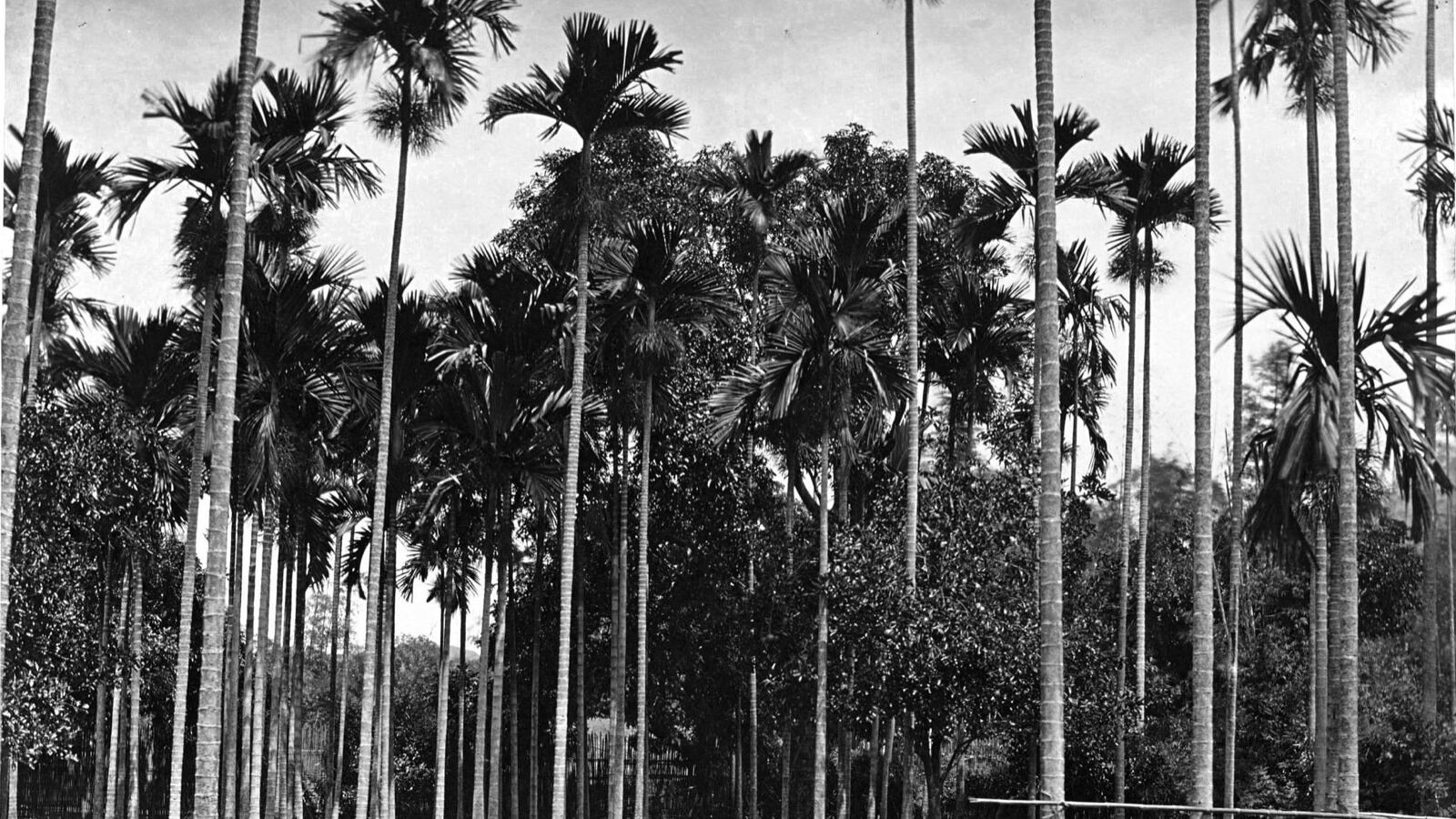
It is a graceful feather palm with a smooth green-ringed trunk and a crown of arching fronds, bearing clusters of orange-to-red egg-shaped fruit, each containing a single hard seed. That seed is chewed — by an estimated hundreds of millions of people, perhaps a tenth of humanity — making the areca one of the most consumed of all stimulant plants, ranking with tobacco, caffeine, and alcohol in global use.
The betel quid
The areca nut is rarely chewed alone. It is the centre of the betel quid (paan): a slice of areca nut is wrapped, with slaked lime and often catechu paste, spices, and tobacco, in a leaf of the betel vine (an unrelated pepper plant, Piper betle — the "betel" of the name properly belongs to the leaf, not the nut), and the whole parcel is chewed.
The chew releases arecoline, a mild stimulant alkaloid that produces a warming, alerting, mildly euphoric buzz — comparable to a strong coffee or a cigarette — along with a copious flow of brilliant blood-red saliva (from the reaction of catechu and lime), which chewers spit out, staining lips, teeth, and pavements the vivid red that is one of the visual signatures of South Asia and Southeast Asia. Betel chewing is ancient — thousands of years old — and deeply woven into the social, ceremonial, and hospitable life of the region, offered to guests and used at weddings and rituals, in the way the kola nut is in West Africa. See historical ecology.
A serious health warning
Unlike most of the stimulant trees in this encyclopedia, the areca nut carries a grave and well-established health cost that must be stated plainly. Betel-quid chewing — especially with tobacco, but the areca nut itself too — is a major cause of oral cancer and of oral submucous fibrosis, a debilitating pre-cancerous stiffening of the mouth, and the areca nut is classified by the World Health Organization as a Group 1 carcinogen (carcinogenic to humans).
In the regions where chewing is common, oral cancer is correspondingly among the most frequent cancers, and public-health campaigns work to reduce the habit against its deep cultural entrenchment and mild addictiveness. So the areca palm is at once a plant of ancient hospitality and culture and a genuine public-health problem — a duality worth being honest about. The areca nut is not a benign chew.
Growing it
Tropical, frost-tender, and a tree of the hot, humid, lowland tropics, the areca palm wants warmth, high rainfall or irrigation, humidity, and deep, moist, well-drained soil, and it is grown as a plantation crop across South and Southeast Asia (India is a huge producer). It is a slender, tall, single-stemmed feather palm, grown from seed and cropping for decades, often interplanted in agroforestry with other crops and shade.
Beyond the nut it is a handsome ornamental palm, and its slim green trunks and airy crowns are a familiar and beautiful part of South and Southeast Asian gardens and landscapes. But its cultivation is overwhelmingly for the chew, with all the economic importance and health cost that entails. See palms and propagation.
See also
- Palms the family the areca belongs to
- Catechu the tree extract that reddens the betel quid
- Kola Nut another stimulant plant bound to hospitality and ritual
- Cacao and Coffee the caffeine stimulant trees
- Historical Ecology the ancient culture of betel chewing
- Coconut and Date Palm other great economic palms