What it is
Hevea brasiliensis, a tall tree of the Amazon rainforest, and the source of essentially all natural rubber.
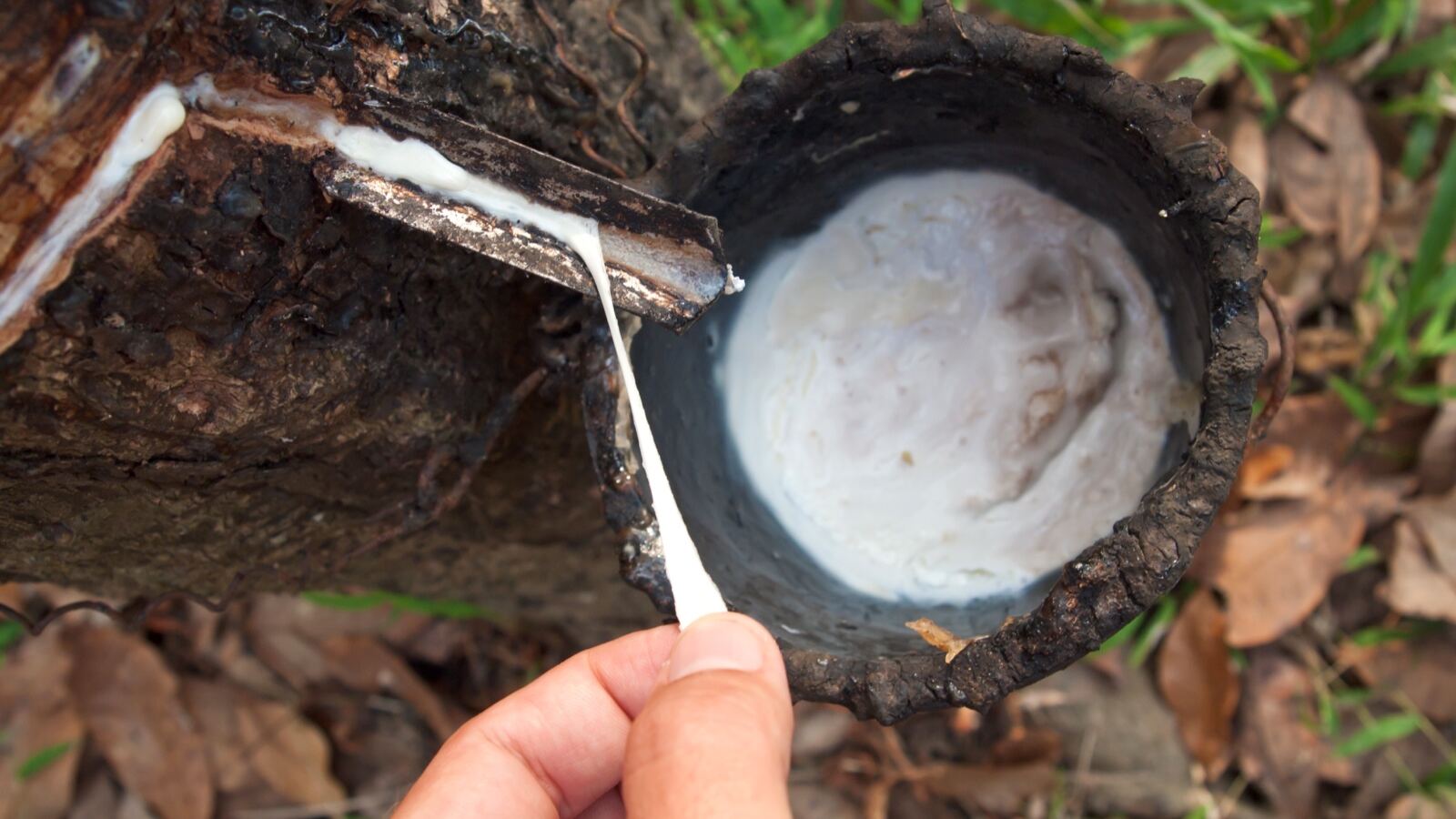
Latex — a milky fluid the tree produces in vessels in its bark, probably as a defence that gums up chewing insects and seals wounds — is harvested by tapping: a shallow diagonal cut through the bark that severs the latex vessels without reaching the wood, letting the latex run down into a collecting cup.
Done correctly, tapping does not harm the tree. A rubber tree is tapped every day or two for 25 to 30 years, the cut advanced slightly each time, and the bark regenerates so the panel can eventually be tapped again — another standing-tree-yields-a-crop system, like cork and maple syrup. It is skilled work, done before dawn when latex flows best.
The disease that shaped the map
Natural rubber production is concentrated overwhelmingly in Southeast Asia — Thailand, Indonesia, Malaysia, Vietnam — thousands of miles from the tree's Amazon home. The reason is one of the most consequential facts in agricultural history, and it turns on a fungus.
Microcyclus ulei, South American leaf blight, is a fungal disease native to the Amazon that attacks Hevea leaves. In the rubber tree's home range it coevolved with the tree and keeps plantations impossible: any dense planting of Hevea in the Amazon is destroyed by the blight, so rubber cannot be grown as a monoculture where it comes from. It can only be tapped from scattered wild trees in the forest — the same wild-harvest constraint as the Brazil nut.
In the 1870s rubber seeds were taken from Brazil to Kew and on to British colonies in Asia — an act Brazil regards as biopiracy, echoing the neem case a century early. In Asia, the blight was absent. Freed from its coevolved enemy, Hevea could be grown in dense, high-yielding plantations, and Southeast Asia became the centre of world rubber while the Amazon industry collapsed.
Henry Ford's attempt to establish Amazon rubber plantations, Fordlândia in the 1920s and 30s, failed largely because of the blight — a monoculture of Hevea in the blight's home range could not survive, exactly as the ecology predicts.
The standing threat
This history is also the industry's standing vulnerability, and it is a textbook illustration of the monoculture-and-disease argument in tree diseases and structural diversity.
The Asian rubber plantations are vast, dense, and genetically narrow, descended from a small founder population and heavily clonal. They are safe only as long as South American leaf blight stays out of Asia.
If the blight reached Southeast Asia — and it is regarded as a serious biosecurity threat, potentially a deliberate one — it could devastate the world's natural rubber supply, because the plantations have no coevolved resistance and are planted in exactly the dense uniform way the disease exploits. It is one of the clearer cases where a single pathogen crossing an ocean could disrupt a global commodity, and it is why Hevea germplasm and blight-resistant breeding are strategic concerns.
Natural versus synthetic
Synthetic rubber, made from petroleum, took much of the market in the twentieth century, but natural rubber has properties synthetics cannot fully match — resilience, heat resistance, and durability under stress — and it remains essential for aircraft and truck tyres, surgical gloves, and many industrial uses. So the crop is not a historical curiosity; it is a strategic material with no full substitute.
That keeps demand high, and with it the pressure to expand plantations — increasingly into biodiverse forest in Southeast Asia and now West and Central Africa, with the same deforestation concerns as oil palm. Rubber is another crop where the environmental question is where and how it is grown, not the tree itself.
Rubber in mixed systems
Against the monoculture model, rubber can be grown in far more diverse ways, and the traditional systems are instructive.
Jungle rubber, the traditional smallholder system of Sumatra and Kalimantan, grows rubber within a diverse regrowing forest — tapping trees scattered among fruit trees, timber, and secondary growth. Far lower-yielding than plantation monoculture, but vastly more biodiverse, more resilient, and providing many products. It is a genuine agroforestry and food forest system, and its replacement by monoculture and oil palm is a real biodiversity loss.
Rubber agroforestry more broadly — intercropping young rubber with food crops, or integrating it with other trees — reduces the monoculture risks and the establishment-phase income gap, and is promoted as a more sustainable model. See silvopasture and alley cropping.
The extractive model — tapping wild and scattered trees in standing forest — is also the basis of the historical and continuing argument for rubber tappers as forest defenders, most famously Chico Mendes, who organised Amazon rubber tappers against deforestation and was killed for it. The rubber tapper's economic interest in the standing forest is the same logic as the Brazil nut collector's and the argument in restoration economics.
Growing it
A strictly wet-tropical lowland tree — high rainfall, high temperature, no frost, and a deep well-drained soil. It is not remotely a temperate crop and has no garden relevance outside the tropics.
Where it grows it is fast, established from grafted clonal stock for yield, and tapped from about 6 to 7 years old.
Its interest to a temperate reader is as one of the great case studies: the tree that could only be plantation-grown by moving it away from its coevolved disease, the biopiracy that moved it, the monoculture vulnerability that history created, and the tapper economy that ties human livelihoods to standing forest.
See also
- Tree Diseases South American leaf blight and monoculture risk
- Macadamia, Cashew and Brazil Nut the wild-harvest parallel
- Oil Palm the same wet-tropical deforestation pressure
- Cork Oak the other bark-and-sap harvest without felling
- Chico Mendes the rubber tappers' movement
- Neem the parallel biopiracy history
- Sapotes
- Quinine Tree
- Tung and Candlenut
- Jatropha
- Gutta-Percha
- Sandbox Tree