One plant
Green tea, black tea, oolong, white, and pu-erh are all the same species — Camellia sinensis, a relative of the ornamental garden camellias.
The differences are entirely in processing, not in the plant. That single fact surprises most people and is the key to the whole subject.
Two main varieties:
C. sinensis var. sinensis, the Chinese tea plant — small-leaved, hardy, tolerant of cold and drought, suited to higher and cooler ground.
C. sinensis var. assamica, the Assam tea plant — large-leaved, more vigorous, tropical, less cold-hardy, and the basis of most black tea.
A tree kept as a bush
Left alone, the tea plant is a tree — var. assamica can reach 15 to 20 m, and ancient wild tea trees in Yunnan are several hundred years old and metres tall.
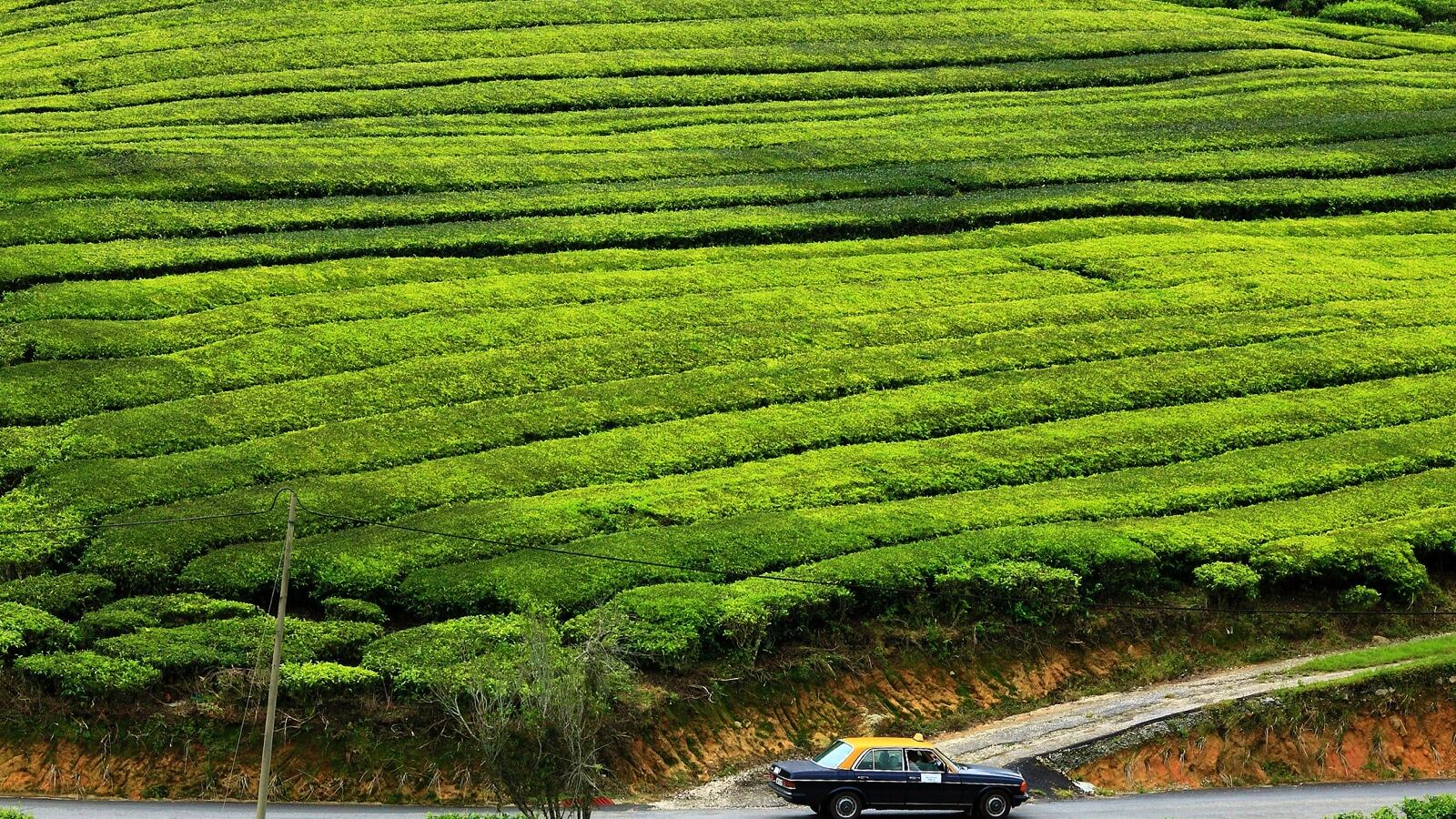
In cultivation it is pruned relentlessly into a low, flat-topped bush — a plucking table at waist height, a continuous clipped surface across the hillside. That shape does two things: it keeps the productive young shoots within reach of hand pickers, and hard regular pruning stimulates the constant flush of new growth that is the crop.
It is the same principle as coppice rotation and hedge management in hedgerow care — cutting a woody plant to force perpetual young growth — applied to a beverage crop. A tea bush kept in production for a century is a heavily and permanently pruned tree.
Only the youngest growth is picked: the bud and the top one or two leaves, the two leaves and a bud of the trade. That tender tip is where the flavour and the caffeine concentrate.
The types are processing steps
What separates the teas is how far the picked leaf is allowed to oxidise — an enzymatic browning, the same reaction that darkens a cut apple — before heat stops it.
White tea — barely processed. Young buds simply withered and dried. Minimal oxidation.
Green tea — oxidation stopped almost immediately by heat (steaming in Japan, pan-firing in China) to keep the leaf green and fresh-tasting.
Oolong — partially oxidised, anywhere from lightly to heavily, then heat-fixed. The broadest and most varied category.
Black tea (called red tea in China) — fully oxidised before drying, which develops the dark colour and malty, robust flavour.
Pu-erh — fermented and aged, sometimes for years, by microbial action rather than oxidation, in a class of its own.
One bush, one flush of leaves, and the entire range comes from decisions made in the hours after picking. It is one of the clearest examples anywhere of processing rather than genetics determining a food.
Shade, altitude, and flavour
Tea shares a great deal with cacao and coffee, including the shade question.
Altitude. The finest teas — Darjeeling, high-mountain oolongs — grow at elevation, where cool conditions slow growth, concentrate flavour compounds, and give the leaf complexity. It is the same slow-growth-improves-quality relationship seen in shaded coffee.
Shade. Some teas are deliberately shade-grown, and Japanese gyokuro and matcha are shaded for weeks before harvest. Shading forces the plant to produce more chlorophyll and more theanine, the amino acid responsible for tea's savoury umami character and its calming effect, and less of the bitter catechins. The result is a sweeter, richer, more intensely green tea. It is a rare case of shade management altering flavour chemistry directly. See shade management.
Terraces. Tea is grown on steep hillsides across Asia, and the terraced plantations are simultaneously cultivation and erosion control — the same engineered-slope logic as the rice terraces in rice. Contour planting on tea slopes is standard. See finding contour.
Caffeine and chemistry
Tea contains caffeine, less per cup than coffee but present, and its effect is modulated by theanine, which produces the characteristic calm-alertness rather than the sharper hit of coffee.
The astringency and much of the health interest come from catechins, a group of polyphenols most abundant in green tea, which oxidise into theaflavins and thearubigins as the leaf is processed toward black — which is why green and black tea have measurably different antioxidant profiles from the identical starting leaf.
As with turmeric, the popular health claims run somewhat ahead of the clinical evidence, though the underlying chemistry is real.
Growing it
Tea is hardier than most people assume, and var. sinensis is grown as far north as Cornwall, Scotland, and the northern United States. It is a genuine possibility in a mild temperate garden, if a slow and small-yielding one.
Acid soil is essential — pH 4.5 to 5.5, the same ericaceous requirement as its relatives the blueberries and the ornamental camellias. On alkaline ground it fails, and it is a container crop there in ericaceous compost. See soil pH.
Free-draining, moist, humus-rich soil, high humidity, and shelter from cold drying wind and hard frost when young.
Part shade to full sun, warmer conditions giving more growth.
Slow to establish and slow to yield — several years before meaningful plucking — and a home crop produces enough for interest rather than supply. Processing a few leaves into green or black tea at home is straightforward and genuinely rewarding.
Propagate from semi-ripe cuttings or from seed, which is short-lived and must be sown fresh. See propagation.
The plants themselves are attractive, evergreen, glossy, and produce fragrant white flowers in autumn — a good ornamental hedge in an acid-soil garden even where it is never picked, and a useful late nectar source. See pollinator habitat.
See also
- Cacao and Coffee the closest agronomic parallels
- Coppice Rotation cutting to force perpetual young growth
- Blueberry and Acid Shrubs the same acid-soil requirement
- Shade Management shade changing flavour chemistry
- Soil pH why tea fails on alkaline ground
- Erosion Control terraced tea on steep slopes
- Cinnamon and Camphor
- Franklinia
- Yerba Maté
- Yaupon and Guayusa
- Catechu