What is down there
Groundwater is not an underground lake. It is water filling the pore spaces and fractures in rock and sediment, moving slowly, sometimes very slowly.
The water table is the level below which those spaces are saturated. It is not flat. It follows the land surface in muted form, rising under hills and intersecting the ground at springs, seeps, and river beds.
An aquifer is a formation that holds and transmits enough water to be useful. Sand, gravel, sandstone, and fractured limestone are good. Clay holds water but will not give it up, which makes it an aquitard.
Two behaviours matter:
Unconfined aquifers have the water table as their upper surface, open to infiltration from above. They recharge quickly, and they contaminate quickly for the same reason.
Confined aquifers sit under an impermeable layer, pressurised. Drill into one and water rises above the level it was struck, sometimes to the surface, which is an artesian well. They are better protected and recharge much more slowly, often over centuries.
That recharge rate is the whole sustainability question. A confined aquifer refilled over 10,000 years is a finite resource being mined, not a renewable supply.
Dug wells and drilled boreholes
Dug or hand-dug wells are wide, shallow, and old technology. A metre or more across, lined with stone, brick, or concrete rings, typically 3 to 15 m deep into an unconfined aquifer. The width stores water, which lets a low-yielding aquifer supply a useful daily volume.
They are cheap, repairable with local materials, and they fail first in drought because they sit in the shallowest, most variable part of the water table. They are also the most easily contaminated, from surface runoff, latrines, and livestock.
Drilled boreholes are narrow, 100 to 200 mm, and deep, from 20 m to several hundred. A rig, a cased hole, a screen at the productive interval, and a submersible pump.
They reach deeper, more reliable, better-protected water. They cost far more, need machinery, and cannot be repaired by hand. When a borehole pump fails in a place with no supply chain, the borehole is finished, which is why the landscape of rural development is littered with abandoned ones.
Before you drill
Find out what is already known. Most countries have geological surveys with records of existing wells, depths struck, and yields. Neighbours' boreholes are the best data available and cost nothing. This is ordinary site reading applied downward.
Check the legal position first. Groundwater abstraction is regulated almost everywhere above modest volumes. Licences, registration, minimum distances from boundaries and septic systems, and required construction standards. Drilling first and asking later is expensive.
Get a proper siting assessment. Geophysical survey, resistivity or electromagnetic, identifies fractured zones and saturated horizons. It costs a fraction of a dry hole. Dowsing is not a substitute, whatever anyone tells you.
Ask what the water will be used for. Irrigation tolerates quality that drinking water does not, and the treatment cost difference is large. See water quality testing.
Yield, drawdown, and the test that matters
Pump a well and the water level drops. That drop is drawdown, and the shape of it around the well is the cone of depression.
A pump test is the only way to know what a well will actually deliver. Pump at a constant rate for hours to days, record the level, then record recovery after stopping. From that you get sustainable yield, which is almost always well below the maximum the pump can pull.
Overpumping a well is self-defeating. Draw the level below the screen and you aerate the aquifer, which can cause iron and manganese precipitation that clogs the screen permanently. Many failed boreholes were killed by their owners.
The cone of depression is where this becomes a community problem. Pumping hard lowers the water table around you, and a shallow neighbouring well inside that cone goes dry. The physics does not respect boundaries, which is why groundwater is a commons and why stakeholder mapping applies underground as much as above.
Contamination
Groundwater is well protected until it is not, and then it is very hard to fix.
Surface entry at the wellhead is the commonest route by far. A cracked lining, a missing cap, or ground sloping toward the well lets surface water bypass all that natural filtration. A proper sanitary seal, a raised headworks, and a concrete apron sloping away solve most of it.
Nitrate from fertiliser and manure, the classic agricultural signature. Slow to arrive and slow to leave; nitrate entering an aquifer today may surface in decades.
Pathogens from latrines and livestock. Minimum separation distances exist for a reason and depend on soil type; in fractured rock or karst, contamination travels much further than the standard distances assume.
Arsenic and fluoride, naturally occurring in some geology and a genuine mass-poisoning problem in parts of South Asia and East Africa. Not detectable by taste, smell, or appearance. Test.
Saline intrusion near coasts, covered in salinity.
The defence is largely land use in the recharge zone. Tree cover, absence of pollutants, and infiltration all matter. See aquifer recharge and permeable surfaces.
Lifting it
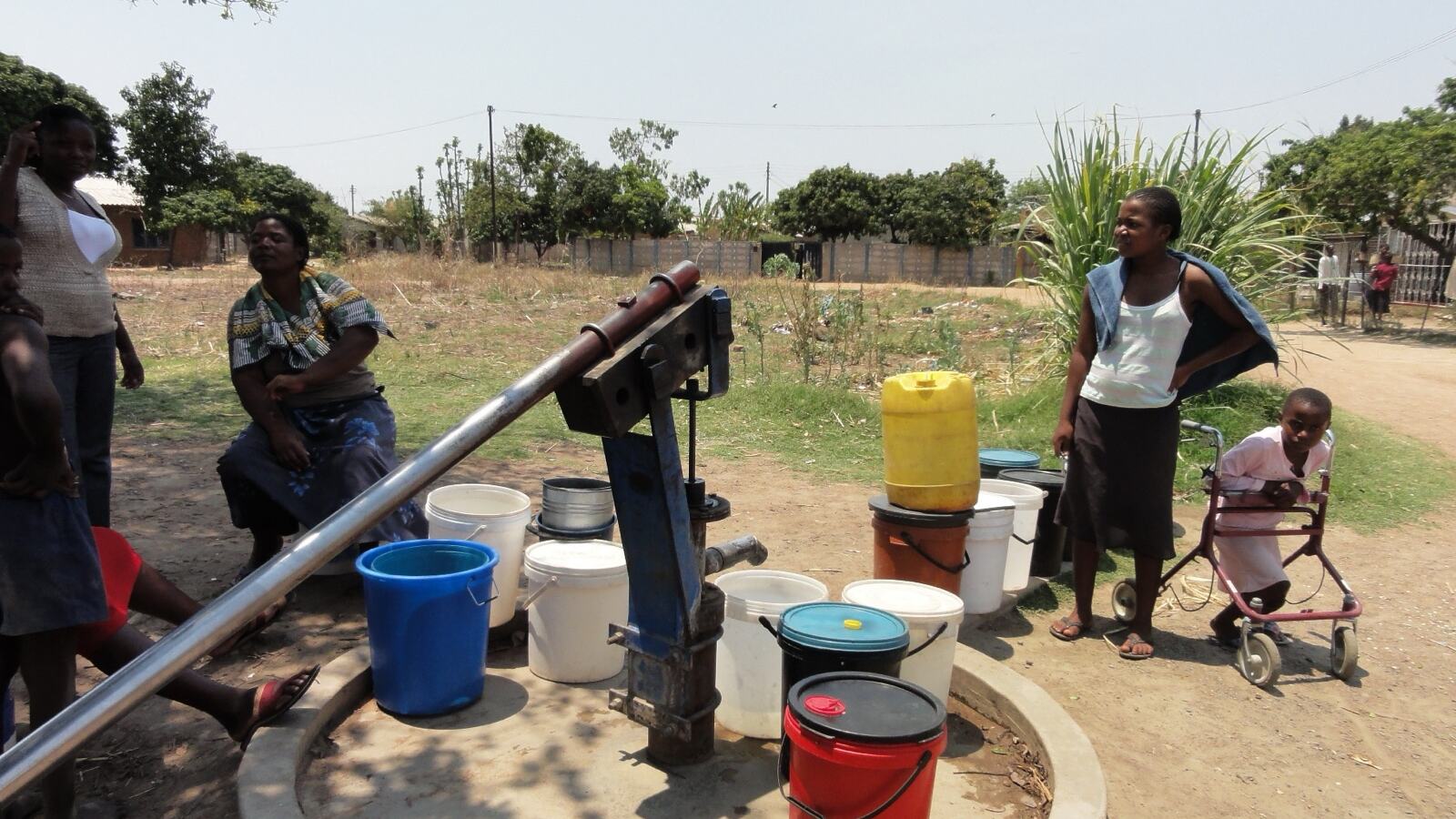
Hand pumps for shallow domestic supply. Repairable, low volume.
Submersible electric pumps for boreholes. Efficient, reliable, and dependent on power.
Solar pumping has changed rural water supply completely. Panels, a controller, and a DC submersible, pumping through the day into an elevated tank so the tank rather than a battery does the storage. No fuel, minimal maintenance, and the daily cycle matches irrigation demand.
The caution is that cheap solar pumping has made groundwater depletion much easier. Removing the fuel cost removed the main brake on abstraction in several regions.
Where head and flow allow, ram pumps move water with no power at all, and gravity-fed systems avoid pumping entirely. Groundwater should not be the first answer if surface options exist.
Groundwater is the last resort, not the first
The order of preference for any site is: reduce demand, then harvest rainwater, then store it in the soil, then use surface water, then pump groundwater.
Soil is the largest and cheapest reservoir available, and it recharges the aquifer as a side effect. See soil water storage. A property that has done its earthworks, swales, and mulching properly needs far less pumped water, and its borehole lasts longer.
Aquifer depletion is one of the defining resource problems of the century. The Ogallala under the American plains, the North China Plain, and the Punjab are all being drawn down faster than they refill, with water tables falling by metres per year in places. Every one of those started as individually reasonable decisions.
See also
- Aquifer Recharge putting water back
- Water Quality Testing knowing what you are drinking
- Salinity intrusion and irrigation damage
- Soil Water Storage the reservoir you should fill first
- Ram Pumps lifting water without power
- Gravity-Fed Systems avoiding pumping altogether
- Spring Development
- Rice
- Date Palm
- Qanats and Karez
- Sand Dams