What it is
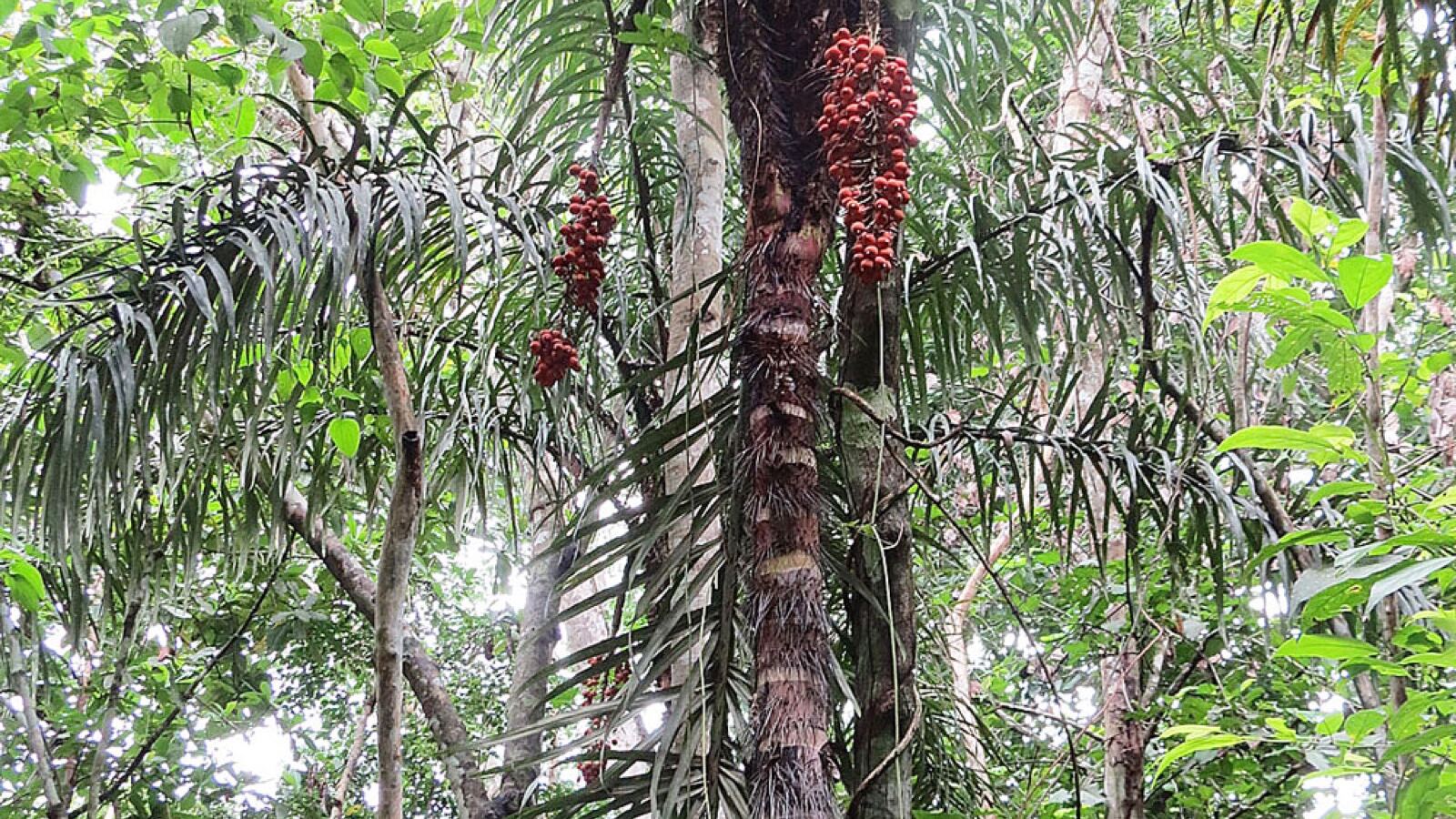
Bactris gasipaes, the peach palm or pejibaye — a tall, clumping, fiercely spiny palm of the American tropics, domesticated by Indigenous peoples of the Amazon and Central America thousands of years ago, and one of the most important native food palms of the region.
It is a true crop of the forest peoples — so thoroughly domesticated that it no longer occurs in a clearly wild form — grown for two very different products: a starchy staple fruit, and the finest heart of palm.
The fruit: a cooked staple
The peach palm's orange-to-red fruit hang in heavy bunches, and — unlike most palm fruit — they are eaten as a cooked starchy staple, not a sweet dessert. Boiled (they must be cooked; raw they are unpalatable and mildly irritant), the fruit has a rich, dense, floury, oily flesh, tasting of a cross between chestnut, pumpkin, and cooked potato — nourishing, filling, and high in oil, protein, vitamins, and starch, close to a complete food.
It was, and is, a staple across parts of the Amazon and Central America (pejibaye is a beloved everyday food in Costa Rica), eaten out of hand, made into flour, drinks, and dishes, and fed to livestock. As a highly nutritious, productive, storable-when-dried tree staple, the peach palm is one of the great underused food trees of the tropics, and a natural component of a tropical food forest. See restoration economics.
Guilt-free heart of palm
The peach palm's second product has become its most commercially important, and it solves a real conservation problem.
Heart of palm — the tender, edible growing bud (the "palmito") at the top of a palm's stem — is a prized delicacy, but harvesting it kills the stem it is cut from, because a palm's single growing point cannot be replaced. Traditionally, heart of palm was cut from wild single-stemmed palms (like the açaí's relative the juçara), each tree killed for one heart — which drove serious over-harvesting and threatened wild palms.
The peach palm changes the equation, because it is clumping and multi-stemmed and suckers freely: cutting one stem for its heart does not kill the plant, which simply grows a replacement sucker, so the clump can be harvested again and again indefinitely. This has made the cultivated peach palm the main sustainable source of heart of palm, grown in dense plantations specifically for the "palmito" and harvested on a cutting rotation like a coppice — turning a delicacy that once meant killing wild trees into a renewable crop. It is one of the clearest cases of domestication and cultivation solving a wild-harvest conservation problem. See reforestation techniques.
The spininess, it should be said, is real: the trunks are ringed with long, hard, black spines, making both fruit and palmito harvest a careful business, though spineless selections have been bred.
Growing it
Tropical, frost-tender, and a palm of the hot, humid, lowland tropics, the peach palm wants heat, high rainfall, and rich, moist, well-drained soil; it is fast-growing, clumping, and productive, cropping fruit within a few years and yielding palmito on a cutting rotation.
It is grown from seed and from suckers, and managed either for fruit (letting stems mature and fruit) or for heart of palm (cutting young stems on rotation). As a domesticated, highly nutritious, dual-purpose, and sustainably-harvestable food palm, the peach palm is one of the most valuable and promising of the Amazon's crop trees. See palms and propagation.
See also
- Palms the family, including the heart-of-palm bud
- Açaí the fellow Amazon fruit palm, and its single-stemmed heart-of-palm relative
- Coconut, Date Palm, and Oil Palm other great economic palms
- Food Forest Design the peach palm as a nutritious staple tree
- Restoration Economics cultivation solving a wild-harvest problem
- Sago Palm another palm staple of the wet tropics