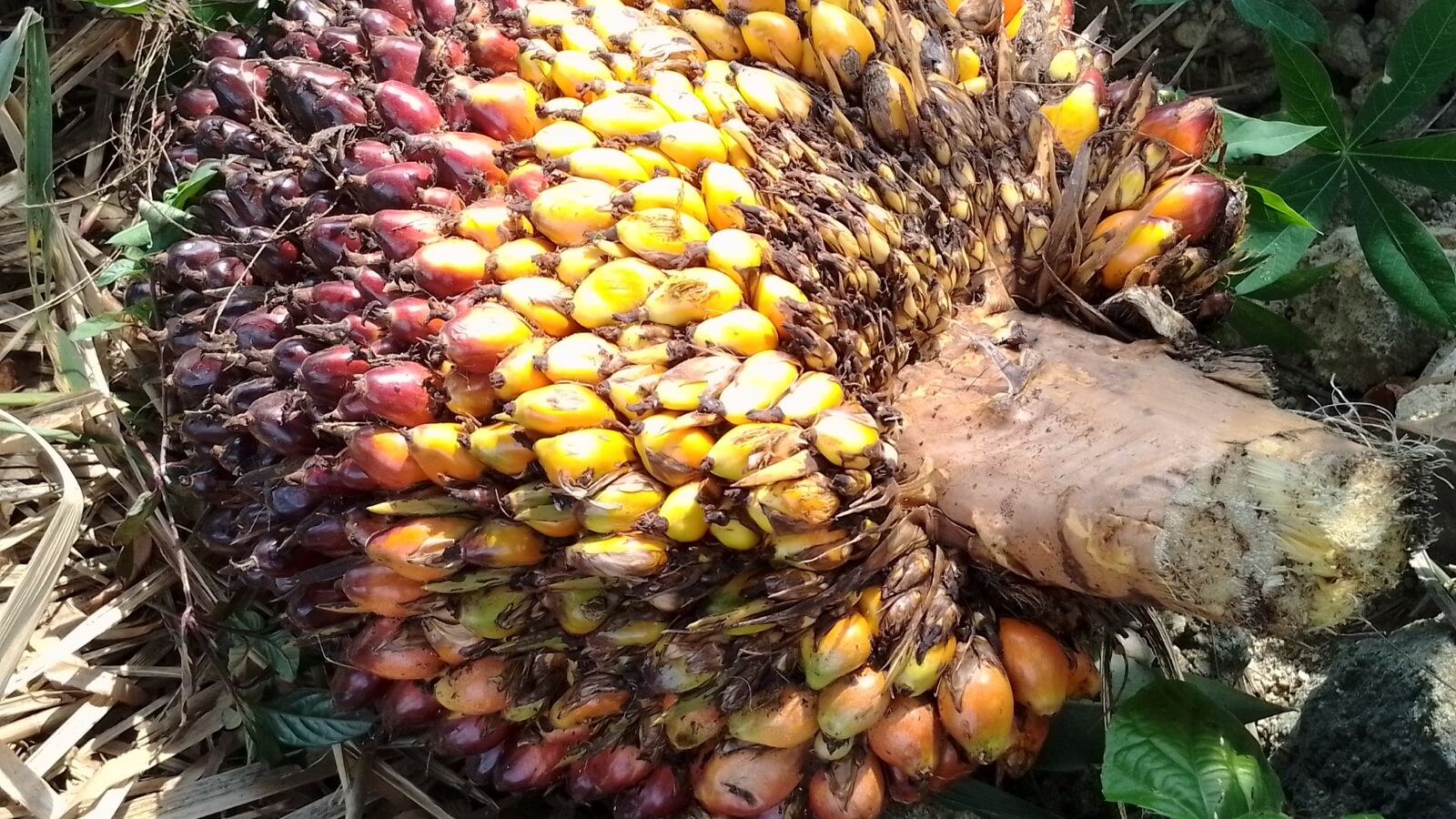
What it is
Elaeis guineensis, the African oil palm, from the forests of West and Central Africa, and now the source of most of the world's vegetable oil.
Like the coconut and date palm, it is a monocot palm — single trunk, single growing point, no resprouting.
It is impossible to write about honestly without holding two facts together: it is the most productive oil crop that exists, and it is one of the largest single drivers of tropical deforestation. Both are true, and the tension between them is the whole subject.
Why the yield matters
Oil palm produces far more oil per hectare than any competing crop — commonly four to ten times the yield of soya, rapeseed, or sunflower per unit area.
Two oils come from the fruit: palm oil from the orange fleshy mesocarp, and palm kernel oil from the seed inside. Between them they appear in a very large share of packaged food, soap, cosmetics, and increasingly biodiesel — it is cheap, semi-solid at room temperature, stable, and versatile.
The yield advantage is the crux of the environmental argument, and it cuts both ways:
Against boycotts: replacing palm oil with another vegetable oil would require several times more land to produce the same quantity, so a switch to soya or rapeseed would clear more land, not less — much of it in other biodiverse regions. A boycott can make the problem worse.
Against complacency: that efficiency has not spared forest, because demand has grown faster than yields, and the crop is grown precisely where rainforest and peatland are.
There is no simple side to be on, which is why this entry sits alongside the honest treatment in carbon accounting and eucalyptus.
The deforestation
Oil palm needs a wet tropical lowland climate — which is exactly the climate of the world's most carbon-dense and biodiverse rainforests, in Indonesia, Malaysia, and increasingly West Africa and Latin America.
The consequences where it has replaced primary forest:
Biodiversity loss. Lowland rainforest is among the richest habitat on earth; oil palm monoculture supports a small fraction of its species. Orangutan, Sumatran tiger, and pygmy elephant decline are directly linked to it.
Carbon. Clearing and burning rainforest releases its enormous above-ground and soil carbon store. Worst of all is planting on drained tropical peat, which oxidises and emits for decades — the same mechanism as peatland restoration, and one of the highest-emission land uses that exists. Peat fires in Indonesian oil-palm landscapes have caused regional air-quality crises.
People. Land conflict, displacement of forest communities, and labour abuses are documented across the industry.
Where it can be defensible
The crop is not the problem; where and how it is grown is. Oil palm on already-degraded or already-cleared land, not replacing forest or peat, is a very different proposition from oil palm on freshly burned rainforest.
The levers that matter:
No new deforestation or peat conversion. This is the single most important condition, and the basis of the better certification standards.
Higher yields on existing land, reducing the pressure to expand — better genetics, management, and the closing of the large yield gap on smallholder plots.
Smallholder oil palm integrated into mixed farming, which supports a substantial share of production and many livelihoods, and which is a different animal from industrial monoculture.
Certification (RSPO and stricter schemes), which is imperfect and has been criticised for weak enforcement, but which is the mechanism through which no-deforestation commitments are made verifiable. The caveats are the same as in carbon accounting: a standard is only as good as its verification.
Restoration of set-aside forest within plantation landscapes, and wildlife corridors connecting fragments.
In its native range
In West Africa, oil palm has been grown for millennia not as monoculture but as a semi-wild agroforestry component — palms retained and encouraged within mixed farm and forest, tapped for palm wine as well as oil.
That traditional system, with palms scattered through a diverse landscape, is close to the opposite of the industrial plantation, and it is a reminder that the tree itself has a benign history. The problem arrived with the scale and the location of modern cultivation. See silvopasture and agroforestry for the integrated model.
Growing and yield
Oil palm bears from 3 to 4 years, yields for about 25 to 30 years, and is then usually felled and replanted because the palms grow too tall to harvest — the same harvest-height problem as tall coconut.
It needs consistent high rainfall, high temperatures, and deep soil, and has no frost tolerance — a strictly wet-tropical crop.
The heavy fruit bunches are cut from the crown, and the fruit must be processed within a day or two before free fatty acids ruin the oil, which ties plantations to nearby mills and shapes the whole industry geography.
The honest summary
Oil palm is the highest-yielding oil crop, which means it uses the least land per litre — and it has still driven enormous forest loss because it is grown in the wrong places to meet relentless demand.
The productive responses are not boycott but pressure for no-deforestation, no-peat, degraded-land-only production, yield improvement on existing plantations, and honest certification. It belongs in the same category of genuinely difficult trade-offs as the eucalyptus and black locust debates: a useful plant whose impact is decided almost entirely by where and how it is grown.
See also
- Carbon Accounting the peat and forest-clearance emissions
- Peatland Restoration why drained tropical peat is the worst case
- Coconut the other major oil palm, and the same structure
- Tropical Fruit Trees the forest the plantations replace
- Wildlife Corridors connecting fragments in plantation landscapes
- Eucalyptus the same useful-plant, wrong-place tension
- Rubber
- Palms
- Tung and Candlenut
- Dipterocarps
- Sago Palm