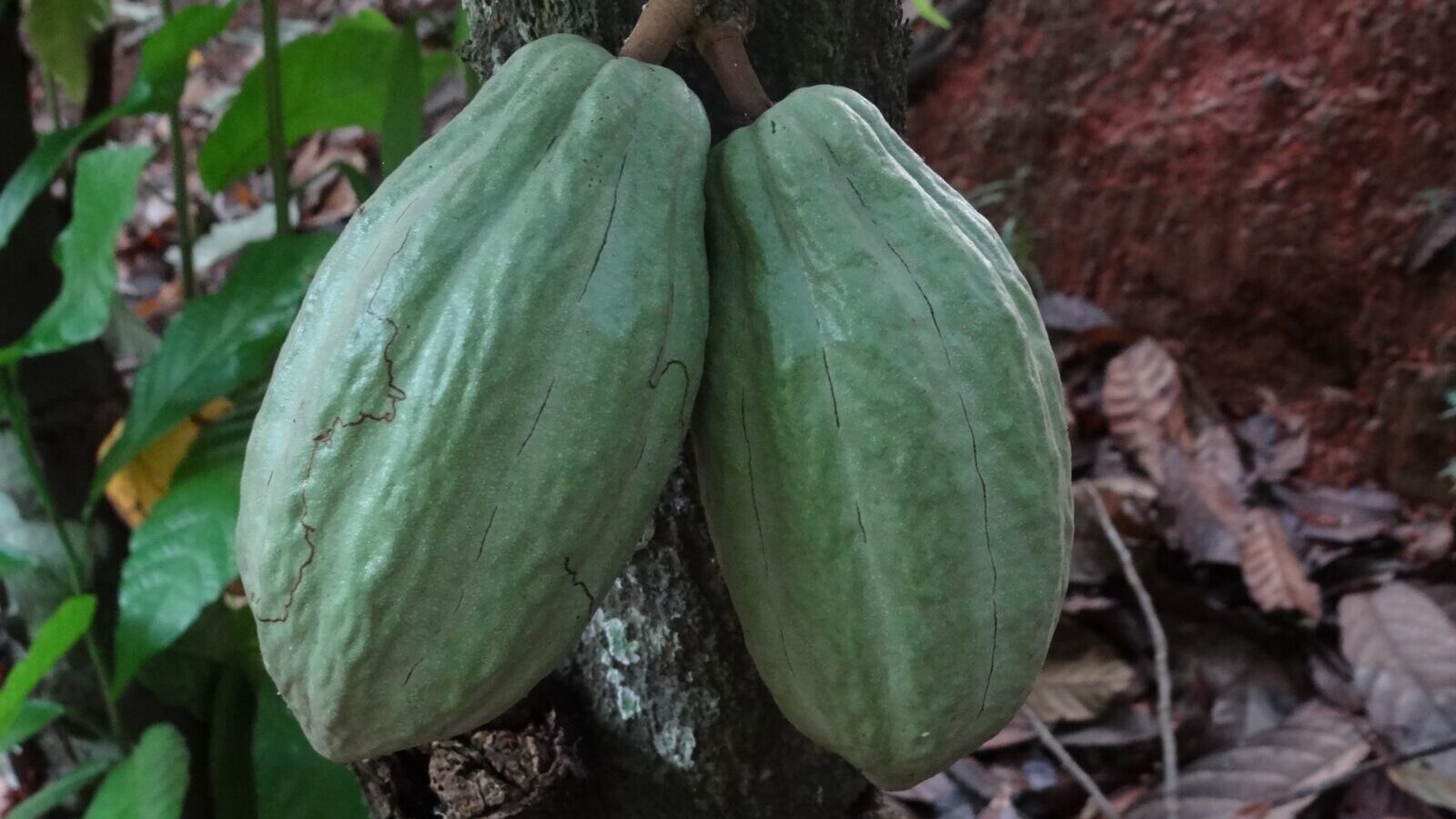
Two crops from the forest floor
Both cacao and coffee evolved as understorey plants, adapted to dappled light beneath a canopy. Neither is naturally a full-sun crop.
That single fact explains most of what follows: the traditional shaded systems, the yield gains and hidden costs of removing the shade, and why these two crops are the strongest commercial case for agroforestry anywhere in the tropics.
Cacao
Theobroma cacao, from the western Amazon, domesticated in Mesoamerica where the beans were used as a drink and as currency.
A small understorey tree, 4 to 8 m in cultivation, and cauliflorous: flowers and pods emerge directly from the trunk and main branches, not from twigs.
The pollination is remarkable and a genuine production constraint. Cacao flowers are tiny, complex, and pollinated almost exclusively by minute flies called midges, mostly in the family Ceratopogonidae. These midges breed in damp decaying organic matter, rotting leaf litter, and old cacao pod husks on the forest floor.
The consequence is direct: a clean, tidy, sun-exposed plantation without litter has no midge habitat and poor pollination. Typically only a small percentage of cacao flowers set pods even in good conditions. Leaving leaf litter and pod husks on the ground is a pollination intervention, and it is free.
Three main variety groups. Criollo is fine-flavoured and disease-susceptible. Forastero is hardy, productive, and the bulk of world supply. Trinitario is a hybrid combining some of each.
Processing makes the flavour. Beans are fermented in the pulp for several days, during which yeasts and bacteria generate the precursor compounds, then dried. Chocolate flavour is created in fermentation, not in the tree, and badly fermented beans from excellent genetics make poor chocolate.
Cacao is vulnerable to a long list of diseases, black pod, witches' broom, frosty pod rot, that spread readily in dense monoculture and are a major driver of the expansion into new forest as old plantations decline.
Coffee
Coffea arabica and C. canephora, robusta. Arabica originated in the Ethiopian highlands, robusta in the lowland forests of central and western Africa.
Arabica is grown at altitude, roughly 1,000 to 2,000 m, prefers 18 to 22 C, and produces the more complex, acidic, aromatic cup. It is self-fertile, tetraploid, and genetically narrow, which makes it vulnerable.
Robusta grows in hotter lowland conditions, yields more, carries roughly twice the caffeine, resists disease considerably better, and produces a harsher cup. It is increasingly important as arabica-growing areas become too warm.
Coffee leaf rust, Hemileia vastatrix, is the defining disease. It destroyed the coffee industry of Ceylon in the 1870s, which is the reason Sri Lanka grows tea, and it has caused major crises in Central America. Warming is pushing rust to higher altitudes into areas that were previously too cool for it.
Climate is the existential problem. Arabica has a narrow temperature range, and projections consistently show large reductions in suitable area under warming. Adaptation means moving uphill where there is uphill available, shifting to robusta and to resistant hybrids, and, importantly, using shade. See climate adaptation.
What shade actually does
Traditional systems grow both crops under a canopy of taller trees, often including nitrogen fixers such as Inga, Erythrina, and Gliricidia, and frequently productive species such as banana, citrus, and timber.
Shade delivers a specific and well-documented set of effects:
Temperature buffering. Canopy reduces maximum temperature and moderates extremes, which directly protects arabica from heat stress and is the cheapest available climate adaptation.
Slower ripening, better cup. Beans mature more slowly under shade, which is widely associated with denser beans and better flavour development.
Soil protection. Litter fall, reduced erosion, and maintained organic matter. Sun systems on slopes lose soil rapidly. See erosion control.
Nitrogen and nutrient cycling from leguminous shade trees and their prunings, which reduces or removes the fertiliser requirement. This is alley cropping logic applied to a perennial crop.
Weed suppression, reducing the largest labour cost in many systems.
Biodiversity. Shade coffee supports bird, bat, and insect communities approaching those of secondary forest, and this is one of the best-documented findings in tropical agroecology. Migratory songbirds wintering in Central America depend heavily on shade coffee, which is the basis for bird-friendly certification. See insectivorous birds and bats.
Pest control. Those same birds and bats measurably reduce coffee berry borer damage, with exclusion experiments showing significant yield protection attributable to them. See predator-prey balance.
Why plantations removed it anyway
Sun-grown systems yield more per hectare in the short term. Full sunlight and heavy fertiliser produce higher output, and that is a real advantage for a grower selling into a commodity market on price.
The costs are deferred and external. Higher fertiliser and pesticide requirements, faster soil degradation, shorter plantation lifespan, greater vulnerability to heat and drought, and biodiversity loss.
Full-sun conversion also increases exposure to exactly the climate extremes that are becoming more frequent, so the economics have been shifting back toward shade in several regions.
The middle ground, moderate shade at roughly 30 to 50 percent canopy with well-chosen species, retains most of the ecological benefit with a modest yield reduction, and it is what most agroforestry programmes now promote. Compare the density logic in silvopasture.
Growing them in a mixed system
Both are excellent understorey components in a tropical food forest, and both are among the few genuinely high-value crops that will produce in shade.
Cacao wants consistent warmth above about 20 C, high humidity, deep soil, and shelter from wind. It is intolerant of drought, waterlogging, and cold, and needs shade in its first years absolutely.
Coffee is more forgiving, tolerating cooler conditions and a defined dry season, which triggers flowering. Both are pruned to keep them at picking height and to maintain productive wood.
In a layered design they sit beneath the canopy of tropical fruit trees and above the herb and spice layer, which is exactly how Kerala homegardens and Central American cabruca systems have worked for centuries. See structural diversity and syntropic agriculture.
The economic argument matters as much as the ecological one: a shaded system that produces cacao, fruit, timber, and firewood from the same ground spreads risk across several products and several timescales, which is what makes it survive a bad price year. See restoration economics.
See also
- Tropical Fruit Trees the canopy layer above
- Food Forest Design assembling the layers
- Nitrogen Fixers the standard shade trees
- Insectivorous Birds pest control in shade systems
- Climate Adaptation the arabica problem
- Restoration Economics why diversified income survives
- Redbud and Sassafras
- Ginger and Turmeric
- Tea
- Leucaena and Gliricidia
- Durian and Mangosteen
- Kola Nut
- Inga
- Yerba Maté
- Jaboticaba
- Cannonball Tree
- Cupuaçu
- Kadamba