What it is
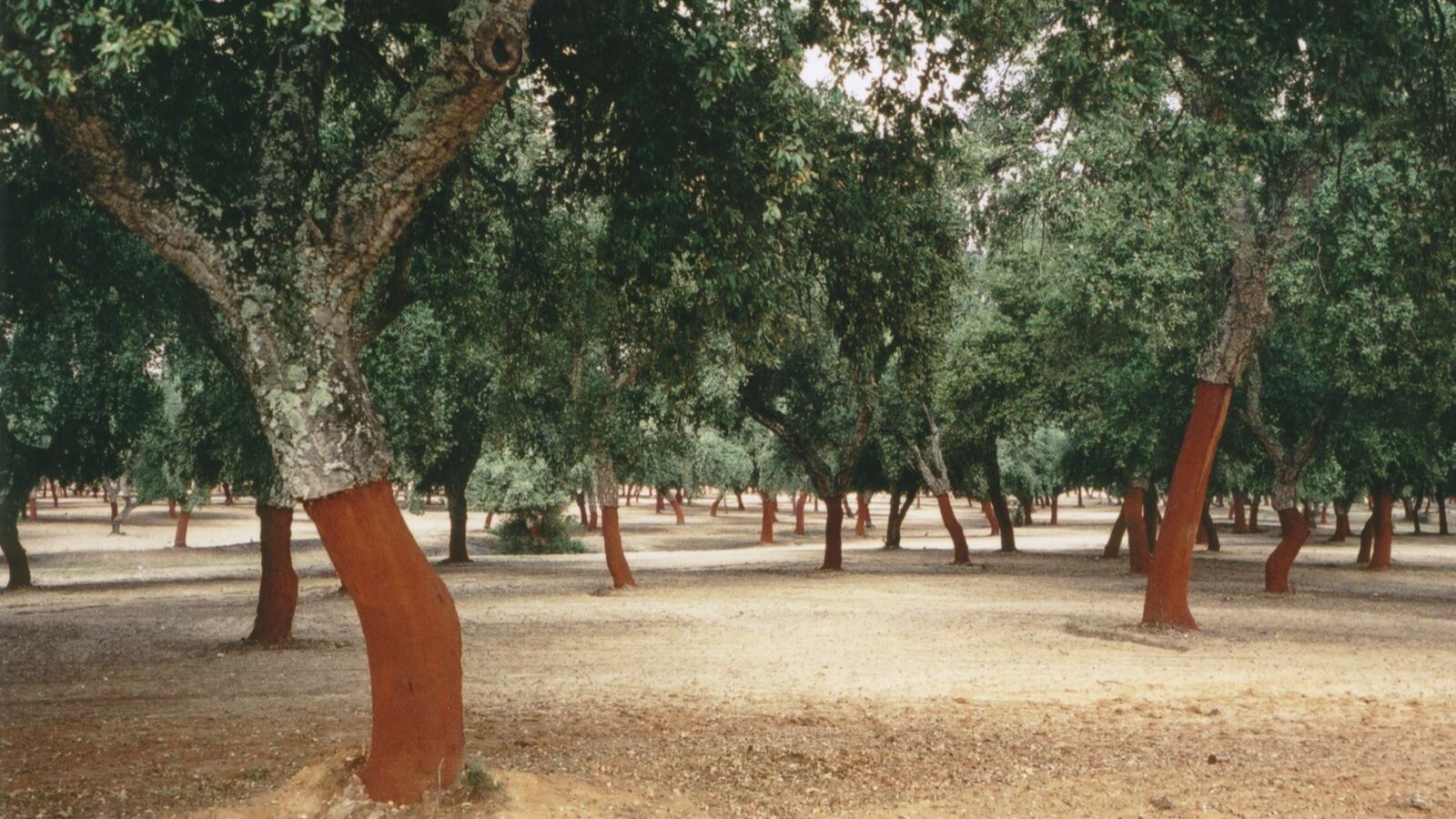
Quercus suber, an evergreen oak of the western Mediterranean — Portugal, Spain, and across to North Africa — and one of the more remarkable trees in cultivation, because it is harvested by removing its bark without felling or harming it.
Most trees die if you strip a complete ring of bark, because you sever the living cambium and phloem — the ring-barking that kills a tree, described in invasive species as a control method. The cork oak survives it because its cork is produced by a special outer layer, the phellogen, that lies outside the living tissue. Strip the cork and the phellogen regenerates a new layer beneath, and the tree carries on.
That single adaptation — thick, self-renewing cork bark, evolved as protection against the Mediterranean's frequent fires — is the basis of an entire economy and one of Europe's most valued cultural landscapes.
Harvesting cork
Cork is stripped from a tree roughly every 9 to 12 years, by hand, with an axe, by skilled workers who peel the bark in large panels without wounding the underlying phellogen — a genuinely skilled and traditional job.
The timeline is long and worth understanding:
The tree is first stripped at around 25 years old, and this first cork — virgin cork — is coarse and irregular and goes to flooring, insulation, and craft uses.
The second stripping, another decade on, is better but still not prime.
Only from the third harvest, when the tree is over 40, does it yield the fine, even cork suitable for wine stoppers, the highest-value use.
A cork oak lives 150 to 250 years and is stripped a dozen times or more over its life, yielding cork every decade without ever being cut down. It is close to the ideal of a non-destructive tree harvest — the same standing-tree-yields-a-crop logic as tapping maples for syrup or rubber for latex, but yielding the bark itself.
The montado
Cork oak is the keystone of the montado in Portugal and dehesa in Spain — a farmed savanna of widely spaced evergreen oaks (cork oak and holm oak) over grazed pasture and rotational cereal, one of the oldest and most celebrated agroforestry systems in Europe.
It is a working silvopasture: the trees give cork, acorns, shade, and shelter; pigs finish on the acorns to make Iberian ham; cattle, sheep, and goats graze between; and cereals and fallow rotate through the understorey. See silvopasture.
And it is exceptionally biodiverse — the montado and dehesa support Iberian lynx, imperial eagle, black vulture, and a rich flora and invertebrate fauna, precisely because they are open, structurally varied, low-intensity landscapes maintained by grazing and traditional management. They are among the clearest European examples of a high-nature-value farmed landscape, and of the structural diversity that comes from mixed ages, open canopy, and old trees.
That biodiversity is entirely dependent on the system continuing to be worked. Abandon it and it scrubs over; intensify it and the old trees and open structure are lost. It is the argument in grassland restoration and meadow management applied to a wooded pasture.
The screw-cap threat
The cork oak is a rare case where a farmed landscape's survival depends on demand for a luxury product, and where that demand was suddenly threatened.
From the 1990s, screw caps and plastic stoppers took a large share of the wine-closure market, driven partly by concern over cork taint — TCA, a compound that can make cork give wine a musty fault.
The fear was that collapsing cork demand would make the montado uneconomic, leading to abandonment or conversion to eucalyptus plantation and intensive agriculture — and with it the loss of the biodiversity, the carbon store, and the fire resistance the landscape provides.
This is a direct, concrete instance of the restoration economics argument: the trees stand because the crop pays, and if the crop stops paying, the trees and everything depending on them are at risk. It reframed the cork industry's marketing around sustainability, and cork's genuine environmental advantages over plastic and aluminium closures — renewable, biodegradable, low-carbon, and supporting the landscape — became a selling point.
The industry has since stabilised, cork taint has been largely engineered out, and cork has held and regained market share, which has taken pressure off the montado. But it remains a landscape whose fate is tied to a wine-bottle stopper.
Cork itself
Beyond stoppers, cork is a genuinely useful material: light, buoyant, compressible, resilient, impermeable, fire-resistant, and thermally and acoustically insulating.
It goes into flooring, insulation, gaskets, bulletin boards, cricket balls, shoe soles, fishing floats, and increasingly into design and construction as a renewable, carbon-storing material. Cork granulate and composite extend the waste into further products, so little is wasted.
The whole cork product is carbon that the tree pulled from the air and that stays locked up for the life of the object — a small but real contribution, and part of cork's sustainability case. See carbon accounting.
Growing it
A Mediterranean-climate tree: hot dry summers, mild wet winters, and tolerant of the poor, acid, sandy soils of the western Mediterranean — it actually prefers acid ground, unlike the holm oak it grows with, which takes lime. It has some frost tolerance but is not a cold-climate tree, and it wants a long warm growing season.
Slow, long-lived, and fire-adapted — the thick cork bark lets it survive fires that kill its neighbours and resprout, a genuine advantage in an increasingly fire-prone Mediterranean. See fire management.
Grown from acorns, which are recalcitrant and must be sown fresh, like other oaks. Not commercially stripped until 25 years old, so it is planted by people investing in a landscape, not a quick return — the definition of a perennials-first tree.
Outside its climate it is grown as an ornamental and curiosity for its striking bark, but not harvested.
See also
- Native Oaks the wider oak genus
- Silvopasture the montado and dehesa systems
- Restoration Economics a landscape that survives on a crop's value
- Structural Diversity why the montado is so biodiverse
- Fire Management cork bark as fire adaptation
- Maples the other harvest-without-felling tree crop
- Evergreen Oaks
- Amur Cork Tree