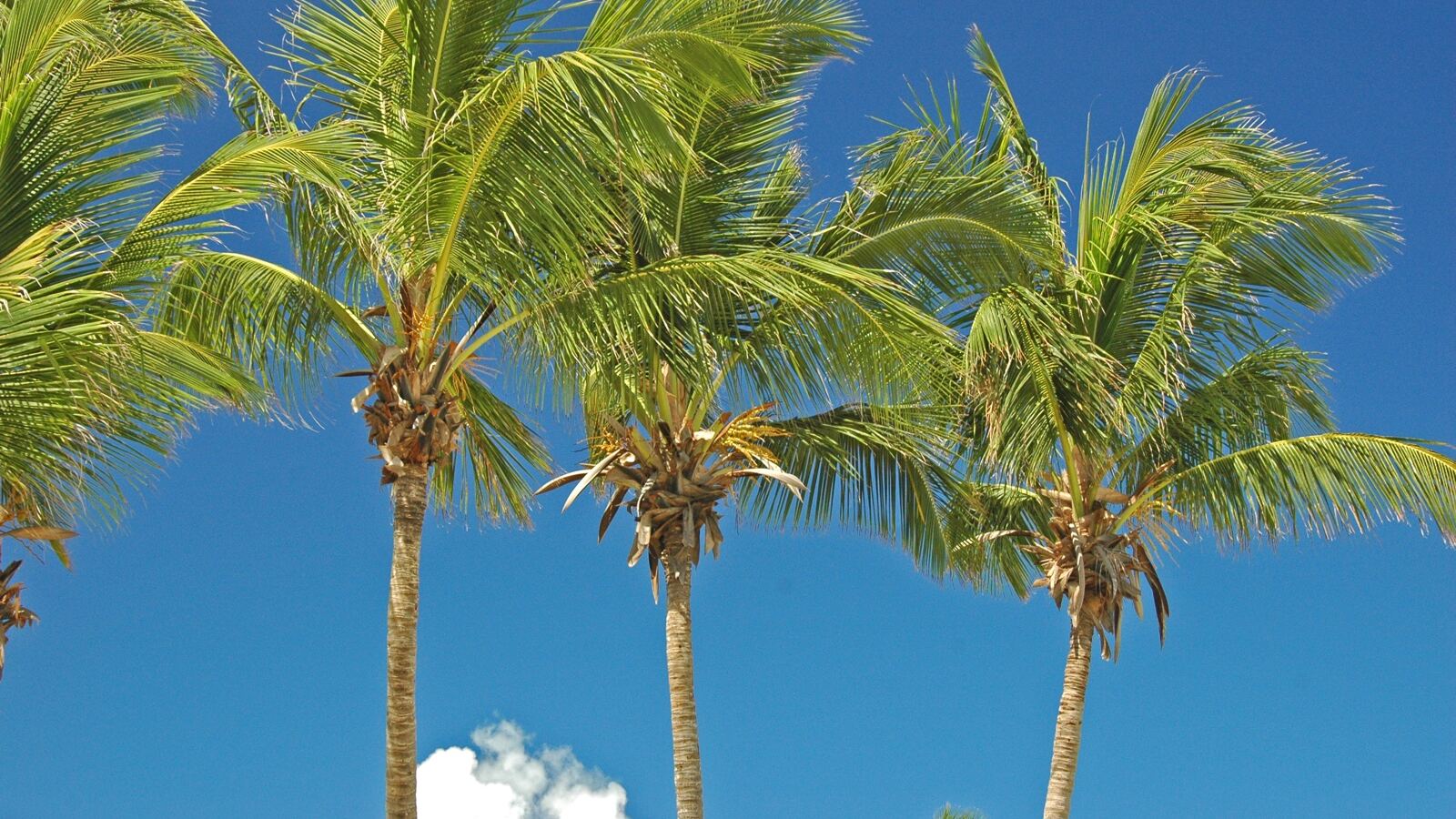
Not trees, but tree-sized
The palms (family Arecaceae) look like the definitive tropical tree — a tall bare trunk topped with a crown of huge leaves — but botanically they are something quite different, and the difference explains almost everything about how they grow.
Palms are monocots, the great group of flowering plants that also contains the grasses, lilies, orchids, bananas, yuccas, and dragon trees. A palm is, in effect, a giant woody grass. It has no true wood, no growth rings, no bark, and no branches, and it cannot heal a wound or thicken its trunk in the way an oak or pine does. This makes them one of the most economically important plant families on Earth while being, structurally, nothing like the trees around them.
How a palm grows
Because a palm is a monocot, it grows by rules that are worth understanding, because they govern how palms are grown and cared for.
- One growing point. A palm grows from a single terminal bud — the "palm heart" or crownshaft — at the very top of the trunk. All the tree's future depends on that one bud; damage it and the whole palm usually dies, since it cannot branch or sprout a replacement (a few palms clump from the base, but most single-stemmed palms cannot). This is why the "heart of palm" harvested as a vegetable kills the tree, and why transplanting and pruning palms is quite unlike other trees.
- No thickening. A palm reaches close to its full trunk diameter near the ground before it grows tall, then extends upward without getting thicker — there is no ring-adding cambium, so an old palm trunk is much the same girth as when it started rising. It cannot repair damage to the trunk, which simply remains as a scar.
- No annual rings, so a palm's age cannot be read from its trunk.
- Fibrous roots. Palms have no taproot; they grow a dense mass of thin roots from the trunk base, which is why even huge palms transplant relatively well and why they tolerate wind by flexing rather than resisting.
Palms come in two broad leaf forms — feather (pinnate) palms like the date and coconut, and fan (palmate) palms like the fan and palmetto palms — a distinction that helps identify them.
The most useful plant family in the tropics
After the grasses, palms may be the most economically valuable plant family in the world, and a catalogue of their products is a catalogue of tropical life.
- Coconut — food, oil, milk, water, fibre (coir), shell, and timber, the "tree of a thousand uses."
- Date palm — the staple fruit and shade of the desert oasis.
- Oil palm — the highest-yielding oil crop on Earth, and the most controversial for the deforestation it drives.
- Sugar and toddy — many palms are tapped for sweet sap made into palm sugar (jaggery), and fermented into palm wine (toddy) and distilled into arrack.
- Sago — starch extracted from the trunk pith of the sago palm, a staple across parts of Southeast Asia and New Guinea.
- Rattan — the flexible climbing stems of Calamus palms, the basis of a huge cane-furniture industry and one of the most valuable non-timber forest products.
- Carnauba wax, from the leaves of a Brazilian palm, used in polishes, cosmetics, and food coatings.
- Betel nut (areca), acai, peach palm, palmyra, and dozens of local fruit and material palms.
That single family underpins the food, shelter, and economy of much of the tropical world, and is central to any tropical food forest or agroforestry system.
Palms as habitat and in the landscape
Palms are keystone plants in many tropical ecosystems, their fruit feeding a huge range of animals, their crowns and old leaf bases sheltering nesting birds, insects, and epiphytes, and their nectar-rich flowers feeding pollinators. In restoration and agroforestry they provide quick canopy, food, and materials. As ornamentals, palms define the look of warm-climate landscaping worldwide — and a number of hardy palms (the Chusan or windmill palm, the dwarf fan palm) are grown well into cool-temperate gardens, giving an exotic effect far from the tropics. See urban forestry.
Growing them
Most palms are tropical or subtropical and frost-tender, though a hardy minority take real cold. They generally want warmth, good moisture, and free-draining soil, and — because of that single vulnerable growing point — should never have their crown bud damaged or all their green leaves removed at once ("hurricane cutting" a palm weakens and can kill it).
Palms are grown from seed, which is the only way for single-stemmed kinds (they cannot be grown from cuttings, having no buds along the trunk), and germination is often slow. Clumping palms can be divided. Feed and water young palms well to speed their slow start. See propagation and tree planting.
See also
- Coconut the archetypal multi-purpose palm
- Date Palm the palm of the desert oasis
- Oil Palm the highest-yielding, most contested oil crop
- Banana and Plantain another giant tree-sized monocot
- Joshua Tree and Yuccas fellow tree-forming monocots
- Tropical Fruit Trees palms in the tropical orchard
- Quiver Tree
- Grass Tree
- Catechu
- Rattan
- Travellers Palm