The oldest agricultural failure
Salinisation has been ending civilisations for five thousand years. Southern Mesopotamian records show wheat being progressively replaced by more salt-tolerant barley, then yields falling anyway, and the political centre moving north. The land is still saline.
It is not a historical curiosity. Something like a fifth of the world's irrigated land is now salt-affected, and irrigated land produces a disproportionate share of global food.
The mechanism is patient and almost invisible until it is advanced.
How it happens
All water carries dissolved salts. Even good irrigation water carries some, typically a few hundred milligrams per litre.
Plants take up water and leave nearly all of it behind. Evaporation from the surface removes water and leaves all of it behind. So every irrigation event deposits salt in the root zone and removes almost none.
In a climate with enough rainfall, winter rain flushes it down past the roots and out. In a dry climate, nothing flushes it. It accumulates, year after year, at a rate that is imperceptible annually and decisive over decades.
A crop irrigated with water at 500 mg per litre, applying a metre of water a year, is adding about 5 tonnes of salt per hectare per year. Something has to remove it, or it stays.
The water table version
The worse mechanism, and the one that destroys whole districts rather than single fields.
Deep-rooted native vegetation used most of the rainfall before it reached the water table. Clear it for shallow-rooted annual crops and more water gets past the roots. The water table rises, sometimes by metres over a few decades.
When it comes within about two metres of the surface, capillary action starts lifting groundwater upward. That water evaporates at the surface and leaves its salt behind, including salt that had been sitting harmlessly deep in the profile for millennia.
The result is dryland salinity, and it needs no irrigation at all. Large areas of Western Australia were destroyed this way by clearing alone. The salt was always there; clearing changed the water balance and brought it up.
Irrigation districts do the same thing faster, by adding water to a landscape without adequate drainage.
Salinity and sodicity are different problems
Frequently confused, and they need opposite treatments.
Salinity is total dissolved salts. Measured as electrical conductivity. The effect is osmotic: salt in the soil solution makes it harder for roots to extract water, so plants show drought symptoms in wet soil. Above about 4 dS/m most crops are affected; some fail well below that.
Sodicity is specifically too much sodium relative to calcium and magnesium, measured as the sodium adsorption ratio. Sodium disperses clay particles. Aggregates collapse, the soil seals, infiltration stops, and it sets like concrete when dry and turns to slurry when wet.
The cruel part: a sodic soil cannot be leached, because water will not pass through it. You have to fix the structure before you can wash the salt out.
Gypsum, calcium sulphate, is the standard treatment. Calcium displaces sodium on the clay surfaces, aggregates re-form, and the soil becomes permeable enough to leach. This is one of the few genuine soil chemistry interventions worth doing at scale.
Establish which problem you have before treating. A soil test reporting conductivity and exchangeable sodium answers it, and water quality testing tells you what you are adding.
Reading the ground
Salinity shows itself before it is measured, if you know the signs.
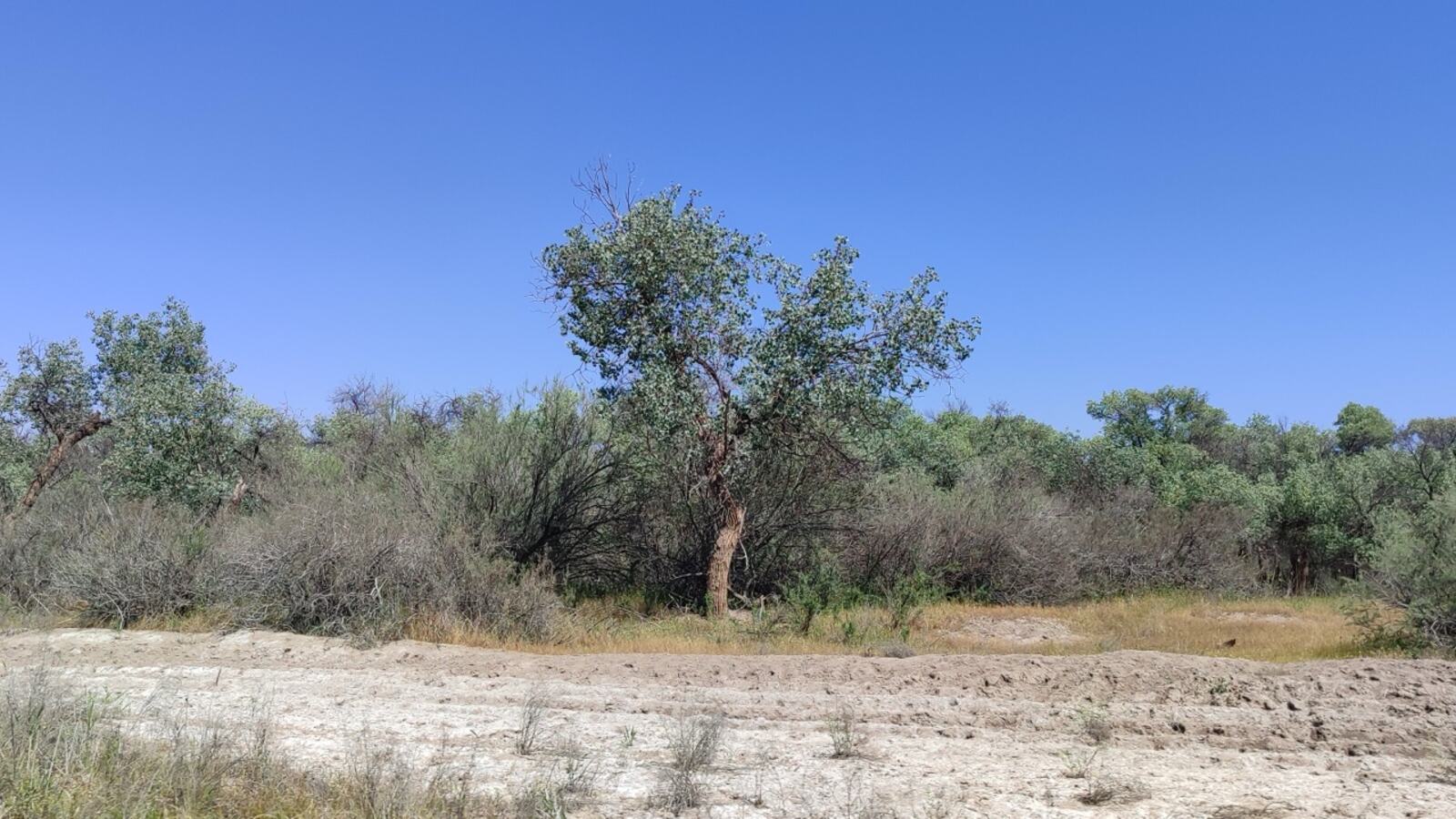
White or grey crusts on the surface, worst in the dry season and in low spots. Bare scalded patches spreading outward. Crops failing in patches rather than uniformly, usually starting in depressions and along seepage lines. Leaf tip and margin burn. Salt-tolerant volunteers taking over: samphire, saltbush, sea barley grass. Trees dying from the top down along a drainage line.
Rising water tables announce themselves too, with waterlogged low ground appearing where it never used to and springs or seeps emerging on lower slopes.
This is indicator species work, and the plants are reliable.
What actually works
Drainage, first and always. Salt has to leave. Subsurface drains, deep open drains, or a permeable subsoil that allows leaching. Irrigating land with no drainage is a decision to salinise it, and the only question is how long it takes.
Leaching fraction. Deliberately apply more water than the crop needs, so the excess carries salt below the root zone. Standard practice in irrigated drylands, typically 10 to 20 percent extra. It only works if there is somewhere for the water to go, which returns you to drainage.
Irrigate efficiently, and be careful here. Drip irrigation reduces evaporation and keeps salt away from the emitter zone, which helps. But high-efficiency irrigation applies less total water, which means less leaching. Efficiency improvements have accelerated salinisation in some districts precisely because they removed the accidental flushing. Efficiency and salt management have to be planned together.
Never irrigate lightly and frequently in a saline situation. Small applications wet only the surface and concentrate salt there. Fewer, larger applications push salt down.
Mulch. Cutting surface evaporation directly cuts the upward salt flux. Mulching for moisture pays twice here.
Do not use sprinklers with saline water. Salt burns foliage directly, and evaporation from wet leaves concentrates it. Subsurface or drip only.
Restore deep-rooted perennials. The landscape-scale answer to rising water tables. Trees and deep perennials use water before it reaches the aquifer and can draw the water table back down. This is slow, needs to be done across a catchment rather than a field, and it is the only real fix for dryland salinity. Alley cropping and silvopasture are the productive versions; windbreaks and shelterbelts contribute.
Living with it
Where reclamation is not realistic, match the plants to the ground.
Tolerance varies enormously. Barley, date palm, saltbush, and many mangroves tolerate conditions that kill most crops. Beans, most stone fruit, and many ornamentals fail at low levels.
Saltbush grazing systems on saline land are genuinely productive, and provide fodder in the dry season when nothing else is available. Saline agriculture is a real field rather than an admission of defeat.
Planting on the shoulder of raised beds rather than the furrow puts seedlings where salt concentrates least, which is a small technique with a large effect on establishment.
See drought-tolerant species and Mediterranean shrubs for the wider dry-climate palette.
Coastal intrusion
A separate route to the same result. Over-pumping a coastal aquifer lowers the freshwater head and lets denser seawater move inland underneath it.
Once a well goes saline it usually stays saline, and pumping harder accelerates it. The fixes are reduced abstraction, moving abstraction inland, and recharge barriers that maintain freshwater pressure against the sea. See aquifer recharge and wells and boreholes.
Sea level rise is extending this problem to places that have not previously had it, which makes it a climate adaptation question as much as a water management one.
See also
- Water Quality Testing measuring what you are applying
- Drip Irrigation efficient application, with a caveat
- Aquifer Recharge holding back coastal intrusion
- Alley Cropping deep roots against rising water tables
- Soil Testing distinguishing saline from sodic
- Drought-Tolerant Species working with the constraint
- Irrigation Scheduling
- Barley
- Date Palm
- Pistachio
- Tamarisk