What it is
Ziziphus jujuba, the jujube or Chinese date, a small thorny deciduous tree of Chinese origin, cultivated there for over 3,000 years and now grown across the warm-temperate and subtropical world.
It is unrelated to the true date palm — the "date" name comes only from the sweet, wrinkled, date-like dried fruit. The tree is small, 5 to 10 m, often thorny and gnarled, with glossy leaves showing three distinct veins from the base and small yellowish flowers. A related species, the Indian jujube or ber (Z. mauritiana), fills the same role in the tropics.
The fruit, fresh and dried
The jujube's appeal is a fruit that is effectively two different foods.
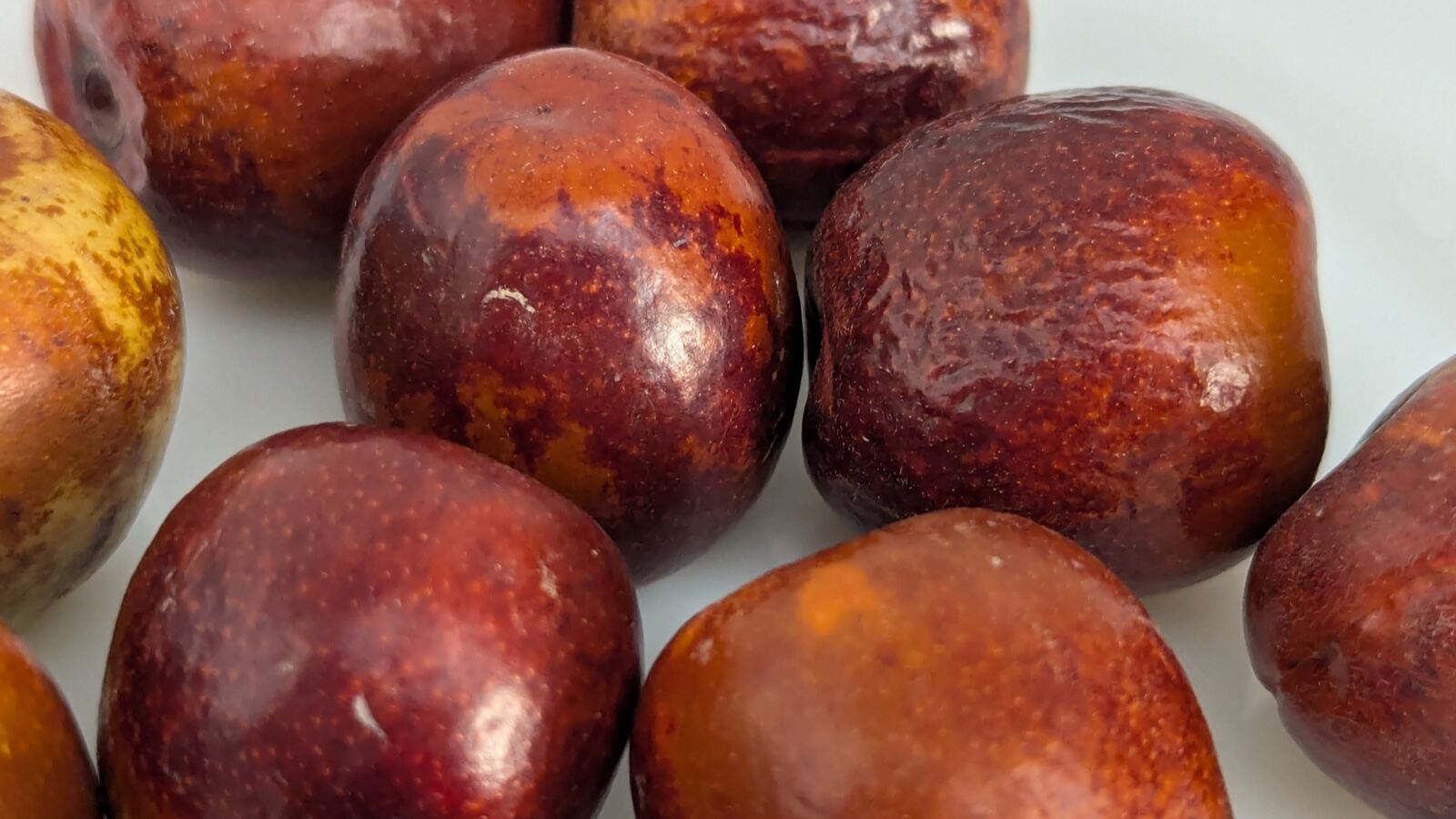
Fresh, the ripe fruit is crisp, sweet, and juicy, eaten out of hand like a small apple — indeed it tastes rather like an apple, and is at its best just as the green skin begins to turn mahogany-brown.
Dried, left on the tree or dried after picking, it shrivels, darkens, and turns chewy and intensely sweet — the familiar wrinkled red "red date" (hong zao) of Chinese groceries. In this form it keeps for a long time and becomes a pantry staple.
In Chinese cooking the dried fruit goes into soups, congee, stuffings, teas, and tonics; it is candied, made into a paste and a syrup, brewed into a wine and a vinegar, and eaten as a snack. It is one of the most deeply embedded fruits in Chinese food culture.
In medicine and culture
Jujube — da zao — is among the most-used ingredients in traditional Chinese medicine, added to a huge range of herbal formulas as a harmonising, tonic, calming ingredient, and used for sleep and digestion. The seeds (suan zao ren) are a separate, important sedative herb. Whatever the pharmacology, the cultural weight is real: the jujube is a symbol of fertility and good fortune, planted at weddings and woven through festival food.
The tree is genuinely nutritious — the fresh fruit is exceptionally high in vitamin C, far above most temperate fruit — which underpins some of its tonic reputation.
Tough where fruit trees fail
For the grower, the jujube's great virtue is toughness in hostile conditions.
It is one of the most drought-hardy of all fruit trees, thriving in hot, dry climates on poor, sandy, and even saline or alkaline soils where apples and stone fruit struggle. It tolerates extreme summer heat, needs little water once established, and is surprisingly cold-hardy in winter when dormant, so it fruits in continental climates with hot summers and cold winters that suit few other subtropical fruits. This combination — drought, heat, salt, poor soil, and winter cold all tolerated — makes it a valuable fruit tree for difficult and drought-prone sites and a natural component of a dryland food forest. It shares this tough-dryland-fruit niche with the pomegranate and the fig.
The trade-off is that it needs a long, hot summer to ripen well, so in cool maritime climates it grows but fruits poorly.
The invasive caution
As always with a tough, seed-heavy, drought-proof plant, there is an invasive side. The Indian jujube (Z. mauritiana) has become a serious invasive woody weed in northern Australia and parts of Africa, forming dense thorny thickets in rangeland — the recurring fate of hardy, bird-dispersed, thicket-forming trees. Check local status before planting in the dry tropics.
Growing it
Full sun and heat; almost any well-drained soil including poor, sandy, alkaline, and mildly saline ground. It resents shade, cool summers, and waterlogging.
Small, slow to moderate, thorny (thornless and improved fruiting cultivars exist — Li, Lang, and many Chinese kinds), and long-lived. It suckers freely from the roots, which can be a nuisance but also a means of propagation. Named varieties are grafted; it also grows from seed and suckers. Largely free of pests and diseases, another part of its easy reputation. See grafting and propagation.
Two or more trees improve fruit set. Little pruning is needed beyond shaping and thinning. See pruning basics.
See also
- Pomegranate another tough, ancient, drought-hardy fruit of the same regions
- Drought-Tolerant Species jujube for hot, dry, poor sites
- Date Palm the unrelated tree it borrows its name from
- Food Forest Design a hardy fruit tree for dryland systems
- Stone Fruit the temperate fruit it outperforms in heat and drought
- Invasive Species the Indian jujube abroad