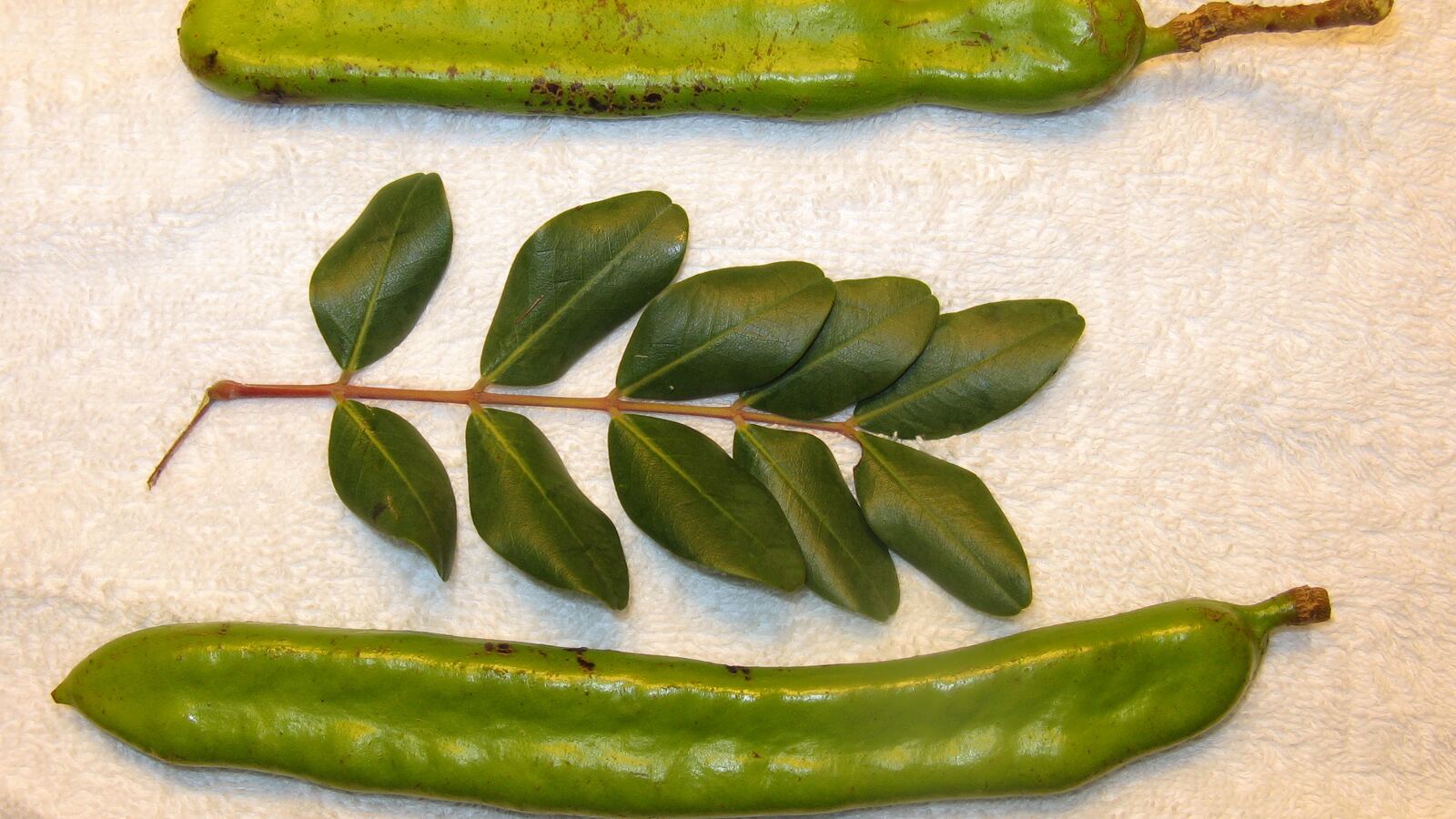
Two pod trees
Both are leguminous trees of dry climates that concentrate sugar and food value into a storable pod, and both have fed people and animals across their ranges for thousands of years. They belong with the nitrogen-fixing food trees — carob, mesquite, honey locust — as the pod-bearing crops of dry country.
Tamarind, Tamarindus indica, a large tropical tree probably from Africa, spread so early across South Asia that its name comes from the Arabic tamr hindi, Indian date.
Carob, Ceratonia siliqua, a Mediterranean tree, and the classic companion of the olive, fig, and grape in the dry farming of the region.
Tamarind: the sour tree
Tamarind is unusual among fruit trees for being valued for sourness rather than sweetness, though the ripe pod is both.
The sticky pod pulp is high in tartaric acid, giving the sharp fruity acidity that is the base of an enormous range of cooking — the souring agent in South Indian sambar and rasam, Thai and Filipino sour soups, Worcestershire sauce, HP sauce, sweet-and-sour dishes, chutneys, and the tamarind drinks and candies of Latin America and the Caribbean.
That combination of acid and sugar, in a pod that dries and stores well, made tamarind a valued trade commodity, and it spread along trade routes early and widely.
The tree is large, evergreen or semi-evergreen, slow, extremely long-lived — several hundred years — and drought- and wind-hard once established, with a dense, heavy, durable timber prized for furniture and tool handles. It casts deep shade and is a classic village and courtyard shade tree across the dry tropics, the centre of social life in many places.
It is a component of dry-tropical silvopasture and food forest systems, giving shade, fruit, fodder, and timber, though its dense shade and reputed allelopathy limit what grows directly beneath it.
Carob: chocolate substitute and unit of weight
Carob is the drought-hard leguminous pod tree of the Mediterranean, and it comes with two well-known claims to fame.
The chocolate substitute. The ripe pod, ground to carob powder, is sweet, dark, and cocoa-like, and is used as a caffeine-free chocolate alternative. It is genuinely different from chocolate — sweeter, without the bitterness or the fat — and whether it is a satisfying substitute is a matter of long and unresolved argument. What is certain is that it is a nutritious, sweet, storable food from a tree that grows on dry, poor, rocky ground where little else fruits.
The carat. Carob seeds are famously uniform in weight, and they were used as a standard weight for gold and gemstones in the ancient Mediterranean — the origin of the carat. The uniformity is partly myth; carob seeds vary more than the story suggests, but the etymological link, through Greek keration, is real.
The tree is evergreen, slow, long-lived, and exceptionally drought- and heat-tolerant, deep-rooted, and tolerant of poor, rocky, alkaline, and somewhat saline soils — the same dryland toughness as the olive and pomegranate it grows alongside. See drought-tolerant species.
Carob is dioecious in the main — separate male and female trees — so a crop needs both, and it is often grafted, with a productive female variety on a hardy seedling rootstock, as in so many tree crops. See grafting.
The pods are also excellent animal fodder, high in sugar and used for livestock across the Mediterranean, and the seeds yield locust bean gum (carob is also called the locust bean, and is one candidate for the locusts of John the Baptist), a widely used food thickener and stabiliser.
The pod strategy
Both trees illustrate a strategy worth naming, because it recurs across dryland legumes.
A tree in dry country cannot rely on a soft, watery, perishable fruit — it would not survive the heat, and there may be no reliable disperser or consumer at the moment of ripening. Instead these trees pack sugar and protein into a dry, durable pod that stores on the tree and off it for months, feeding people, livestock, and wildlife through the dry season, and dispersing when eaten.
It is the same logic as the date, which cures to a storable high-sugar fruit, and it is why pod-bearing legumes — carob, tamarind, mesquite, honey locust, acacia — are so central to dry-country agroforestry and pastoralism. The pod is drought-country's answer to the problem of storing food in a tree. See nitrogen-fixing food trees.
Whether these particular species fix nitrogen is worth a note: carob does not nodulate despite being a legume, one of the non-fixing legumes like redbud; tamarind's nitrogen fixation is limited and uncertain. So their value is the pod and the shade, not soil enrichment — a useful correction to the assumption that every leguminous tree feeds the soil.
Growing them
Tamarind is a strictly tropical and warm-subtropical tree, frost-tender, wanting heat and tolerating drought once established. Slow, long-lived, and grown from seed or grafted. Outside the tropics it is a container or glasshouse plant.
Carob is a Mediterranean-climate tree, tolerant of light frost but needing hot dry summers to ripen pods, and grown across the Mediterranean, California, Australia, and similar climates. Undemanding, drought-hard, slow, and extremely long-lived — a plant-once tree in the perennials first sense. Plant a male and females, or a grafted self-fertile selection.
Both are of interest to a temperate reader mainly as examples of the dryland pod-tree strategy and as components of Mediterranean and dry-tropical food forests.
See also
- Nitrogen-Fixing Food Trees mesquite, honey locust, and the pod-tree group
- Olive the Mediterranean companion of carob
- Date Palm the other great storable dryland fruit
- Drought-Tolerant Species the dry-climate palette
- Silvopasture pod trees as fodder and shade
- Redbud and Sassafras another non-fixing legume
- Mesquite
- Frankincense and Myrrh
- Golden Shower Tree
- Ashoka Tree
- Gum Arabic
- Logwood
- Santol