What it is
Almost every fruit tree you have ever eaten from is two plants bolted together.
The top, the scion, is a cutting of a named variety. It carries the fruit. The bottom, the rootstock, is a different plant entirely, chosen for how big it grows, what soil it tolerates, and what diseases it shrugs off.
Join them so their cambium layers touch and they fuse into one tree with two sets of genetics. That is grafting.
Why bother
Because fruit trees do not come true from seed. Plant a pip from an excellent apple and you get a seedling that is genetically novel and almost certainly worse. Apples are extreme outbreeders: the odds of a seedling being worth eating are somewhere around one in ten thousand.
So every variety in existence, Bramley, Cox, Egremont Russet, is a clone. One original seedling, propagated by grafting ever since. The Bramley in your garden is physically continuous with a tree grown from a pip in Nottinghamshire around 1809.
The second reason is control. A seedling apple grows to 10 m and fruits in year eight. The same variety on a dwarfing rootstock stays at 2.5 m and fruits in year three.
The rootstock decides more than the scion
This is the part people skip, and it matters more than variety choice.
Rootstock sets final size, how soon it fruits, whether it needs permanent staking, how it copes with drought or waterlogging, and its resistance to root disease.
Apple. The M and MM series out of East Malling. M27 is extremely dwarfing, 1.5 to 2 m, needs staking for life and good soil. M9 is the commercial standard for intensive orchards, 2 to 3 m, heavy early cropping, permanent support, shallow roots that hate drought. M26 is semi-dwarfing at 3 to 4 m. MM106 is the reliable garden choice at 4 to 5 m, free-standing once established, but dislikes waterlogging. MM111 and M25 are vigorous, 5 to 8 m, for standards, grazing orchards, and poor ground.
Pear. Usually grafted onto quince. Quince C is more dwarfing, Quince A is the standard. Some varieties are graft-incompatible with quince and need an interstem, a compatible third piece grafted between rootstock and scion.
Cherry. Colt is semi-vigorous. The Gisela series brought cherries down to netting height, which is the only reason home cherry growing is practical against birds.
Plum. Pixy is dwarfing, St Julien A is the general purpose middle, Brompton is vigorous.
Choose the rootstock for the site and the labour you can commit. A vigorous tree on poor ground beats a dwarf that needs irrigation and a stake forever. See aged orchard rejuvenation for what happens when that choice was made badly fifty years ago.
The grafts worth learning
You need two, maybe three. The rest is variation.
Whip and tongue. The workhorse for dormant bench grafting when scion and rootstock are the same diameter, roughly pencil thickness. A long sloping cut on both, then a matching tongue cut into each face so they interlock. Maximum cambium contact and a mechanically self-holding joint. Late winter, before the sap moves.
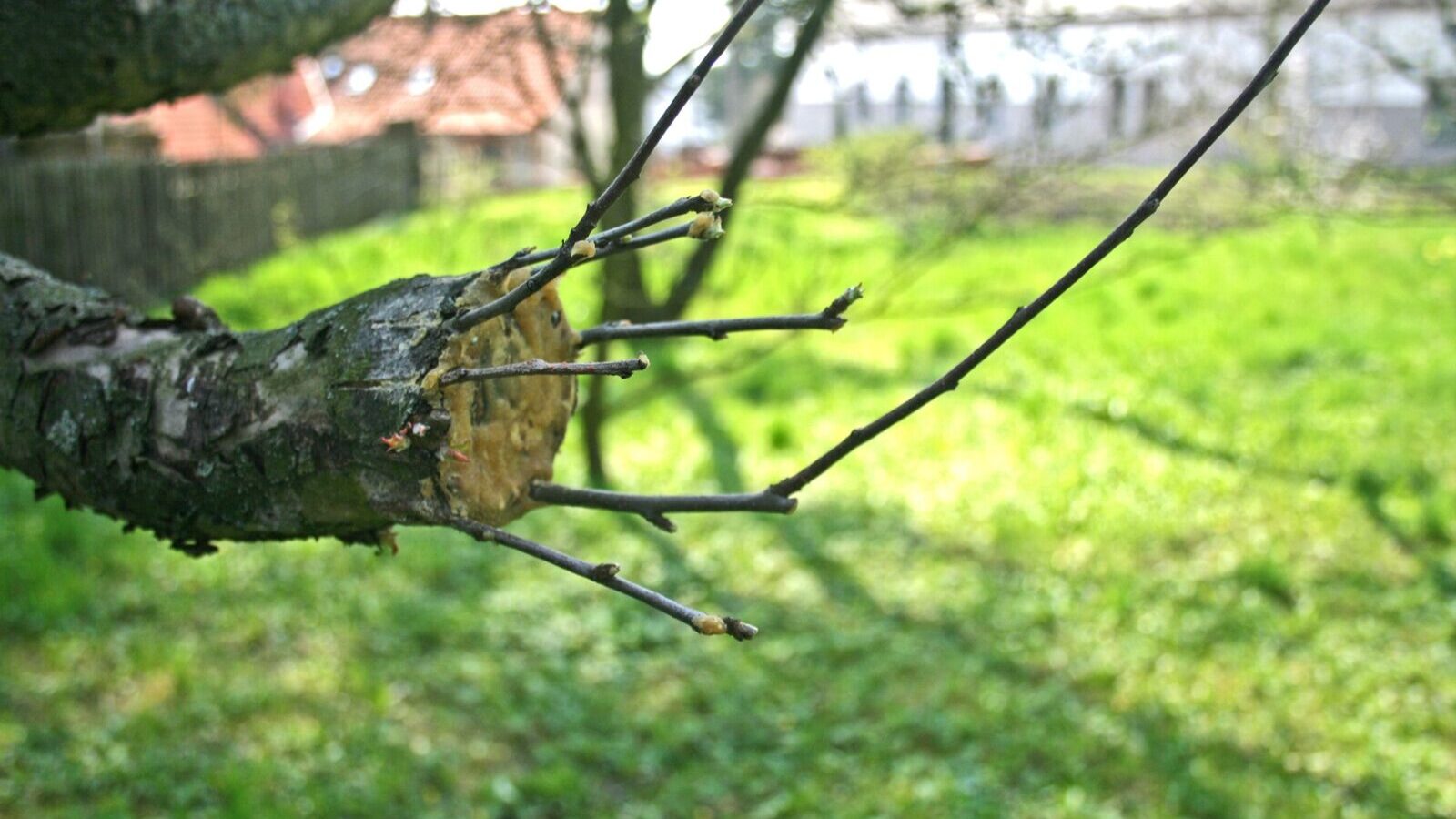
Cleft graft. For when the rootstock is much thicker than the scion, including topworking an established tree. Split the cut stock, insert a wedge-cut scion at the edge so the cambium lines meet on one side, seal everything. Crude, strong, and forgiving.
Chip budding. A single bud with a chip of wood behind it, slotted into a matching notch in the rootstock. Done in summer while the bark is active, July to early September in temperate climates. Economical, since one scion stick yields a dozen buds instead of two grafts.
T-budding. A bud slipped under a T-shaped bark flap. Traditional for roses and stone fruit, needs the bark to lift cleanly, so a narrower seasonal window than chip budding.
What actually makes it take
Cambium contact. Everything else is detail.
The cambium is a single cell layer between bark and wood. It is the only tissue that can divide and knit. If the cambium of scion and stock touch along a decent length, the graft takes. If they miss by two millimetres, it fails no matter how neat your cuts were.
When diameters differ, line up one side rather than centring the scion. One good contact line beats two near misses.
Then: sharp blade, clean cuts in one stroke, no touching the cut faces, bind firmly, seal against desiccation. A grafting knife with a single bevel and a genuinely sharp edge does more for your success rate than any technique.
Timing
Dormant grafts, whip and tongue and cleft, go on in late winter to early spring, as the rootstock is waking but before the scion does. Cut scion wood in midwinter when fully dormant and store it cold and slightly damp so it stays behind the rootstock.
Budding is a summer job, done onto a growing rootstock with bark that slips.
Wound the tree at the wrong time and you invite the pathogens in tree diseases. Silver leaf in particular is why plums and cherries are cut in summer, never winter.
Why grafts fail
Cambium missed. Cuts dried out before binding. Scion wood was not dormant. Binding too loose and the joint moved. Binding left on too long and it strangled the union.
Graft incompatibility is the slow one. Some combinations sit together for years and then part cleanly at the union, sometimes decades later, often in wind. Pear on quince without an interstem is the classic case.
After it takes
Remove all growth from the rootstock below the union, repeatedly. The rootstock will keep trying to send up its own shoots, and they will outgrow the scion if you let them. An orchard of vigorous rootstock suckers with one weak variety on top is a common outcome of neglect.
Cut the binding once the union has knitted, usually by the end of the first season. Ties left on will girdle exactly as they do in tree planting.
Keep the graft union above soil level for life. Bury it and the scion roots, and the whole point of the rootstock is gone.
Beyond fruit
Grafting preserves genetics that cannot be preserved any other way. David Milarch's work propagating champion trees is grafting used as an archive: an ancient tree's exact genotype, moved onto young roots before the original falls.
It is also the practical answer to variety loss. A dying orchard's last tree of an unnamed local variety can be scion wood next winter. See seed banking for the complementary approach, and seed saving for the crops where seed does work.
See also
- Plant Propagation cuttings, layering, and division
- Apples and Pears what you are most likely grafting
- Aged Orchard Rejuvenation working with what is already grafted
- Pruning Basics shaping what you have joined
- Tree Diseases why cutting season matters
- Fruit Tree Guilds what to plant underneath
- Crab Apple
- Magnolias
- Grapes
- Melons
- Pistachio
- Tamarind and Carob
- Ginkgo
- Witch Hazel
- Mango
- Wild Roses
- Almond
- Sapotes
- Ackee
- Amla
- Hardy Orange
- Finger Lime