Why store water underground
Surface storage loses water and takes land. A farm pond in a hot dry climate can lose 1.5 to 2.5 m of depth per year to evaporation alone, which for a shallow pond is most of it.
Underground storage loses nothing to evaporation, occupies no surface area, needs no dam wall, cannot fail catastrophically, does not breed mosquitoes, and does not silt up.
The trade is access. Water underground has to be pumped back out, it moves away from where you put it, and it is shared with everyone else drawing on the same body. See wells and boreholes.
For most drylands the arithmetic still favours underground. The volumes available are far larger than any tank, and the cost per cubic metre stored is a fraction of built storage.
Managed aquifer recharge
The formal term for deliberately putting water into an aquifer rather than letting it run off.
The principle is simple: intercept water when it is abundant, hold it long enough to soak in, and recover it when it is scarce. Monsoon rainfall that would leave the catchment in three days becomes a supply that lasts through the dry season.
The methods run from village-scale earthworks to engineered injection.
The techniques
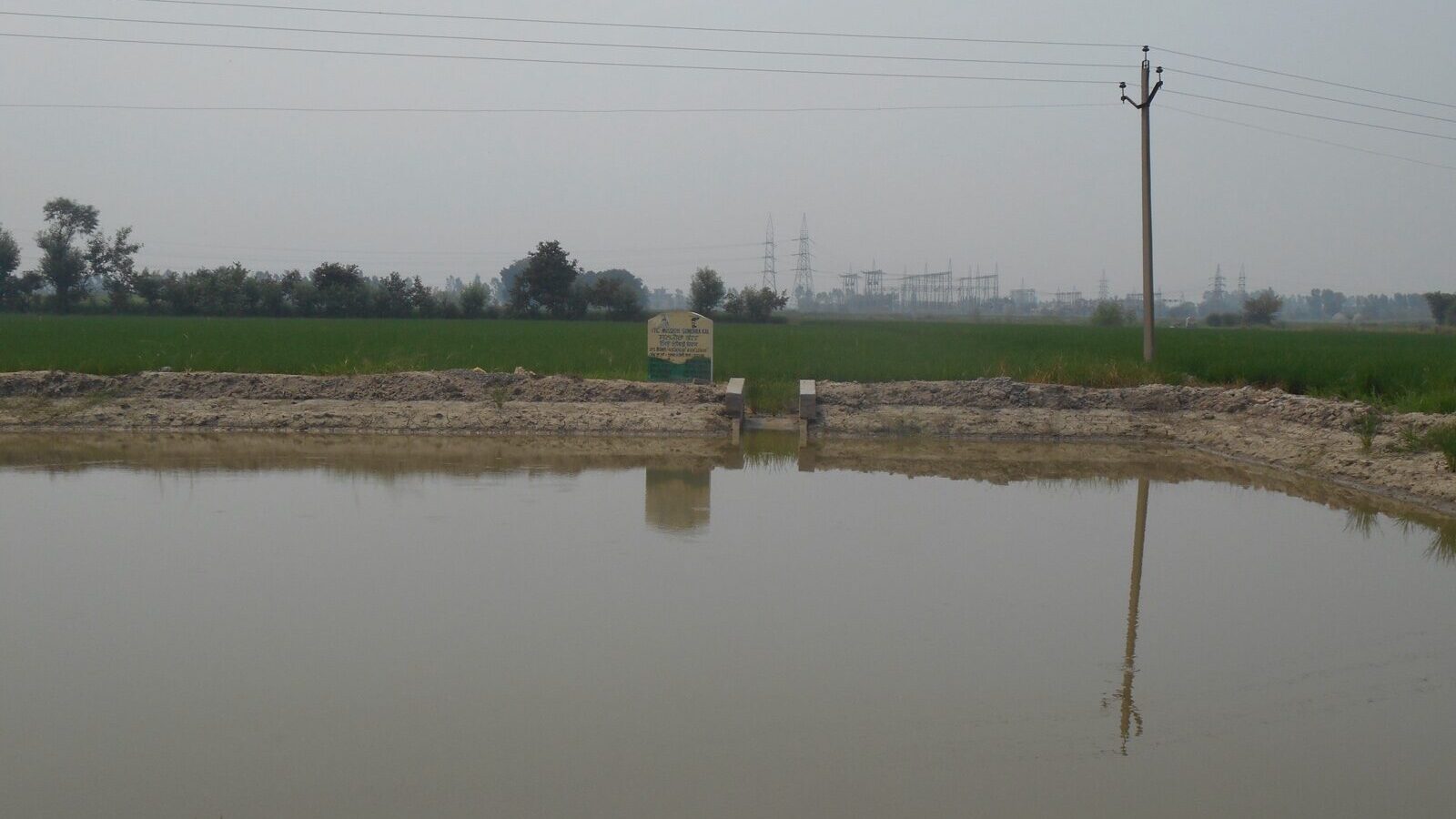
Check dams and percolation tanks. Low structures across seasonal watercourses, holding runoff so it infiltrates through the streambed rather than running to the sea. The workhorse of Indian water conservation and responsible for the recovery of tens of thousands of dried wells. The point is not the water stored behind the dam but the water that soaks down beneath it. See check dams.
Recharge wells and shafts. A bored shaft that bypasses an impermeable surface layer to deliver water directly into a permeable horizon. Necessary where clay caps the aquifer and surface infiltration cannot work.
Infiltration basins. Shallow flat-bottomed basins that pond water and let it soak. Cheap and effective where the soil is permeable. Need periodic scraping as fines seal the base.
Spreading grounds. Diverting river flow across a wide permeable area, common in alluvial fans.
Contour earthworks. Swales, bunds, and keyline cultivation slow water across the whole slope rather than at one point. Diffuse, unglamorous, and at landscape scale the largest contributor of all. Every metre of runoff slowed is recharge.
Rooftop recharge. Piping roof runoff into a filtered recharge pit rather than a tank. Used across urban India where storage space is unavailable but the aquifer is depleted. Pairs with catchment calculation and needs a first-flush diverter.
Injection wells. Pumping treated water directly into an aquifer under pressure. Engineered, expensive, and used mainly for coastal barriers against salinity intrusion or for large municipal storage.
Soil and vegetation do most of it
The largest recharge intervention available is not a structure. It is what covers the ground.
Bare compacted soil sheds most of what falls on it. The same soil with cover, roots, and organic matter absorbs it. Infiltration rates differ by an order of magnitude between degraded and healthy ground, and that difference applies across the whole catchment rather than at a few points.
Trees do this best. Root channels are macropores that carry water down fast, canopy breaks raindrop impact so the surface does not seal, and litter maintains structure. A wooded catchment recharges its aquifer in a way a grazed bare one cannot.
This is the mechanism behind John D. Liu's documentation of the Loess Plateau, where restoring vegetation across a vast degraded catchment brought back springs and base flow. It is also why decompaction, organic matter building, and rotational grazing are groundwater interventions even though nobody calls them that.
See soil water storage for the volumes involved. They are larger than people expect.
Do not recharge your problems
Recharge bypasses the natural filtration that protects groundwater. Whatever goes down stays down, and aquifer contamination is effectively permanent on human timescales.
Filter and settle first. Sediment seals infiltration surfaces and shortens the working life of any recharge structure. A silt trap and a settling stage in front of the recharge point is not optional.
Divert the first flush. The first runoff carries the accumulated contamination of the whole dry period, and it is exactly what you do not want underground.
Know your source. Road runoff carries hydrocarbons and metals. Farmyard runoff carries pathogens and nitrate. Neither belongs in a recharge structure without treatment.
Watch the water table. Recharging into an already-high water table can waterlog root zones and mobilise salts upward, which is one of the mechanisms behind dryland salinity.
Recharge is a commons
Water put into an aquifer moves, and it does not stay under the land that paid for it.
That is the central difficulty. An individual who builds recharge structures benefits partly, and the rest of the benefit goes to everyone else drawing on the same aquifer, including people pumping hard and contributing nothing.
Which is why successful recharge programmes are almost always collective. The village-level water conservation movements in Rajasthan and Maharashtra worked because whole communities built structures across whole catchments and agreed limits on abstraction at the same time. Recharge without abstraction rules simply funds more pumping, and the water table keeps falling.
Getting that agreement is the hard part, and it is social rather than hydrological. See community engagement and stakeholder mapping.
Start with water mapping at catchment scale rather than plot scale. The leverage points are usually upstream of the land you control.
See also
- Check Dams the highest-return recharge structure
- Wells and Boreholes the other end of the system
- Soil Water Storage the largest reservoir available
- Water Mapping finding the leverage points
- Swales diffuse recharge across a slope
- Salinity what badly managed water tables cause
- Spring Development
- Date Palm
- Tamarisk
- Sand Dams
- Qanats and Karez