What they are
Two robust fan palms of the hot, dry tropics of Africa and Asia, both enormously useful to the peoples of arid country:
Doum palm (Hyphaene thebaica and relatives) — of the drylands of North and East Africa and Arabia;
Palmyra palm (Borassus flabellifer) — of the dry tropics of South and Southeast Asia, above all southern India and Sri Lanka.
Both have the large, fan-shaped (palmate) leaves that distinguish them from the feather-leaved coconut and date palm, and both are drought-hardy trees of savanna, dry coast, and desert oasis.
The doum: the palm that branches
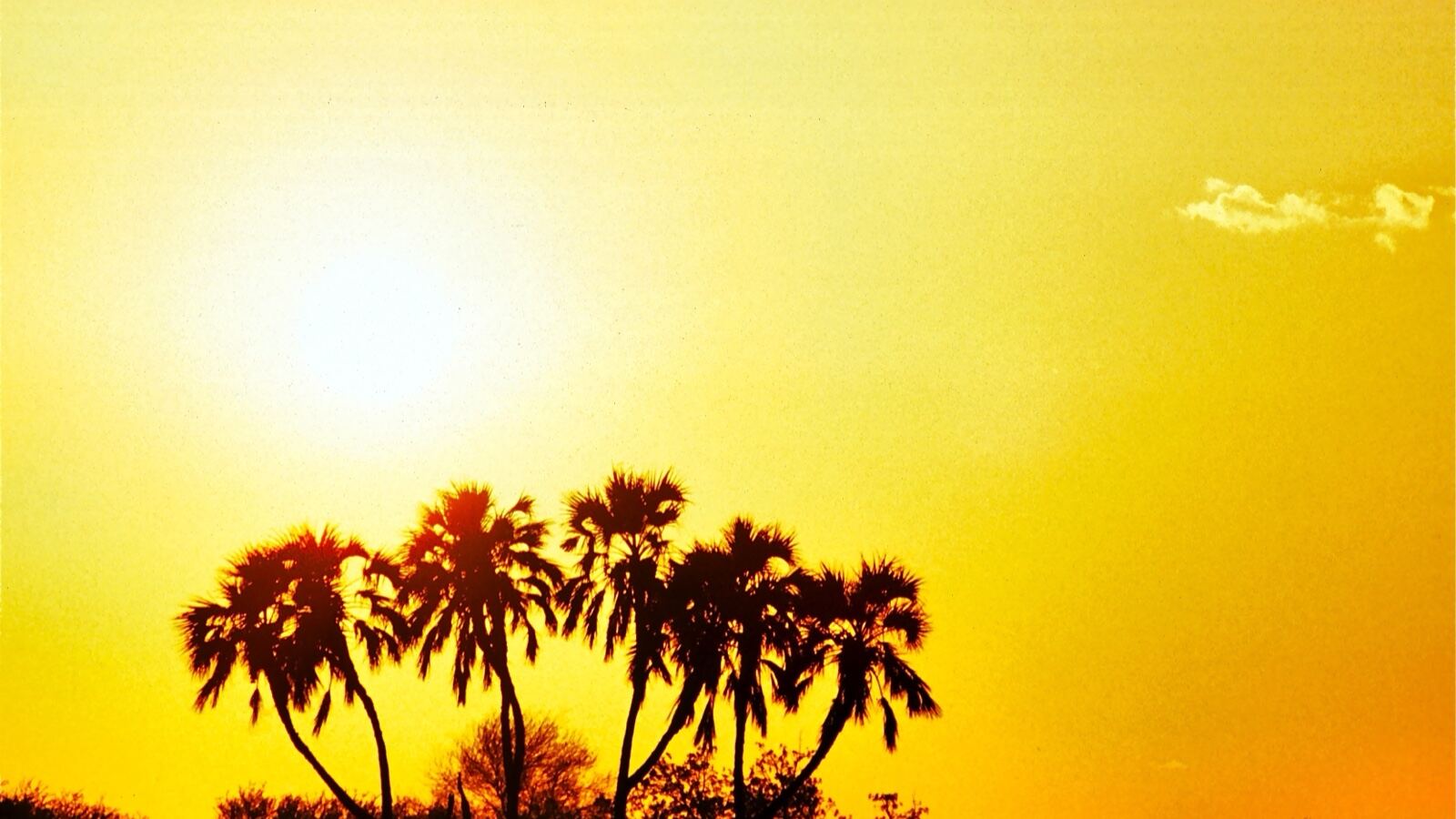
The doum palm is famous for a botanical rarity: it is one of the very few palms that branches. Almost all palms have a single unbranched trunk with one growing point (as explained in palms), but the doum's trunk forks repeatedly, dividing in two again and again to build a distinctive, candelabra-like, branched crown — a strange and instantly recognisable silhouette in the African dryland.
Its fruit is its other claim to fame: a hard, shiny, brown fruit whose fibrous outer flesh tastes strongly of gingerbread, giving the tree its other name, the "gingerbread palm." The fruit was valued enough in ancient Egypt to be placed in tombs (doum fruit was found in Tutankhamun's), and it is eaten, made into drinks and sweets, and used in medicine across its range. Every part of the doum is used — leaves for mats, baskets, rope, and thatch; the trunk for timber; the seed (vegetable ivory) for carving — making it, like the palmyra, a whole toolkit of a tree for the dry lands where it grows. See drought-tolerant species.
The palmyra: the tree of a thousand uses
The palmyra palm is one of the most useful and revered trees of South Asia — a tall, straight, hardy fan palm so bound up with the life and culture of the Tamil country that it is the official tree of Tamil Nadu, celebrated in classical Tamil literature (which lists hundreds of its uses) as the "karpaha" or celestial tree, the "tree of a thousand uses."
Its uses are indeed legion:
- Sugar and drink — the flower stalks are tapped for a sweet sap (toddy), drunk fresh, fermented into palm wine, or boiled down into palm sugar (jaggery) — one of the great sugar sources of the dry tropics, the same tapping done to many palms;
- Fruit — the young fruit yields translucent, jelly-like "ice-apple" (nungu) seed-sockets, a beloved sweet coolant in the hot season, and the ripe fruit's fibrous pulp is eaten;
- Sprouted seed — the germinating seed produces a crunchy edible tuber (panangkizhangu);
- Leaves — for thatch, mats, baskets, fans, and — historically hugely important — as the writing material of the palm-leaf manuscript, on which much of the classical literature of South and Southeast Asia was recorded;
- Timber — the hard, durable, black outer trunk wood ("porcupine wood") for rafters, posts, and construction.
The palmyra is, in short, an entire economy in a single drought-proof tree, and it holds a cultural and spiritual place to match. See restoration economics and historical ecology.
Growing them
Both are tropical to subtropical, tolerant of considerable heat and drought, and adapted to poor, dry, sandy, and even saline soils — the doum to desert and dry savanna, the palmyra to the dry plains and coasts of South Asia. Both want full sun and are frost-tender, and both are slow-growing and very long-lived.
They are grown from seed (large and slow to germinate, sending down a deep sinker root), and are typically not so much planted as protected and harvested where they grow wild or semi-wild, tapped, cut, and gathered from across their long lives. As drought-proof, multi-purpose trees that clothe, feed, sweeten, shelter, and record whole cultures of the dry tropics, the doum and palmyra are among the most useful palms of all. See palms and propagation.
See also
- Palms the family, and why branching (as in the doum) is so rare
- Date Palm the other great palm of the desert oasis
- Coconut the feather-palm "tree of a thousand uses" of the wet coast
- Drought-Tolerant Species palms for hot, dry country
- Nipa Palm another sugar-tapped, thatch-yielding palm
- Historical Ecology the palmyra and the palm-leaf manuscript