Three ancestors
Almost every citrus fruit in existence descends from just three wild species: the pomelo, the mandarin, and the citron. Everything else is a hybrid, a backcross, or a mutation of one.
Sweet orange is a mandarin and pomelo hybrid. Grapefruit is a pomelo and sweet orange cross that arose in Barbados in the eighteenth century. Lemon is a citron and sour orange hybrid. Lime, bergamot, and clementine are all similar recombinations.
Citrus hybridises with extraordinary readiness, which produced this tangle and also means seedlings rarely come true. Which in turn is why citrus, like apples and pears, is propagated by grafting.
The genus originated in the foothills of the Himalaya and south-east Asia and spread west along trade routes. The citron reached the Mediterranean first, and oranges much later.
Everything happens at once
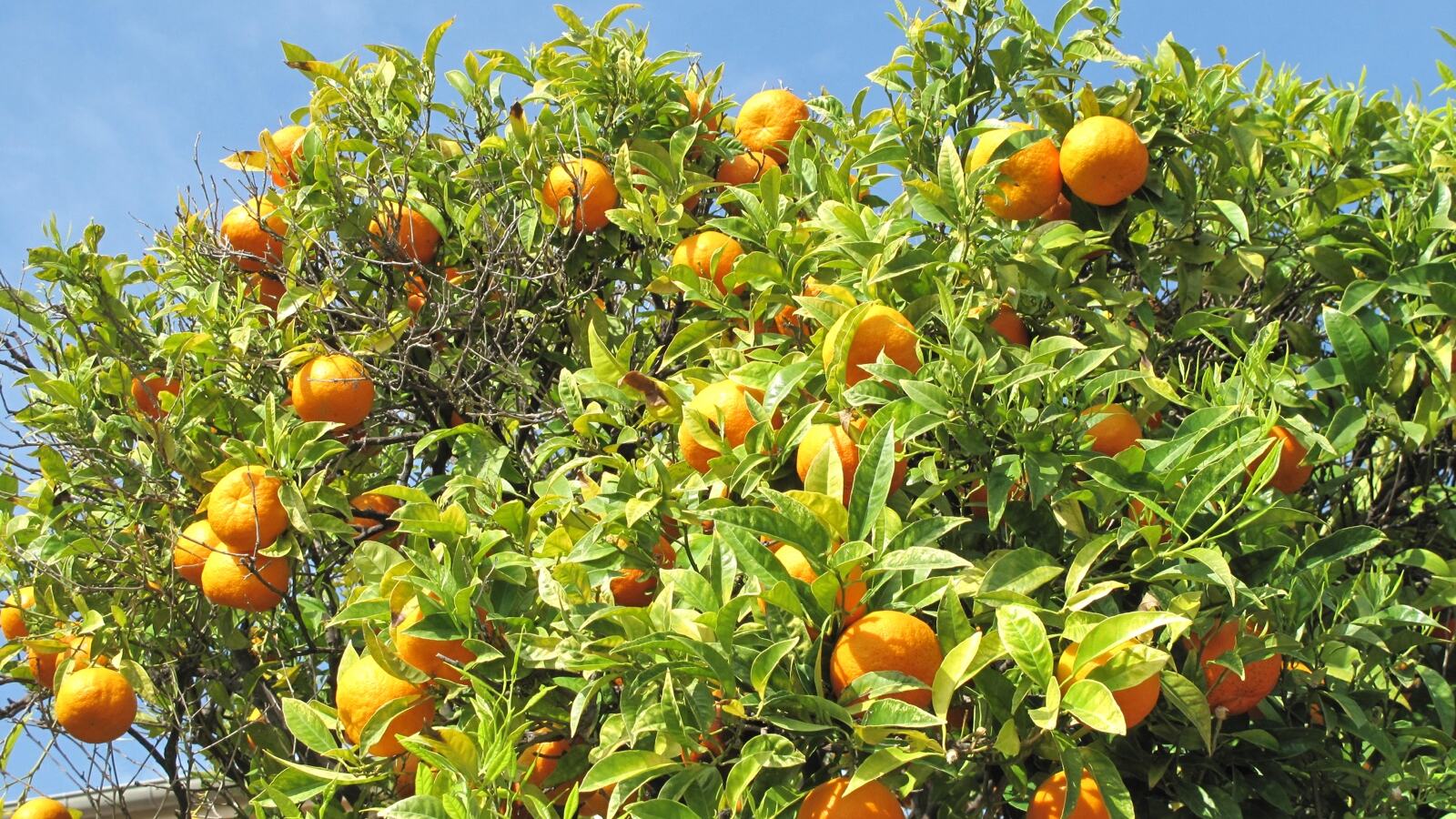
Citrus is evergreen and, unusually, often carries flowers, immature fruit, and ripe fruit simultaneously.
Fruit takes a long time to mature, from six months to over a year depending on type, so a tree may still be ripening one season's crop when the next flowering begins. Lemons in favourable climates flower almost continuously.
This has a practical consequence: citrus does not have a dormant season in the way deciduous fruit does, so it draws nutrients and water year-round and there is no convenient window for hard pruning. Feeding is little and often rather than a single dormant-season application.
Fruit also holds well on the tree, which is effectively free storage. Oranges left hanging continue to improve for weeks, unlike most fruit. See harvest and storage.
Rootstocks decide survival
As with other grafted fruit, the rootstock determines cold tolerance, soil tolerance, disease resistance, and vigour, and it matters more than variety for whether a tree survives.
Trifoliate orange, Poncirus trifoliata, is deciduous, notably cold-hardy, dwarfing, and resistant to Phytophthora root rot and citrus tristeza virus. It dislikes alkaline soil. It is the usual base for cold-climate and container citrus.
Citrange and citrumelo, hybrids of trifoliate with sweet orange or grapefruit, combine much of that hardiness with better tolerance of a range of soils.
Sour orange was the historic standard, tolerant of heavy and calcareous soils, and largely abandoned because it is devastated by citrus tristeza virus.
Never plant citrus on its own roots in a marginal climate. The rootstock is what gets it through winter.
Cold, and the limits
Citrus is subtropical, and cold tolerance varies substantially:
Kumquat and trifoliate are the hardiest, tolerating hard frost. Satsuma mandarins take several degrees below freezing. Sweet orange and grapefruit are damaged around minus 3 to minus 5. Lemons and limes are the most tender, damaged at or just below freezing.
Fruit is damaged at higher temperatures than wood, so a tree can survive a freeze that ruins the crop.
Citrus also needs heat to ripen properly. In marginal climates trees survive and produce fruit that never develops sugar, which is why citrus grown outdoors in cool temperate regions is usually disappointing even when the tree looks healthy.
The traditional answer is the orangery: a building with large south-facing glazing where tubbed trees overwintered and were moved out for summer. It remains the correct approach in cold climates. See container growing and frost protection.
Growing them in pots
Citrus is among the better fruit for containers, and the requirements are specific enough that most failures come from the same handful of mistakes.
Free-draining medium. Citrus roots rot readily in wet compost. Use an open, gritty mix, never a dense water-retentive one.
Do not overwater. The commonest cause of death. Let the surface dry between waterings, and water less in winter when growth stops.
Feed constantly in growth. Citrus is hungry, particularly for nitrogen, and needs micronutrients. Yellowing between green veins on new leaves is usually iron or manganese, and usually because the medium or the water is too alkaline for uptake. See nutrient deficiency and soil pH.
Use rainwater where the tap supply is hard, since citrus prefers slightly acid conditions.
Give maximum light and good air movement.
Overwinter cool and bright, around 5 to 10 C, not warm and dark. A heated living room in winter is a common killer: high temperature drives growth the low light cannot support, and the tree drops its leaves.
Watch for scale insects, mealybugs, and red spider mite, all of which thrive on indoor citrus. See mealybugs and scale and whiteflies and spider mites.
Huanglongbing
Citrus greening disease is the most serious threat facing the crop worldwide, and it is worth understanding as a case study in how a vector-borne disease dismantles an industry.
It is caused by a bacterium spread by the Asian citrus psyllid. Infected trees produce small, lopsided, bitter fruit that stays green at the base, and decline over several years. There is no cure and no resistant commercial variety.
It has devastated citrus in Florida, where production has fallen by a large majority since its arrival in 2005, and it is present across Asia, Brazil, and parts of Africa.
Management is containment: psyllid control, removal of infected trees, and strict controls on plant movement, which means never moving citrus material between regions. The parallels with Xylella in olives and with the epidemics in tree diseases are close, and the route of arrival is the same one every time.
Groves and biodiversity
Conventional citrus is grown as intensive irrigated monoculture with high input requirements, and it is a significant water user in regions that are increasingly short, notably Spain, California, and parts of Australia. See salinity, since citrus is notably salt-sensitive and irrigation-driven salinisation is a real constraint.
Organic and mixed citrus systems with ground cover, flowering understorey, and hedgerows support far more beneficial insects, and biological control of scale and mealybug with parasitoid wasps and predatory beetles is well established and effective in citrus specifically. See predator-prey balance and pollinator habitat.
Citrus flowers are also an exceptional nectar source, and orange blossom honey is a significant product in its own right.
See also
- Grafting and Rootstocks why rootstock decides hardiness
- Container Growing citrus in pots
- Frost Protection overwintering in cool climates
- Nutrient Deficiency diagnosing yellow leaves
- Tree Diseases greening in context
- Olive the other great Mediterranean tree crop
- Pomegranate
- Sapotes
- Curry Tree
- Bael
- Acerola
- Amur Cork Tree
- Sichuan Pepper
- Finger Lime