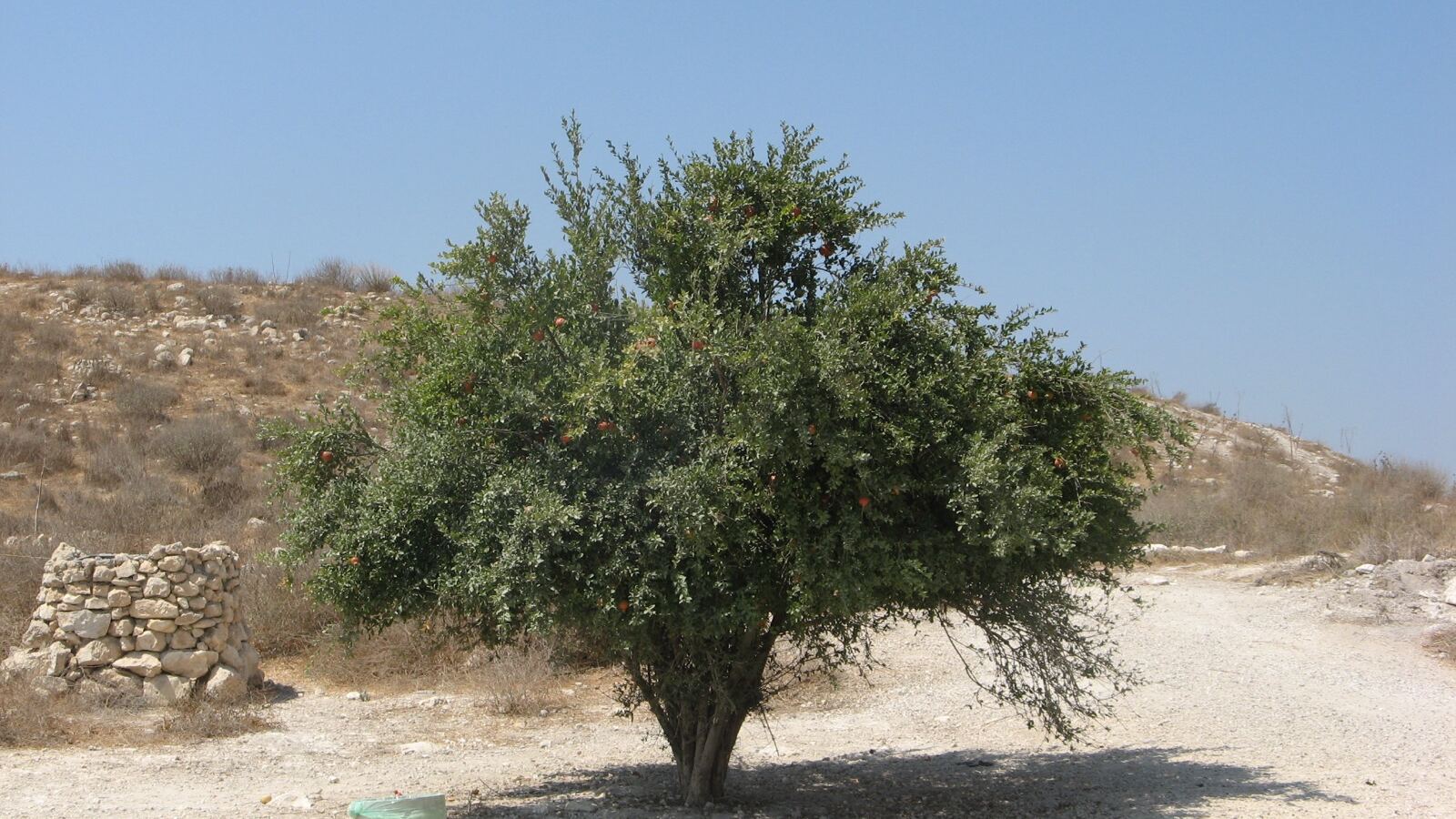
What it is
Punica granatum, a large deciduous shrub or small tree from Iran and the surrounding region, cultivated for at least 5,000 years and woven through the mythology and art of every civilisation that grew it.
Small, tough, long-lived — individual plants live and fruit for 100 to 200 years — and among the more drought- and salt-tolerant fruit crops, which is why it is a classic understorey of the date palm oasis.
The fruit is a balausta, a specialised berry with a leathery rind enclosing hundreds of seeds, each surrounded by a juicy red aril. The aril is the edible part, and the crop is unusual in that you eat the seed coats rather than flesh.
Built for dry heat
The pomegranate's tolerances put it firmly in the dryland fruit category with olive, fig, and date.
Drought. Deep-rooted and genuinely drought-tolerant once established, it fruits on rainfall alone in Mediterranean and semi-arid climates.
Salt. Notably salt-tolerant, tolerating soil and water that damage most fruit trees — another reason it persists in the salinised oasis landscapes discussed in salinity.
Heat. It needs a long hot dry summer to ripen fruit properly. Like the date palm, the plant is far hardier than its fruit — pomegranate survives to about minus 10 to minus 12 C, so it grows as an ornamental well outside the fruiting range, but the fruit needs heat those regions cannot supply.
See drought-tolerant species and Mediterranean shrubs.
It splits if you water it wrong
The defining growing problem, and it is a water-management fault rather than a disease.
When a pomegranate is nearly ripe, a sudden increase in water — a rain event, or heavy irrigation after a dry spell — makes the arils swell faster than the rind can accommodate, and the fruit splits open. A split fruit spoils quickly and is invaded by mould and insects.
The fix is even moisture through ripening, avoiding the dry-then-wet cycle. In a Mediterranean climate the problem is autumn rain arriving as the fruit matures, which is largely why pomegranate does best in reliably dry-autumn regions and disappoints in wetter ones. It is the same splitting mechanism seen in tomatoes and carrots, on a leathery-skinned fruit.
Mulching and consistent irrigation reduce it; a wet autumn defeats it. See irrigation scheduling and mulching for moisture.
Suckering
Pomegranate suckers freely from the base, and left alone it becomes a dense multi-stemmed thicket.
That is either useful or a nuisance depending on intent:
Grown as a thicket, it makes an impenetrable, drought-proof, spiny hedge — a traditional stock barrier and boundary across its native range. See hedgerow care.
Grown as a fruit tree, it is trained to a single trunk or a few main stems, with the suckers removed regularly to concentrate energy in the fruiting framework.
The suckering also makes propagation trivial — pomegranate roots very readily from hardwood cuttings and from suckers, so a variety is easily multiplied and shared, with no grafting needed. See propagation.
Growing it
Full sun, free drainage, and heat. It tolerates poor, stony, alkaline, and saline soil, and dislikes only waterlogging and deep shade.
Prune to an open framework for light and air, remove suckers and dead wood, and thin fruit if a heavy set threatens to break branches. It fruits on the tips of new growth on mature wood, so avoid shearing all the new growth off.
Self-fertile, mostly, so a single plant fruits — though yields improve with more than one, and pollination is by bees and helped by some self-pollination. See native bees.
Container growing works well and is the practical route in a cool climate, allowing the plant to be moved into maximum warmth and under cover for winter — the same approach as citrus and olive. Dwarf ornamental pomegranates fruit in pots. See container growing.
Pests and diseases are few in a dry climate, which is part of the appeal; leaf and fruit spot and aphids are the main issues, worse in humidity. See aphids.
In a system
Pomegranate is a natural component of a dry-climate food forest and the classic oasis understorey beneath date palms, tolerating the heat, the shade, and the saline water that would defeat softer fruit. See date palm.
It also makes a good drought-proof edible hedge, a windbreak component in dry regions, and an ornamental with brilliant orange-red flowers that are genuinely good for pollinators.
The dried rind, bark, and roots have a long history of medicinal and tanning use, high in tannins, and the flowers and rind yield dyes.
The fruit
Harvested when the rind has coloured fully, sounds metallic when tapped, and the fruit feels heavy — pomegranates do not ripen further off the tree, so timing matters as it does with melons.
Whole fruit stores remarkably well — weeks at room temperature, months refrigerated — because the tough rind protects the arils. That storability, in a fruit that grows where little else does, is much of why it was a valued trade and travelling fruit across the ancient world. See harvest and storage.
The juice is the major product, fresh and as grenadine and the Persian and Caucasian sauces, and pomegranate molasses is a staple of Middle Eastern cooking.
See also
- Date Palm the oasis overstorey it grows beneath
- Olive the companion dryland fruit tree
- Fig Species the third classic Mediterranean fruit
- Drought-Tolerant Species the dry-climate palette
- Salinity why pomegranate tolerates saline oasis water
- Container Growing fruiting it in a cool climate
- Tamarind and Carob
- Jujube
- Crape Myrtle