What it is
Couroupita guianensis, the cannonball tree — a large tree of the South American tropics, and one of the most extraordinary-looking trees in the world, grown as a curiosity and a sacred tree far beyond its Amazonian home.
It belongs to the family Lecythidaceae — which makes it a close relative of the brazil nut — and, like the brazil nut, it produces its seeds inside a hard, heavy, woody pod. But the cannonball tree presents its flowers and fruit in a way that stops everyone who sees it.
Flowers and cannonballs on the trunk
The cannonball tree is a spectacular example of cauliflory — flowering and fruiting directly on the trunk — the same habit as the jaboticaba and cacao, and here taken to a dramatic extreme.
Long, tangled, snaking flower stalks grow straight out of the trunk, and along them open large, waxy, intensely fragrant flowers in orange, pink, and red, with a strange arrangement of stamens — a ring of fertile stamens in the centre and a hood of sterile ones above — that is one of the most complex flowers of any tree.
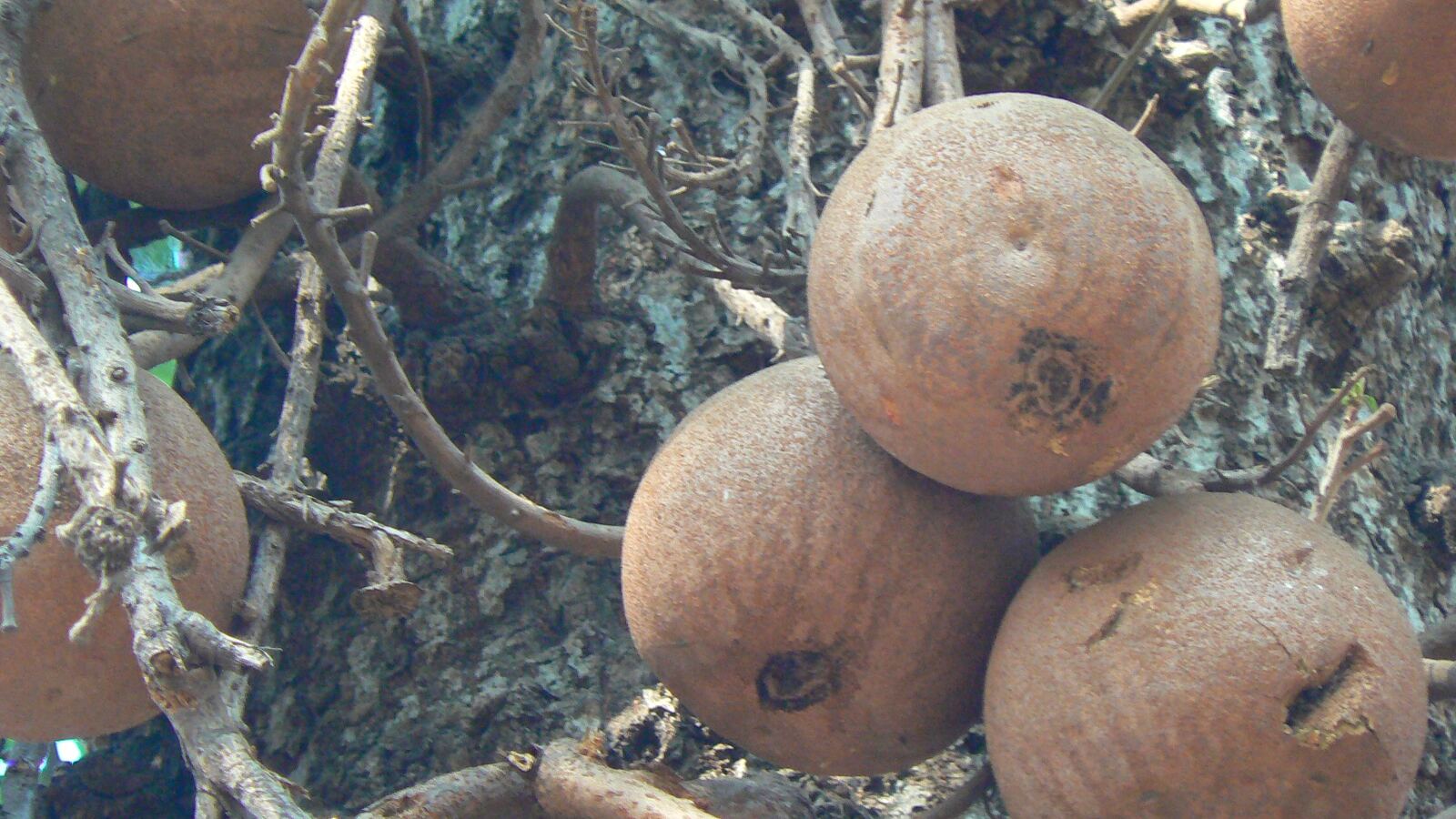
Those flowers give way to the fruit that names the tree: huge, round, hard, woody, brown "cannonballs" — up to 25 cm across and weighing a couple of kilos — that hang in clusters directly on the trunk, looking exactly like rusty cannonballs slung against the tree, and dropping with a loud crack when ripe. A falling cannonball is a genuine hazard, so the trees are fenced or sited away from paths. The fruit pulp is edible in principle but smells unpleasant, even foetid, when it splits open, and is largely left to the animals — pigs, peccaries, and others — that eat it and disperse the seeds.
Pollinated by buzzing bees
The complex flower is built for a specific job. The central fertile stamens offer pollen (there is no nectar), while the hood of sterile stamens offers a special "fodder" pollen as a reward — and the flowers are worked mainly by large bees, especially carpenter bees, which the flower dusts with fertile pollen as they gather the reward pollen. It is a sophisticated pollination mechanism, of the kind common in the brazil-nut family, and a good example of a flower's odd shape being entirely explained by its pollinator. See pollinator habitat and native bees.
A sacred tree
Though South American in origin, the cannonball tree has been widely planted in India and across South and Southeast Asia, where it has taken on deep religious significance and is often found in the grounds of Hindu and Buddhist temples.
In Hindu tradition it is associated with Shiva: the flower's hooded arrangement of stamens is seen as resembling the sacred naga (serpent) sheltering a lingam, and the tree is called the nagalingam or shiva kamal and treated as sacred, its flowers offered in worship. (In some Buddhist countries it is confused with, and planted as, the sacred sal tree under which the Buddha was born, though botanically it is unrelated.) This religious status means the striking, fragrant, cannonball-hung tree is a familiar sight in temple courtyards across the region — another instance, like the banyan and iroko, of a tree's cultural and sacred role shaping where it grows. See historical ecology.
Growing it
Tropical, frost-free, and wanting the hot, humid, high-rainfall conditions of the lowland tropics, with deep, rich, moist soil; it is a large tree that needs plenty of space and is grown almost entirely as an ornamental, curiosity, and sacred tree rather than for any product.
It is slow to reach flowering size but then flowers and fruits prodigiously along the trunk, a year-round spectacle. Grown from seed and cuttings, and best sited well away from where its heavy cannonballs could fall on people or property. Where the climate allows, few trees are more astonishing to encounter. See propagation and tropical fruit trees.
See also
- Brazil Nut its close relative in the Lecythidaceae, with the same woody pods
- Jaboticaba and Cacao and Coffee more cauliflorous trees
- Sausage Tree another tree of huge, trunk-hung fruit
- Native Bees the carpenter bees that pollinate the flowers
- Banyan and Strangler Figs another sacred temple tree
- Historical Ecology the cannonball tree's religious spread
- Sal Tree
- Davidson Plum