What it is
Plinia cauliflora (and related species), the jaboticaba or Brazilian grape tree — a small evergreen tree of southern Brazil, in the myrtle family, Myrtaceae, and so a relative of the guava, feijoa, clove, and rose apple.
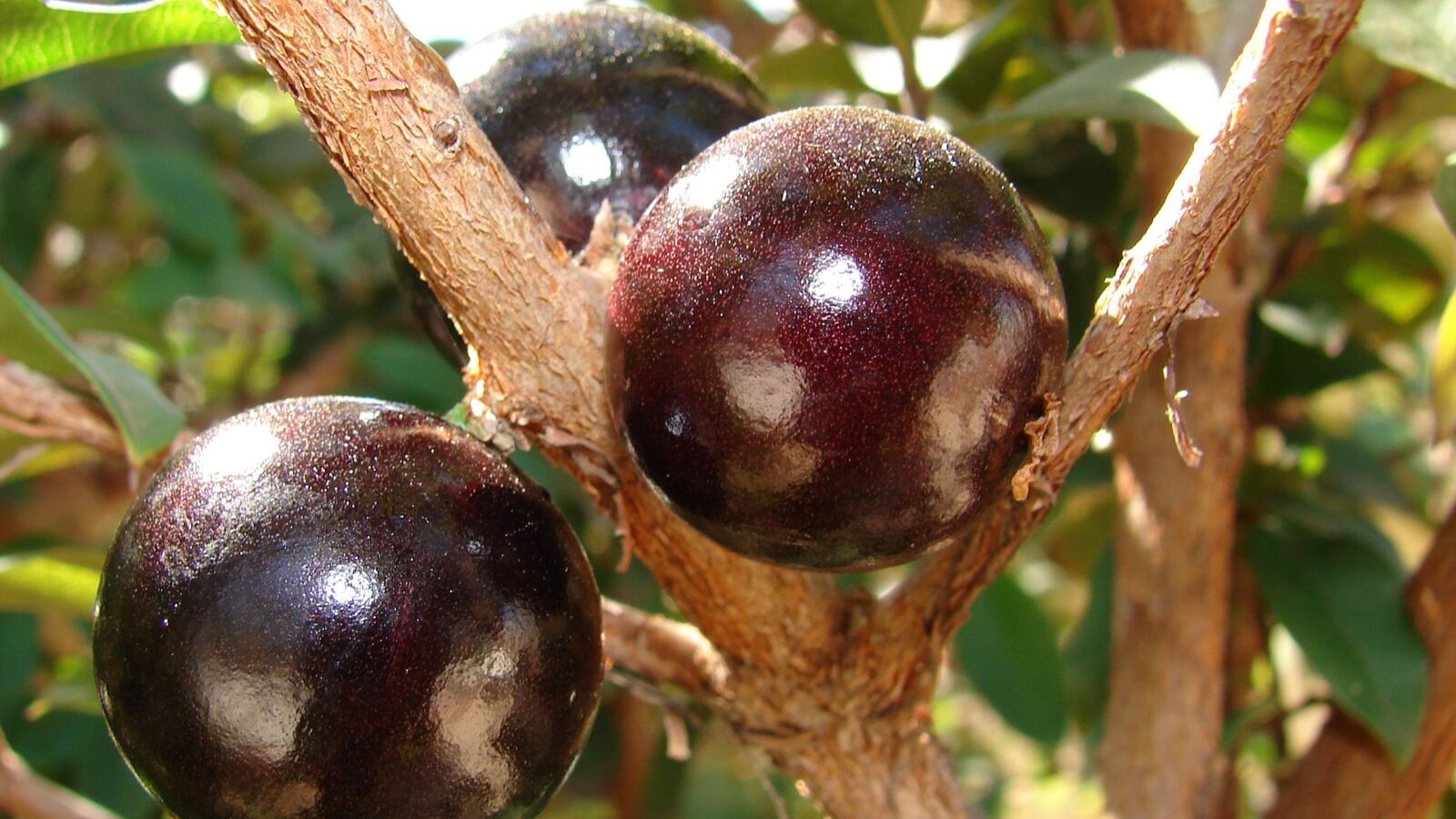
It bears a dark, round, grape-like fruit with sweet, translucent, jelly-like flesh and a thick skin — pleasant, refreshing, and grape-to-lychee in flavour — but the fruit is not what makes people stop and stare. What makes the jaboticaba unforgettable is where the fruit grows.
Fruit straight from the trunk
The jaboticaba is the most famous example of cauliflory — the botanical habit of flowering and fruiting directly on the trunk and main branches, rather than out at the twigs where fruit normally forms.
When a jaboticaba comes into season, its bark erupts all over with flowers and then fruit: the entire trunk and the large limbs become densely covered, from ground to crown, in white fuzzy blossom and then in shining dark-purple fruit packed cheek by jowl along the wood — so that the tree looks as though it has been studded with grapes, or dipped in them. It is one of the strangest and most beautiful sights in the fruit world, and the reason the jaboticaba is grown as a curiosity and ornamental as much as for eating.
Cauliflory is not unique to the jaboticaba — it appears in the cacao (whose pods grow on the trunk), the jackfruit, the sausage tree, and various figs — and it is generally an adaptation of the shady tropical forest understorey: presenting flowers and fruit low on the trunk makes them accessible to the animals that pollinate and disperse them on the forest floor and in the lower levels — bats, terrestrial mammals, and understorey birds — rather than up in a canopy those animals cannot easily reach. In the jaboticaba's case the trunk flowers are worked by bees and the fruit eaten by many animals. See pollinator habitat.
The fleeting fruit
The jaboticaba's fruit is delicious but famously fleeting: picked ripe, it ferments and spoils within two to four days, so — like the lychee before cold chains — fresh jaboticaba is essentially unknown outside its growing regions and is a treat of the garden and the local market. In Brazil it is eaten fresh straight off the trunk and, because there is always a glut all at once, made into jellies, jams, juices, wines, and liqueurs to preserve the harvest. The skin, thick and tannic, is often spat out fresh but used in the preserves.
The tree fruits astonishingly heavily and, in a warm climate, may crop several times a year, each time covering itself anew — a generous, if short-lived, harvest each round.
Growing it
Subtropical to tropical, and marginally frost-hardy (mature trees tolerate light frost, which lets it be grown in warm-temperate as well as tropical gardens), the jaboticaba wants full sun to light shade, and moist, deep, slightly acidic, well-drained soil with steady water — it dislikes drought, salinity, and alkaline soil, and appreciates mulch and humidity.
Its one great drawback for the impatient is slowness: a seedling jaboticaba can take eight to fifteen years or more to begin fruiting, so it is a tree planted by the patient or for the next generation (grafted plants fruit sooner). It is slow-growing, long-lived, dense, and handsome, with attractive peeling bark, making a fine evergreen specimen and a rewarding, if long-awaited, fruit tree and a natural component of a subtropical food forest. Grown from seed (which comes fairly true) and by grafting to shorten the wait. See propagation and grafting.
See also
- Guavas and Feijoa its myrtle-family fruit relatives
- Rose Apple and Jambolan more Syzygium-and-myrtle fruit
- Cacao and Coffee another cauliflorous tree (cacao's trunk pods)
- Breadfruit and Jackfruit jackfruit's trunk-borne fruit
- Sausage Tree cauliflory in an African tree
- Food Forest Design the jaboticaba as a long-term fruit tree
- Cannonball Tree
- Langsat and Duku
- Judas Tree
- Davidson Plum