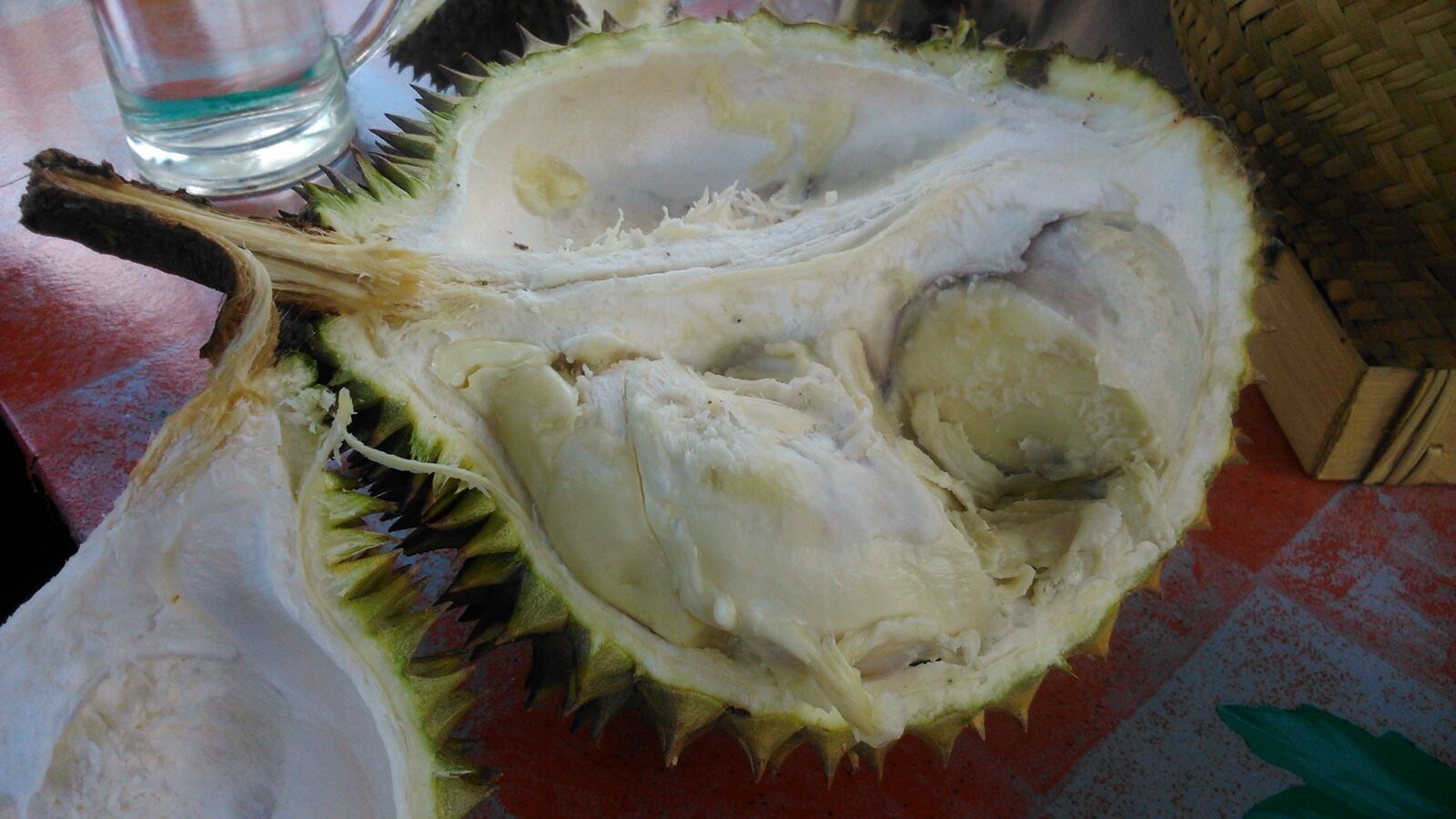
Two icons of the Malay world
Southeast Asian fruit culture crowns two species: durian the "king of fruits," mangosteen the "queen." They are unrelated botanically but paired in folklore, and each is a large evergreen forest tree domesticated in the humid tropics of the Malay Archipelago.
Durian: the fruit that divides everyone
Durio zibethinus, the durian, is a large tree of the mallow family (kin to cacao, baobab, and kapok) bearing heavy, football-sized fruit covered in hard sharp spikes — heavy enough, and armed enough, that a falling durian is a real danger and people are injured by them each year.
Its fame is the smell. The custard-soft flesh gives off a powerful, penetrating aroma that people describe wildly differently — rich almonds and caramel to some, rotting onions, turpentine, and sewage to others — and it is strong enough that durian is banned from many hotels, aircraft, and public transport across Southeast Asia, marked with the familiar crossed-out durian sign. Chemically the smell is a complex mix of dozens of sulphur and ester compounds, and genetics partly determine whether a person finds it heavenly or repellent.
To those who love it — and it is passionately loved, commanding high prices and connoisseurship of named varieties like Musang King rivaling that of fine wine — the flesh is one of the great eating experiences: thick, sweet, creamy, complex. It is intensely cultural, the centre of a seasonal fruit obsession across the region. In the forest the strong smell and rich flesh serve to attract large animals — orangutans, elephants, and others — that eat the fruit and disperse the big seeds, a working large-animal dispersal system of the kind the avocado has lost.
Mangosteen: the queen
Garcinia mangostana, the mangosteen, is the cool counterpoint — a slow-growing evergreen bearing round fruit with a thick, deep-purple rind that opens to reveal segments of snow-white flesh, delicate, sweet-tart, and universally admired. Where durian overwhelms, mangosteen refreshes.
In the humoral "heating and cooling" framework of Southeast Asian tradition, durian is intensely "heating" and mangosteen "cooling," so the two are eaten together to balance — a nice piece of food culture whatever its physiology. The purple rind is extraordinarily high in tannins and pigments and has a long medicinal use, and mangosteen is notoriously difficult to grow, being one of the most tropical and demanding of all fruit trees, intolerant of any cold, drought, or poor drainage.
The growing challenge
Both are strictly hot, wet, lowland tropical trees, and both are slow and demanding — which is why, despite their fame, neither is a major world crop on the scale of banana or mango.
Durian needs high heat, high humidity, deep rich soil, and years to bear (grafted trees sooner), and its heavy spiked fruit and towering size make orchards hazardous and harvest skilled — the fruit is usually left to fall and collected, as picking under-ripe ruins the flavour.
Mangosteen is even fussier: it will not tolerate temperatures below about 4°C or above 38°C, demands constant moisture and humidity, grows agonisingly slowly (a decade or more to first fruit from seed), and has an unusual reproduction — its seeds are apomictic (clonal, formed without fertilisation), so every mangosteen is essentially genetically identical, a natural clone, and there are effectively no varieties.
Propagation. Durian is grafted to speed bearing and fix varieties; mangosteen is grown from its clonal seed. Both need frost-free, humid, sheltered sites and patience, and both belong only in the true wet tropics or a heated glasshouse. See tropical fruit trees, grafting, and propagation.
See also
- Tropical Fruit Trees durian and mangosteen among the wider crop
- Cacao and Coffee durian's relatives in the mallow family
- Kapok and Balsa more mallow-family tropical giants
- Avocado a fruit that lost the large animals durian still feeds
- Mango the more widely grown tropical fruit
- Banana and Plantain the tropical staple by contrast