What it is
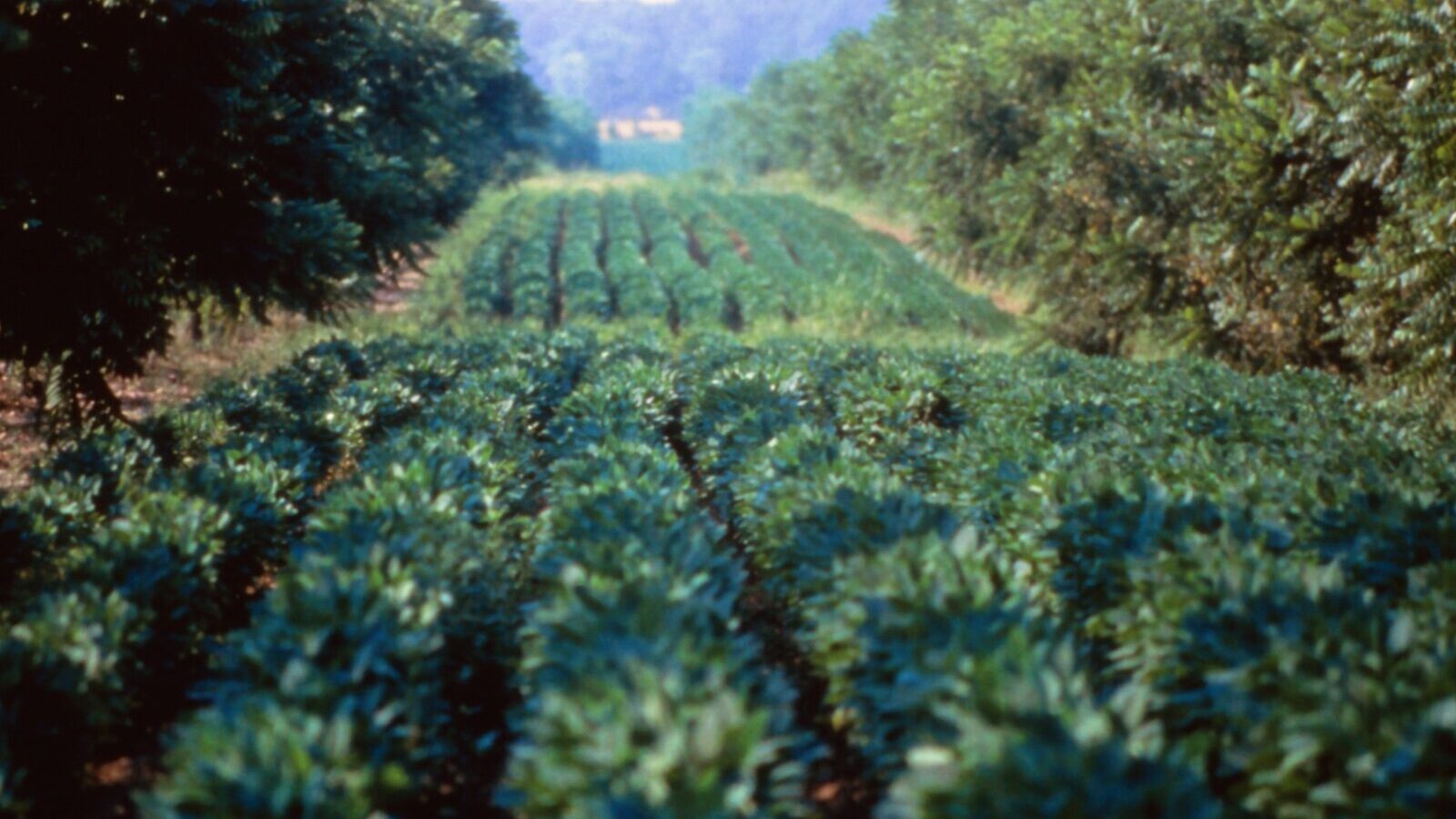
Rows of trees with wide alleys of crop between them, farmed as one system.
The trees run in lines, usually widely spaced, and the alley between is cropped conventionally with whatever the farm already grows: cereals, vegetables, forage. Machinery works up and down the alleys as normal.
Sometimes called silvoarable, to distinguish it from silvopasture, where the between-row use is grazing.
The appeal is that it does not require a farmer to abandon what they know. The arable operation continues. Trees are added into it.
Why it works
The trees use resources the crop cannot reach. Tree roots go below the crop rooting zone and take water and nutrients that would otherwise leach past. Nitrate leaching from arable land drops substantially under alley cropping, which matters where water quality is regulated.
Shelter raises yields. Wind reduction of 30 to 50 percent across the alley cuts transpiration stress and physical damage. In exposed regions the sheltered alley can outyield open field despite losing ground to the tree rows.
Light is only partly shared. With rows oriented well and crops harvested before the canopy is at full density, competition is far less than the ground area suggests.
Two income streams, decades apart. Annual crop revenue continues while timber or fruit accumulates.
Land equivalent ratios of 1.2 to 1.4 are typical in European trials, so 100 hectares of alley cropping produces what roughly 120 to 140 hectares of separated tree and crop land would.
The design decisions
Orientation. North to south in temperate latitudes, so the shadow sweeps across the alley through the day rather than parking on one strip. Where wind is the dominant problem rather than light, orient perpendicular to the prevailing wind instead and accept the shading cost. On sloping ground, run rows on the contour and the system doubles as erosion control.
Alley width. Set by machinery first, then light. A common rule is alley width of at least the final tree height, often 24 to 40 m in modern arable systems. Make it an exact multiple of your working width, sprayer, drill, combine, or you will waste a pass forever.
Tree spacing within the row. Tight, 2 to 8 m, because you will thin. Plant more than you need and remove the poor ones.
Species. High-value timber is the usual choice, since the whole system is a long-dated investment: walnut, wild cherry, poplar, oak. Poplar for short rotation, walnut where the climate suits, though note walnut's allelopathy limits what grows near it. Fruit and nut rows shorten the payback. Nitrogen-fixing rows change the economics again, see nitrogen fixers.
Understorey strip. The metre or two under the trees should not be bare. Sown with a flowering strip it becomes the beetle bank and pollinator reservoir for the whole field, which is often the largest biodiversity gain in the system. See pollinator habitat and native bees.
Root pruning, the technique that makes it viable
The tree roots that compete with the crop are the shallow lateral ones in the alley.
Running a subsoiler or root-pruning blade down each side of the tree row, 40 to 60 cm deep, every few years, severs those laterals and pushes the tree to root deeper. Competition in the alley falls sharply and the tree is more drought-resilient for it.
This is the single technique that most often separates alley cropping that works from alley cropping that slowly loses its alleys.
The tropical version
In the humid tropics, alley cropping usually means something different and faster: hedgerows of fast nitrogen-fixing shrubs, Leucaena, Gliricidia, Calliandra, cut back several times a season with the prunings spread as mulch on the alley.
The trees here are a fertility pump rather than a timber crop. Cut low, they resprout, and the biomass and fixed nitrogen go straight onto the growing crop. Yields on poor tropical soils can double without imported fertiliser.
Mechanically this is chop and drop systematised into rows, and it shares its logic with syntropic agriculture and coppice rotation.
The catch is labour. Cutting hedgerows several times a season by hand is demanding, and adoption has been strongest where labour is available and fertiliser is not.
Establishment
The first three to five years are all cost and no return, and this is where schemes are abandoned.
Protect the trees. Machinery, deer and rabbits, and sprayer drift are all lethal to young stock. Guards and a clearly marked row, and brief whoever is driving.
Control grass in the tree strip, not with a strimmer against the stems. Mulch or a herbicide-free covered strip. See weed management and tree planting.
Formative pruning from year two. The whole timber value depends on a straight clear stem of 4 to 6 m, and you get that by pruning early on a schedule, not by hoping.
Plan the thinning from the start. Half the trees planted are removed. Deciding which at year fifteen rather than year two costs you the form of the ones that remain.
Where it does not fit
Very small fields, where the headland losses dominate. Extremely windy sites where establishment is impossible without prior shelter. Irrigated systems where tree roots interfere with the irrigation design.
And any situation where the land is rented on a short tenancy. Nobody plants a forty-year crop on a five-year lease, which is a policy problem rather than an agronomic one, and one reason uptake lags the evidence. See stakeholder mapping.
See also
- Silvopasture the grazed equivalent
- Windbreaks the shelter function on its own
- Erosion Control contour rows on slopes
- Nitrogen Fixers rows that fertilise the alley
- Syntropic Agriculture the intensive tropical relative
- Hedgerow Care managing linear tree features
- Wild Cherry
- Macadamia, Cashew and Brazil Nut
- Leucaena and Gliricidia
- Teak
- Inga
- Faidherbia
- Shisham