What it is
Inga, a large genus of fast-growing leguminous trees of tropical Central and South America — above all the ice-cream bean, Inga edulis — that have become one of the most valuable groups of trees in tropical agroforestry.
Like the leucaena, coral tree, and other leguminous trees, inga is a nitrogen fixer that enriches the soil, grows fast, coppices well, and does many jobs at once — but it combines these with an edible fruit and a set of qualities that have made it the centre of a genuinely important sustainable-farming system.
The ice-cream bean
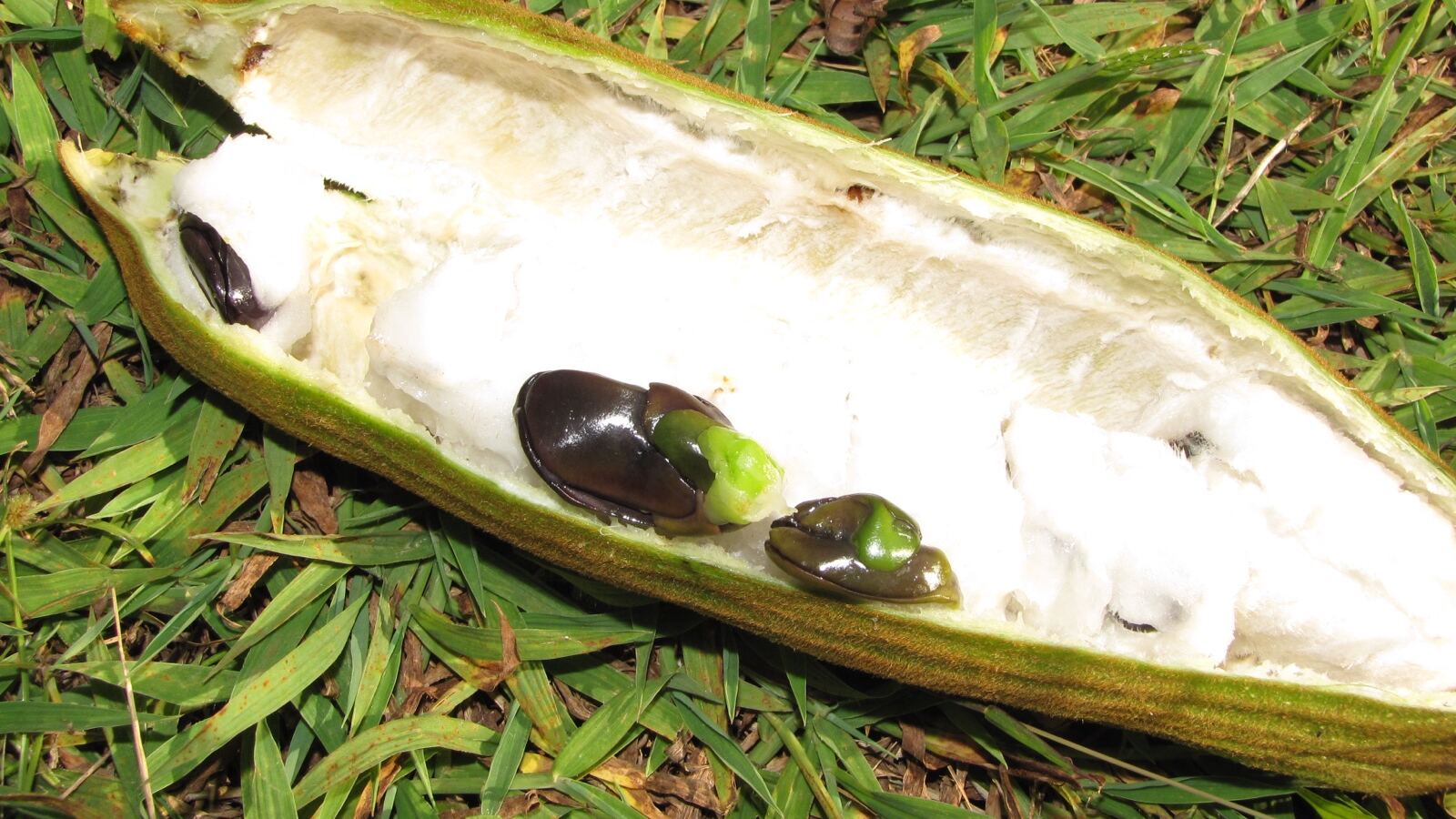
The ice-cream bean gets its name from its remarkable pods. Inga produces long, green, sometimes twisted pods — up to half a metre or more in some species — filled with seeds, each wrapped in a fluffy, sweet, white pulp (an aril, again).
That white pulp is sweet and cottony, tasting like vanilla ice cream or candy floss, and it is eaten fresh straight from the pod — sucked off the seeds like a natural sweet — a beloved treat for children across tropical America and a genuine minor fruit crop sold in local markets. It is one of the few nitrogen-fixing agroforestry trees that is also a pleasant fruit, which adds to its appeal on a farm. The flowers are showy pompons of white stamens, rich in nectar and worked by bees, hummingbirds, and moths.
Inga alley cropping
Inga's real importance is agronomic, and it addresses one of the central problems of the humid tropics: how to farm the same piece of land year after year without exhausting it and being forced to clear more forest.
Across the wet tropics, the traditional answer has been slash-and-burn — clear and burn a patch of forest, crop it for a few years until the poor tropical soil is exhausted and weeds take over, then abandon it and clear a new patch, driving continual deforestation. Inga alley cropping offers an alternative, developed and championed over decades of research:
- Inga trees are planted in hedgerows (alleys), with crops grown in the strips between them.
- The fast-growing inga shades out weeds (removing the main reason land is abandoned) and, as a legume, fixes nitrogen and builds soil.
- Periodically the inga rows are pruned hard, and the leafy prunings are laid down as a thick mulch — the classic chop-and-drop — which suppresses weeds, feeds the soil, and holds moisture, while the wood is used for fuel.
- Crops are grown in the mulched alleys, and because fertility and weed control are renewed by the trees, the same plot can be cropped indefinitely, breaking the slash-and-burn cycle and taking the pressure off standing forest.
This system — proven with smallholder farmers in Central and South America — is one of the clearer success stories of alley cropping and regenerative tropical agriculture, and inga's combination of speed, nitrogen fixation, dense weed-suppressing shade, tolerance of poor acid soils, easy coppicing, and edible pods makes it close to an ideal tree for the job. See silvopasture and nitrogen fixers.
Growing it
Tropical and frost-tender, wanting warmth and moisture; inga is notably tolerant of the poor, acidic, leached soils of the humid tropics — the very soils that defeat many crops — as well as of periodic waterlogging, which is central to its usefulness where soils are difficult.
It is very fast-growing, coppices and pollards readily (essential for the alley-cropping mulch cycle), and is grown easily from its large seeds, which are best sown fresh as they lose viability quickly. It provides fuelwood, shade for coffee and cacao, fodder, nectar for honey, and the edible pods, all while building soil — a multi-purpose tree of exactly the kind that makes leguminous agroforestry so productive. See propagation.
See also
- Alley Cropping the system inga anchors
- Leucaena and Gliricidia the other great agroforestry legumes
- Coral Tree a fellow nitrogen-fixing, multi-purpose legume
- Nitrogen Fixers the soil-enriching role
- Chop-and-Drop the prune-and-mulch cycle inga alleys use
- Cacao and Coffee the crops inga commonly shades
- Rain Tree
- Sesbania