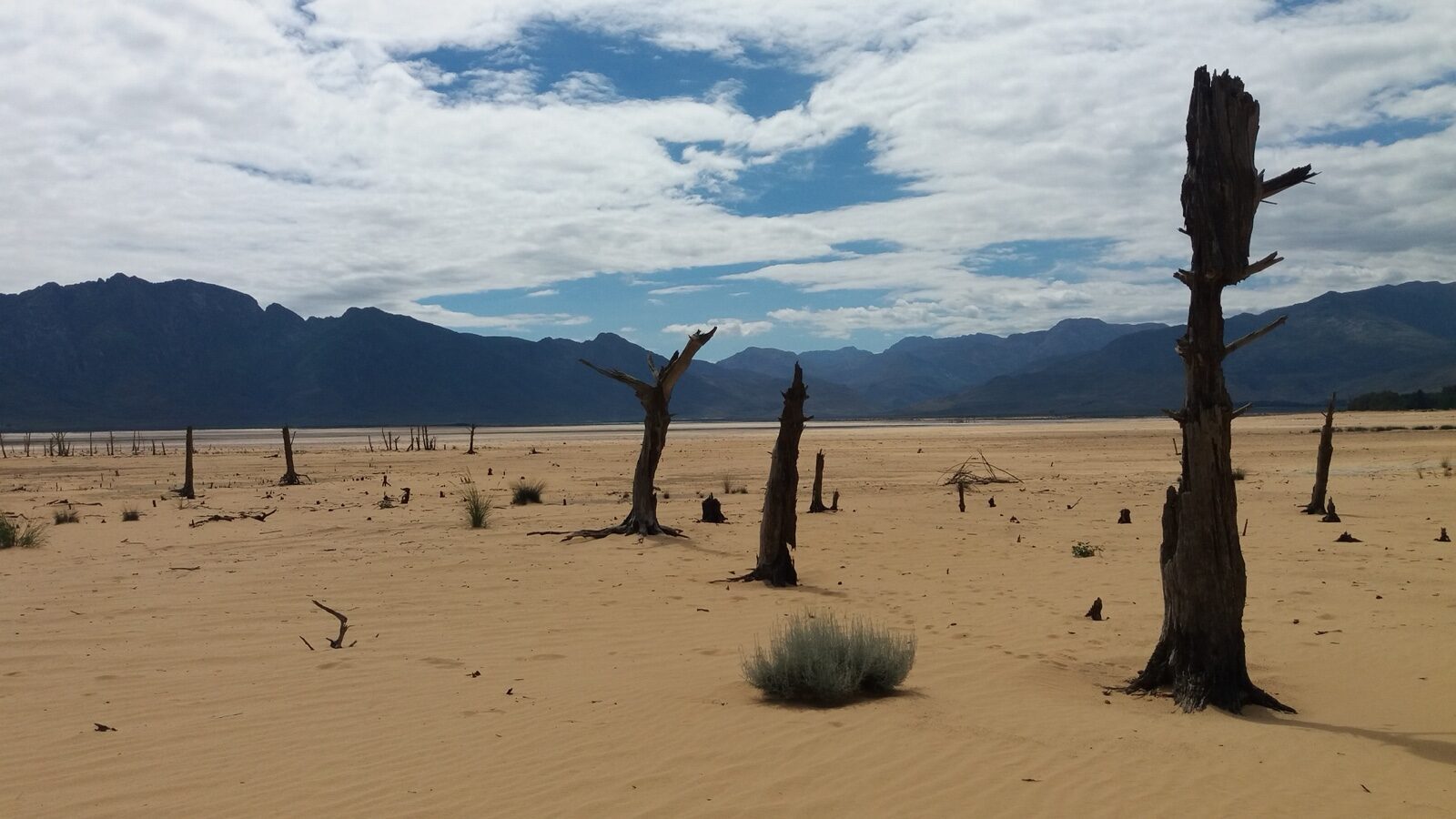
The problem with planting for today
A tree planted now will live through conditions that do not currently exist anywhere near it.
An oak going in this winter is making a bet on the climate of the 2100s. The seedling is adapted, through its provenance, to the conditions its parents experienced. Those conditions are moving faster than the species can migrate.
Natural tree migration runs at something like 100 to 500 m per year, limited by seed dispersal and the time to reproductive age. Climate zones are currently moving several kilometres per year. The gap is the entire problem, and no amount of protection closes it.
Variability kills before averages do
The common framing, that a region will become warmer and drier on average, is misleading in a specific and dangerous way.
Trees do not die of averages. They die of events: the single unprecedented drought, the late frost after an early warm spell, the storm on saturated ground, the winter warm enough to break dormancy in February.
An early warm spell that triggers bud burst three weeks early, followed by a normal late frost, destroys a season's growth and can kill young trees outright. That is a variability failure in a climate whose average looks fine.
Design for the extremes, not the mean. That means species and structures that tolerate a wider range rather than ones optimised for a projected new normal. It also means storm damage recovery is now a planning assumption rather than an emergency.
Provenance: the cheap intervention
Provenance is where the seed came from, and within a single species it can matter more than species choice.
Scots pine from northern Scotland and Scots pine from Spain are the same species with substantially different drought tolerance, growth rhythm, and frost timing. Local provenance has been the default restoration advice for decades, and for good reason: locally adapted stock performs best in local conditions.
The trouble is that local conditions are the thing changing.
Three positions, in increasing order of intervention:
Local provenance. Best adapted to current conditions, best matched to local wildlife phenology. Increasingly a bet on a climate that is leaving.
Composite or mixed provenance. Local stock plus a proportion, often 20 to 40 percent, from populations 200 to 500 km toward the warmer or drier end of the species range. Keeps local adaptation, adds genetic variation that may prove useful, and lets selection do the choosing. This is the mainstream recommendation now and the lowest-regret option.
Provenance shifting. Deliberately sourcing the bulk of stock from a warmer part of the range. Higher risk of frost damage in the near term, better matched to projections later.
Mixed provenance is what most restoration practitioners have converged on, because it hedges rather than predicts, and because the genetic breadth is valuable regardless of which projection turns out right. See seed banking and minimum viable populations.
Assisted migration, and the argument about it
Moving species rather than provenances, beyond their current range.
Three degrees of it, which get conflated in arguments and should not be:
Assisted population migration. Moving genotypes within the species' existing range. Uncontroversial, widely practised, essentially the provenance question above.
Assisted range expansion. Moving a species just beyond its current edge, into territory it would likely reach on its own given time. Moderately accepted.
Assisted species migration. Long-distance movement into entirely new regions. Genuinely contested.
The case for: species cannot move fast enough, refusing to act guarantees losses, and we already move species constantly with far less thought.
The case against: this is how invasions start. Every catastrophic introduction was once someone's good idea, and we are poor at predicting which species will behave. See invasive species. There is also a pathogen risk, since moving plants moves their diseases, as tree diseases documents repeatedly.
The moderate position, and the practical one: shift provenances freely, expand ranges cautiously at the margins, treat long-distance species movement as a last resort requiring evidence. And whatever you do, do it as a trial with monitoring attached rather than as a landscape-scale commitment.
Design choices that hedge
Independent of provenance, structure buys resilience.
Species mixture over monoculture. If you cannot predict which species copes, plant several and let the site decide. A mix where a third fails is a thinned woodland. A monoculture where the species fails is a dead field. This is the practical argument in structural diversity.
Age mixture. Even-aged stands fail all at once. Mixed ages mean the next cohort is already there. See woodland management.
Genetic breadth within species. Wide-provenance stock means a tolerant fraction exists. This is precisely what is carrying ash forward through dieback.
Water in the ground. Everything that improves infiltration and soil water holding buys drought tolerance directly, and it is the highest-return adaptation work available. Soil water storage, swales, keyline design, and organic matter building all do this. A soil at 5 percent organic matter holds far more plant-available water than the same soil at 2 percent.
Shade and shelter. Canopy moderates temperature extremes at ground level substantially. Nurse trees, windbreaks, and shade management are adaptation measures.
Connectivity. Species that can move will, if there is a route. Wildlife corridors are climate infrastructure.
Species selection under uncertainty
Broaden rather than replace. Keep the species that belong and add ones from the warmer end of the region's plausible future, in small proportions, as trials.
Favour species with wide natural ranges, since a species spanning many climate zones has the genetic capacity to cope. Favour ones that regenerate readily, because a system that seeds itself adapts faster than one that is replanted.
For dry-trending regions, drought-tolerant species and Mediterranean shrubs are the obvious reference points, and dryland practitioners are decades ahead of temperate ones. Yacouba Sawadogo and Tony Rinaudo worked out how to regenerate land under conditions temperate regions are only now approaching.
Be careful with fast fixes. The temptation is a fast-growing tolerant exotic that survives anything. Sometimes that is right. Often it produces a stand that survives and supports nothing, and the eucalyptus debate is the standing example.
Accept some losses
The uncomfortable part. Some species will not persist where they currently are, and some sites will not carry woodland at all under future conditions.
Planning that assumes every existing community can be held in place will waste resources defending the indefensible. Triage applies here as it does in invasive species: identify what is genuinely at risk and can be helped, what will persist regardless, and what is going to change whatever you do.
Managing a transition well is a legitimate outcome. A site that becomes open wood pasture instead of closed woodland is not a failure if that is what the climate now supports and it is functioning.
See also
- Seed Banking preserving genetic options
- Structural Diversity mixture as insurance
- Soil Water Storage the highest-return adaptation
- Invasive Species the risk assisted migration runs
- Monitoring treating every choice as a trial
- Carbon Accounting the mitigation side of the same question
- Spruces
- Silver Fir
- Redbud and Sassafras
- Pistachio
- Hackberry
- Silk Tree
- Lychee and Longan
- Joshua Tree and Yuccas
- Quiver Tree
- Cedar of Lebanon
- Maackia
- Biomes