Two eastern understorey trees
Both are small trees of the eastern North American forest edge and understorey, both are widely planted ornamentally, and both do something structurally unusual.
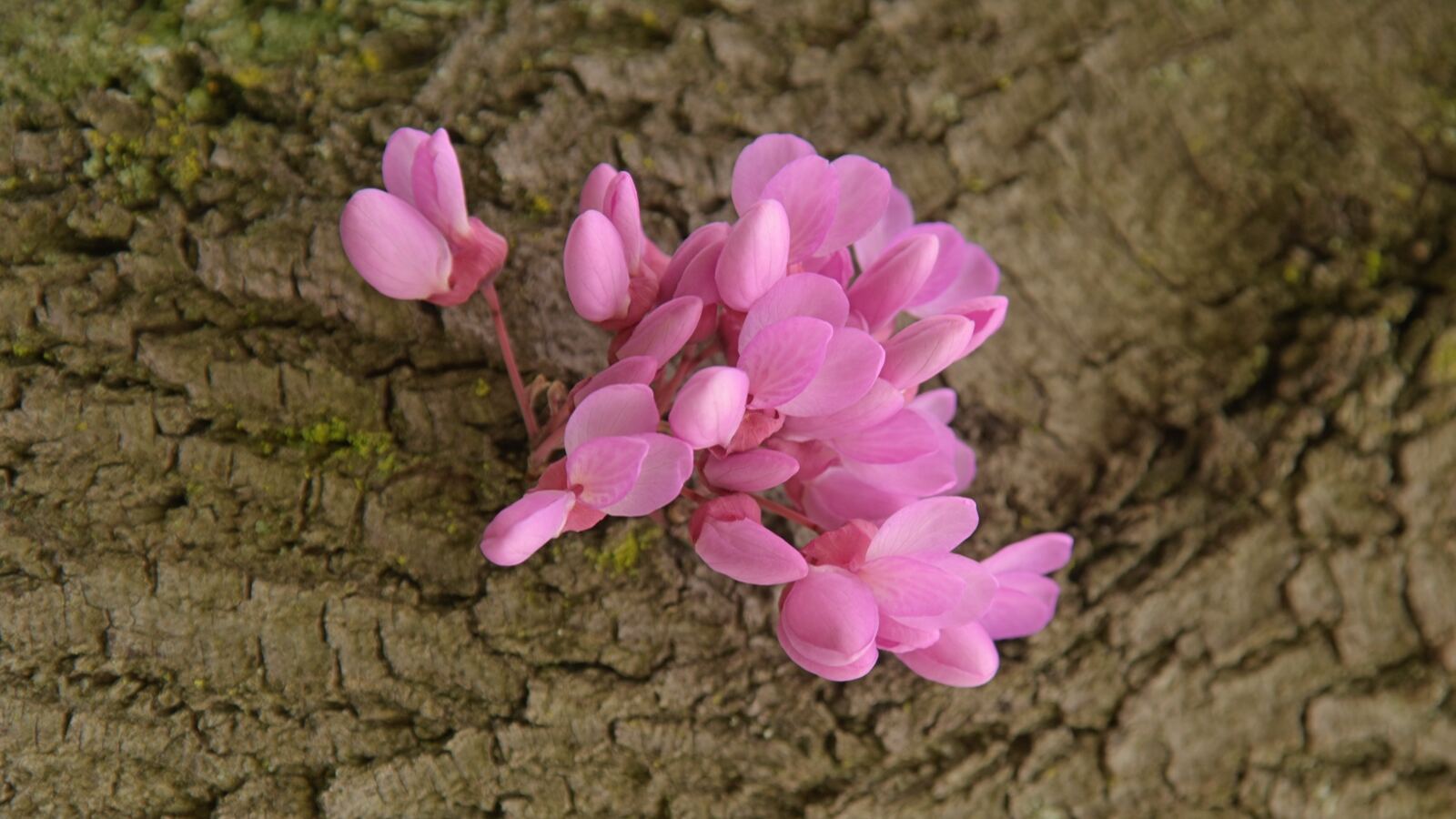
Redbud, Cercis canadensis. A legume, flowering in dense magenta-pink clusters directly on bare wood in early spring, before the leaves.
Sassafras, Sassafras albidum. In the laurel family, with intensely aromatic bark and roots and — its signature — three different leaf shapes on the same plant.
Redbud flowers out of its trunk
Redbud is cauliflorous: flowers emerge directly from old wood, including the main trunk and the largest branches, not just from young twigs.
Cauliflory is common in the tropics — cacao and jackfruit both do it — and rare in temperate trees, which makes redbud a conspicuous exception. The usual explanation in the tropics is access for large pollinators or support for heavy fruit; in redbud it produces a display of flowers running the length of every branch and up the trunk.
The flowers are pea-shaped, since it is a legume, and they appear before the leaves, which is what makes a redbud in early spring so conspicuous against bare woodland.
They are also edible — mildly sweet and slightly acid, good in salads — as are the young seed pods.
A legume that mostly does not fix
Redbud is in the Fabaceae, so the reasonable expectation is nitrogen fixation.
In fact Cercis is one of the genera in the family that does not form rhizobial nodules. It belongs to the Caesalpinioideae, a subfamily in which nodulation is patchy and frequently absent, unlike the near-universal nodulation in the pea subfamily.
So a redbud does not enrich soil the way black locust or alder does, and it should not be planted expecting it to. It is a useful correction to the assumption that legume equals nitrogen fixer. See nitrogen fixers and nitrogen-fixing bacteria.
The flowers are, however, a significant very early nectar source for bumblebees and early solitary bees. See native bees.
Sassafras and its three leaves
Sassafras produces three distinct leaf shapes, often on the same branch:
Entire — a simple oval. Two-lobed — the mitten, with a thumb. Three-lobed — a trident.
Why a plant would do this is not settled. Suggestions include herbivore confusion, optimising light capture at different canopy positions, and simple developmental variability. Whatever the reason, it is one of the easiest identification features in the eastern forest and a good thing to hand to anyone learning trees.
The whole plant is aromatic — crush a leaf or scratch a twig and it smells of root beer and citrus.
Safrole
Sassafras root bark was the original flavouring of root beer, and sassafras tea was a widely used folk medicine and a significant colonial export from North America to Europe in the seventeenth century.
Its principal aromatic compound, safrole, was banned as a food additive by the US FDA in 1960 after it was shown to be carcinogenic and hepatotoxic in rodent studies.
Commercial root beer has used artificial flavouring or safrole-free sassafras extract since. Sassafras tea made from the root is still consumed traditionally, and the honest position is that occasional use is a different exposure from the doses used in the animal studies — but it is not a herb to drink daily, and pregnant women are advised to avoid it entirely.
Safrole is also a precursor in illicit drug manufacture, which places further restrictions on sassafras oil in many jurisdictions.
Filé powder, made from dried ground sassafras leaves, is a different matter — the leaves contain little to no safrole, and filé remains a standard thickener and seasoning in Louisiana Creole cooking, particularly gumbo.
Wildlife
Sassafras is a larval host for the spicebush swallowtail and the promethea moth, and its blue fruit on bright red stalks is taken readily by thrushes, catbirds, and woodpeckers. Deer browse it heavily. See caterpillars and seed-dispersing birds.
Redbud is a host for Henry's elfin butterfly, and its seeds are eaten by birds and small mammals. Both are important early-season nectar sources.
Both are thicket-forming, spreading by root suckers, which makes them useful for edge and screen planting and a nuisance in a tidy border.
Sassafras is also strongly associated with laurel wilt, a lethal disease vectored by the introduced redbay ambrosia beetle, which has killed large numbers of redbay and is spreading into sassafras across the southeastern United States. See tree diseases.
Growing them
Redbud. Tolerant of a wide range of soils including alkaline, wants sun to part shade, and dislikes waterlogging. Small — 6 to 9 m. Taprooted when young and best planted small. Hardy to about minus 25 C, though provenance matters considerably: southern seed sources are not hardy in northern gardens. See climate adaptation.
Susceptible to canker and verticillium wilt.
Sassafras. Prefers moist, well-drained, acid to neutral soil, and dislikes chalk. Sun to part shade, 9 to 18 m. Transplants very badly because of a deep taproot and brittle fleshy roots — plant small container stock or direct-seed, as with hickory and pawpaw. Suckers freely.
Both give good autumn colour — sassafras among the best in the eastern forest, turning orange, scarlet, and purple, often several colours on one tree.
Both are good sub-canopy components in a mixed planting, and redbud in particular is one of the more useful small ornamental trees for early nectar. See structural diversity and food forest design.
See also
- Nitrogen Fixers and why redbud is not one
- Cacao and Coffee the tropical cauliflory comparison
- Native Bees very early nectar
- Hickory and Pecan the taproot transplanting problem
- Serviceberry the other small early-flowering native
- Tree Diseases laurel wilt in sassafras
- Tamarind and Carob
- Katsura
- Silverbell and Snowbell
- Bauhinia
- Judas Tree