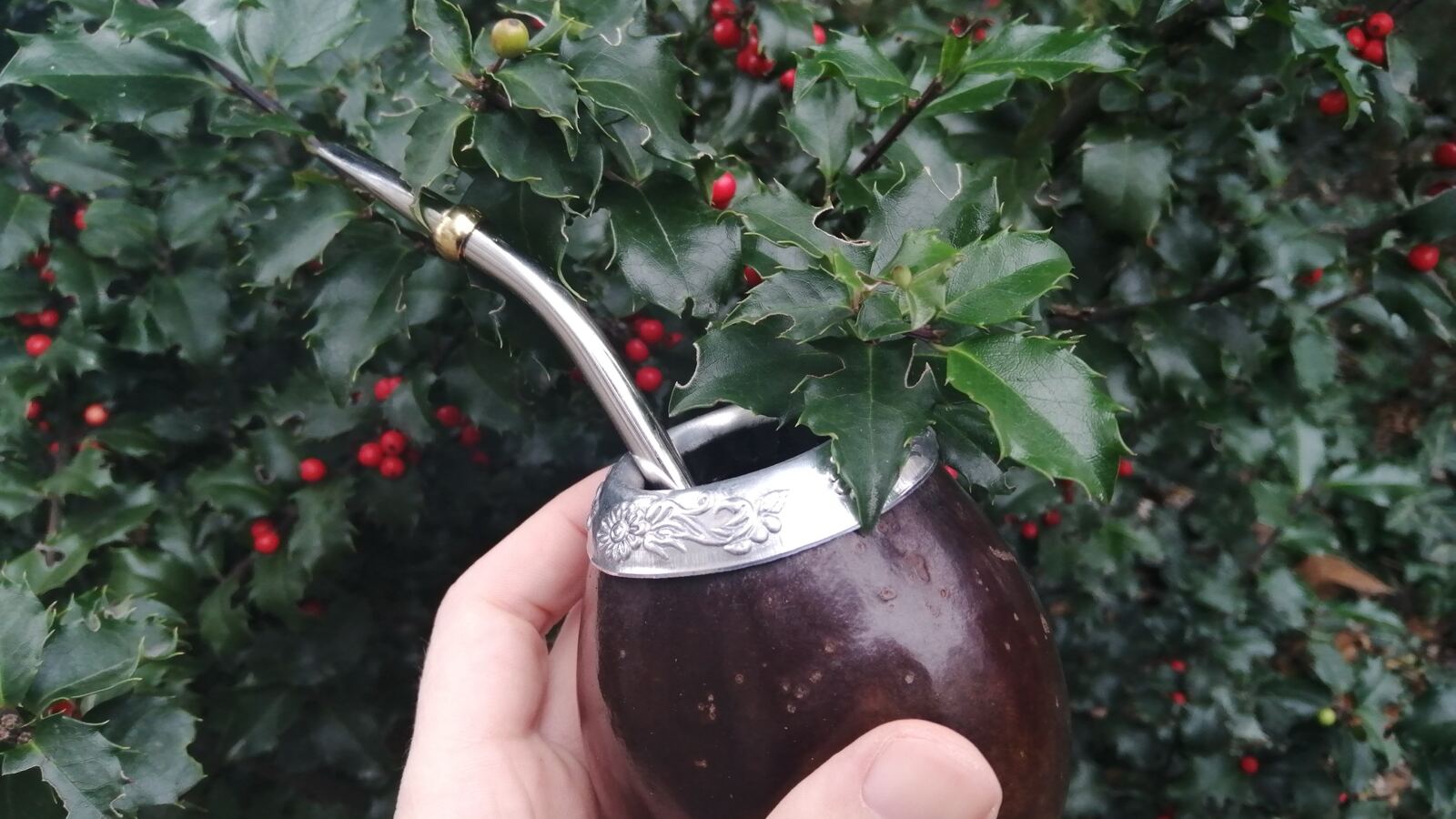
What it is
Ilex paraguariensis, yerba maté, an evergreen tree of the subtropical forests of southern Brazil, Paraguay, Argentina, and Uruguay, whose dried leaves make maté — the caffeinated drink that is, more than any other, the social ritual of southern South America.
Remarkably, yerba maté is a holly — a member of the genus Ilex, the same genus as the spiny-leaved, red-berried Christmas holly of the northern hemisphere. It is one of the few hollies with a major economic use, and the leaves, dried and aged, carry caffeine (and the related theobromine of cacao), which is why the drink stimulates like coffee, tea, and kola.
The drink and the ritual
Maté is prepared and drunk in a way that is as much about the social ritual as the caffeine, and the traditional method is unmistakable:
- the dried, crushed leaves (yerba) are packed into a hollow gourd (also called a mate);
- hot — not boiling — water is poured over them;
- and the infusion is sipped through a bombilla, a metal straw with a filter at the bottom that strains out the leaf.
The same gourd is refilled with water again and again through a session, and — crucially — it is passed from person to person, each drinking the gourd dry in turn before it is refilled and handed on. This sharing of a single gourd and straw around a circle is the heart of maté: it is a gesture of friendship, welcome, and belonging, woven into daily life across Argentina, Uruguay, Paraguay, and southern Brazil, where people carry a thermos of hot water and a gourd everywhere. To be offered maté is to be included; to share the gourd is to share community. It is one of the clearest examples in this encyclopedia of a tree's product being inseparable from a social ritual — like the kola nut's ceremonies of welcome in West Africa.
Maté has a grassy, bittersweet, vegetal flavour, drunk plain (amargo) or sweetened, hot or — as tereré, in Paraguay's heat — ice-cold. It is prized as a lift that is smoother and longer than coffee, and it carries genuine nutrients and antioxidants (alongside the ordinary cautions about very hot drinks and heavy consumption).
From wild forest to plantation
Maté was first used by the Guaraní people, and its cultivation has a distinctive history. The Jesuit missions of colonial Paraguay learned — after long effort — how to germinate the difficult seed and established the first maté plantations, so that "Jesuit tea" became a major colonial trade; the secret of growing it was closely held, echoing the monopolies around cinnamon and quinine.
Today maté is grown both in sun plantations and, increasingly, under shade in a more forest-like, agroforestry system that better suits this naturally understorey tree, supports more wildlife, and is promoted as more sustainable — a maté version of the shade-grown-versus-sun debate familiar from coffee. See pollinator habitat.
Growing it
Subtropical and marginally frost-hardy: yerba maté wants a warm, humid, subtropical climate with ample rainfall, and deep, moist, well-drained, acidic soil; it tolerates some cold but not hard frost or drought, and it grows naturally as an understorey tree, so it appreciates some shade, especially when young.
It is a slow-growing evergreen tree (kept pruned to a harvestable shrub in cultivation), and the leaves are harvested, then dried and often aged for months to develop the flavour. The seed is notoriously slow and erratic to germinate — the historical obstacle to its cultivation — needing careful treatment, and the plant is also grown from cuttings. For the right climate it makes an attractive, useful, evergreen crop tree and a living link to one of the world's great drinking traditions. See propagation.
See also
- Holly the northern-hemisphere relatives of yerba maté
- Cacao and Coffee the other great caffeine and stimulant trees
- Kola Nut another stimulant tree bound to a social ritual
- Tea the other great leaf-infusion beverage
- Quinine Tree another crop the Jesuits helped spread
- Pollinator Habitat shade-grown maté and wildlife
- Yaupon and Guayusa