What it is
Illicium verum, the star anise — a small-to-medium evergreen tree of southern China and northern Vietnam, grown for its distinctive star-shaped fruit, one of the essential spices of Chinese and Southeast Asian cooking.
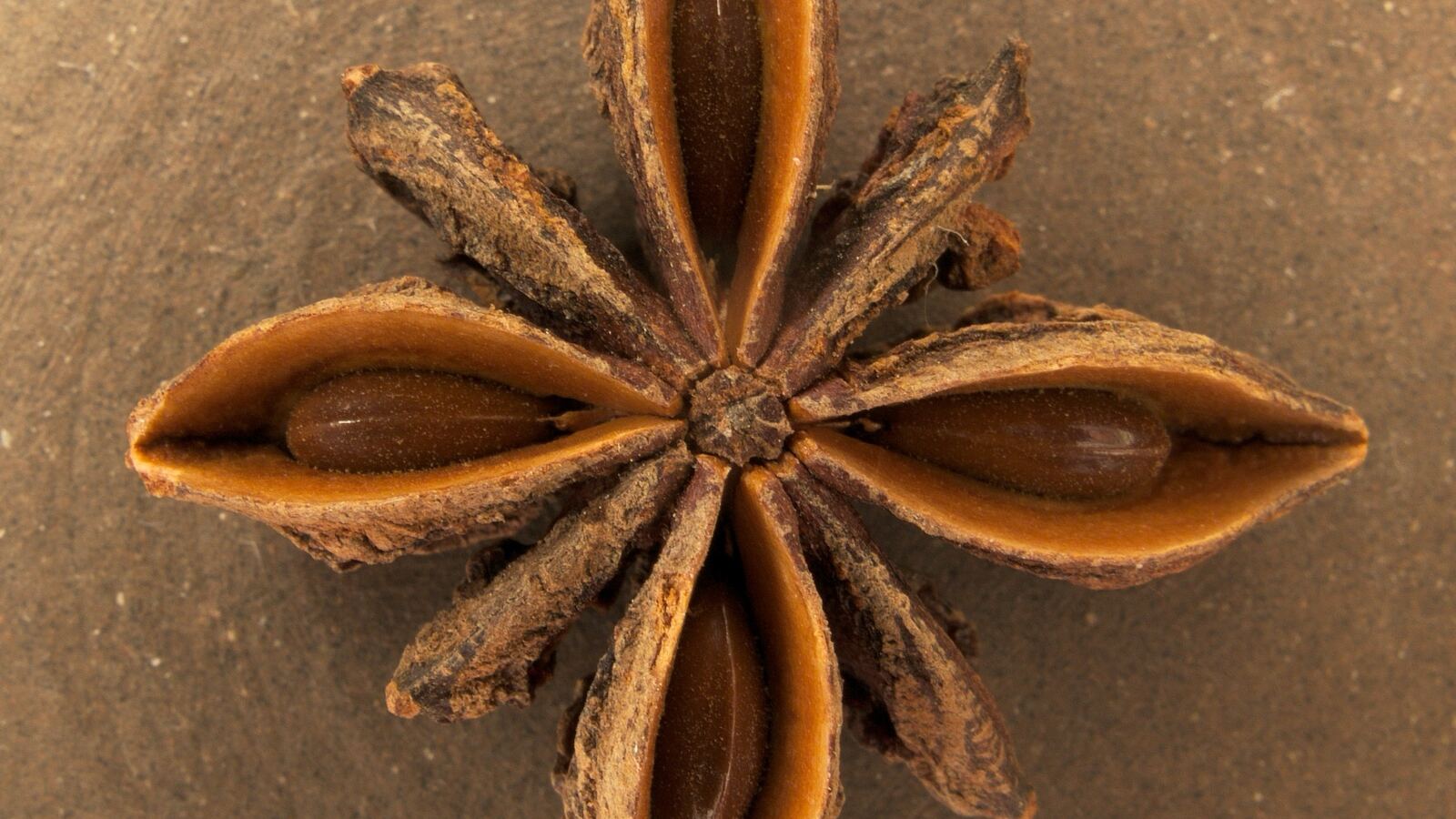
It is a member of a very ancient lineage of flowering plants (the star-anise family is one of the most primitive branches of the flowering plants, close to the base of the whole group, near the magnolias). The tree bears its spice as a hard, brown, woody eight-pointed star, each point a boat-shaped pod holding a single shiny seed — one of the most beautiful and recognisable of all spices.
The spice
Star anise has a warm, sweet, powerful liquorice-and-anise flavour (it shares the compound anethole with true anise and fennel, though the plants are unrelated), and it is a cornerstone of the cuisines of China and Southeast Asia. It is one of the spices of Chinese five-spice powder, it flavours the great slow-simmered master stocks and braises (red-cooked pork, pho broth, tea eggs), and it perfumes both savoury dishes and sweets. A single star, or a point or two, deeply scents a whole pot. It is used across Indian and Middle Eastern cooking too, and in mulled drinks, baking, and liqueurs. As a spice tree it stands with cinnamon and clove and nutmeg among the great warm aromatics.
The Tamiflu connection
Star anise has a claim to fame far beyond the spice rack: for years it was the world's principal source of the raw material for a major antiviral drug.
The star anise fruit is rich in shikimic acid, and shikimic acid was the key starting material in the manufacture of oseltamivir — the influenza drug Tamiflu. When fears of a flu pandemic (bird flu, and later swine flu) drove governments to stockpile Tamiflu, demand for shikimic acid — and therefore for star anise — surged dramatically, and for a time a large share of the world's star anise harvest was diverted to drug production, causing spice shortages and price spikes. It is one of the most striking modern examples of a humble kitchen spice becoming a strategic pharmaceutical raw material (manufacturers have since developed other routes to shikimic acid, easing the dependence). It sits alongside the quinine tree and the willow among the trees that quietly underpin modern medicine. See tree diseases for the wider theme of plants and human health.
A dangerous look-alike
One serious warning attaches to star anise. Its close relative, Japanese star anise (Illicium anisatum), looks very similar but is highly toxic — it contains potent neurotoxins (anisatin) that cause seizures and serious illness, and it must never be consumed.
Because the two are hard to tell apart once dried and are sometimes adulterated or confused in trade, there have been real cases of poisoning — notably in infants given "star anise tea" for colic — traced to contamination of culinary star anise with the toxic Japanese species. The lesson is to buy culinary star anise (I. verum) from a reputable source, and to treat any star anise of uncertain origin with caution. It is a clear example of two nearly-identical plants, one a beloved spice and one a poison — the same trap seen in the sumacs and elsewhere.
Growing it
Subtropical to warm-temperate, and a tree of humid, mild, frost-free-to-lightly-frosted mountain climates, star anise wants warmth, high humidity, ample moisture, partial shade when young, and rich, moist, well-drained, acidic soil; it dislikes drought, hard frost, and dry heat. It is slow-growing, evergreen, and long-lived, with attractive glossy foliage and yellow flowers.
It is grown from seed and cuttings, and comes into bearing after some years, cropping its stars for decades. Where the climate is mild and moist enough, it makes a handsome, aromatic evergreen tree and a source of home-grown spice; elsewhere it is a plant for a large pot or a sheltered warm garden. See propagation and tropical fruit trees for the wider warm-climate tree context.
See also
- Cinnamon and Camphor and Clove, Nutmeg, and Allspice other great spice trees
- Magnolias the ancient lineage star anise sits near
- Quinine Tree and Willow other trees that underpin medicine
- Sumac and Smoke Tree another edible plant with a poisonous look-alike
- Sichuan Pepper another distinctive Chinese spice from a tree
- Tree Diseases trees, drugs, and human health
- Champak
- Mountain Pepper