The numbers
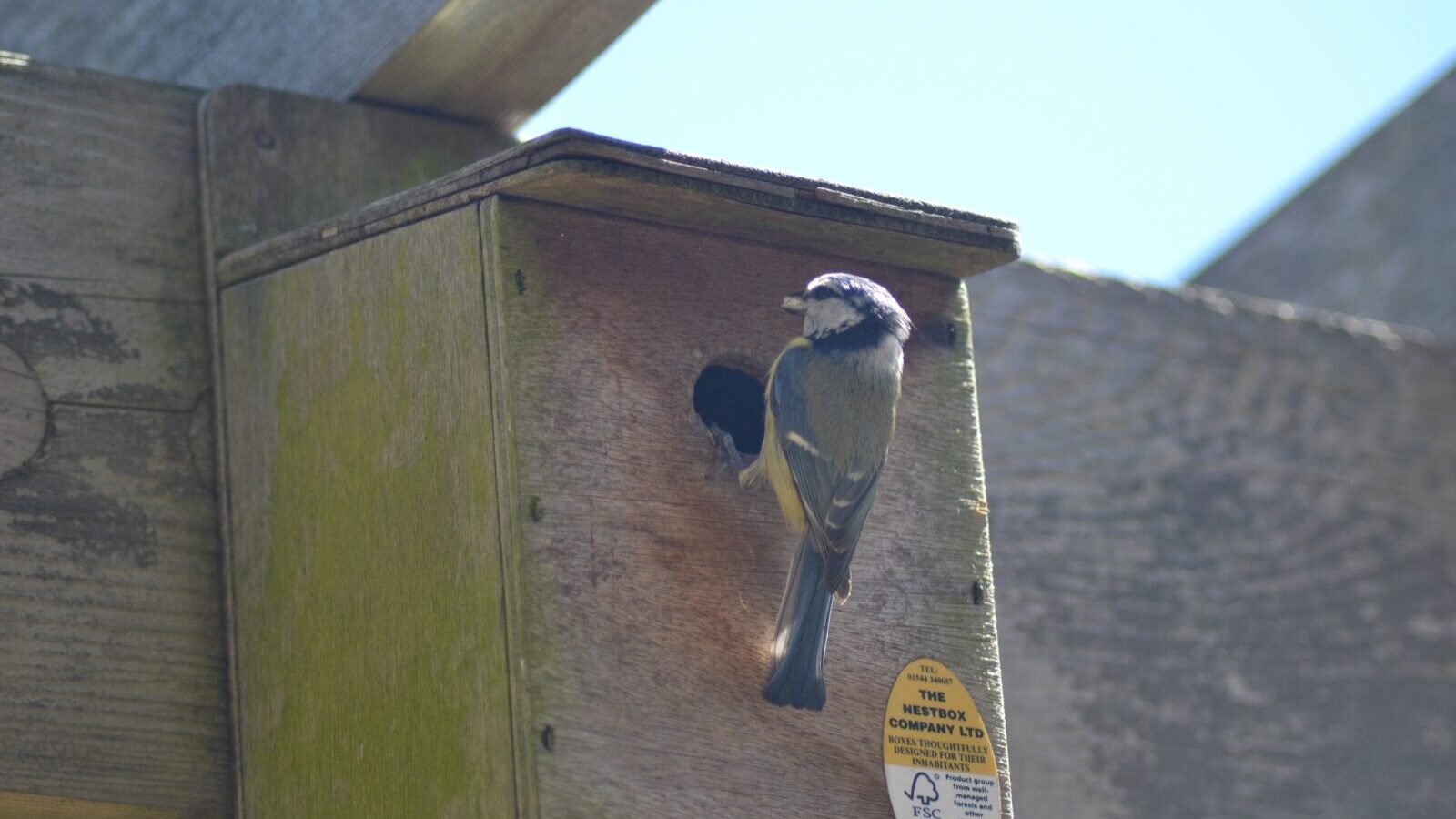
A single brood of blue tits is fed on the order of 10,000 caterpillars over the two to three weeks in the nest. A pair raising eight or ten young works continuously through daylight, and the food is almost entirely soft-bodied larvae.
Multiply that across a few boxes in an orchard and the effect is not marginal. Controlled studies in apple orchards have repeatedly found that excluding birds with netting increases caterpillar damage substantially, and that adding nest boxes reduces it, with measurable improvements in fruit quality.
Birds are the most effective biological control most growers already have and mostly do not manage deliberately.
Timing is why it works
The reason birds hit pests so hard is that their breeding is synchronised with the pest peak.
Tits time their laying so that the chicks' peak demand coincides with the caterpillar flush on trees in late spring. That flush is precisely the caterpillar population that would otherwise strip foliage and damage fruit.
That synchrony is currently being disrupted. Warmer springs advance leaf burst and caterpillar emergence faster than birds have adjusted their laying dates, and the mismatch reduces breeding success. It is one of the clearest documented consequences of warming in temperate ecosystems, and it makes bird populations less effective as controls in exactly the seasons when pest pressure is rising. See climate adaptation.
Who does what
Different birds work different parts of the system, which is why structure matters more than any single species.
Tits, warblers, and chiffchaffs work the canopy and foliage for caterpillars, aphids, and small larvae.
Treecreepers, nuthatches, and woodpeckers work bark crevices, taking overwintering eggs, pupae, and boring larvae. Woodpeckers take codling moth larvae from under bark through the winter.
Flycatchers and swallows take flying adults, intercepting moths and flies before they lay.
Wrens and dunnocks work the low dense layer close to the ground.
Thrushes and blackbirds work the ground and leaf litter for slugs and snails, leatherjackets, and soil larvae.
Owls and kestrels take voles and gophers, which matters for young trees, since voles ring-bark them under winter cover.
The point is that no single species covers the whole system, and habitat that supports only canopy feeders leaves the ground and bark unattended. See structural diversity.
Nest boxes
The cheapest intervention available, and the one that produces the most measurable result.
Hole size decides the tenant. 25 mm admits blue tits and excludes larger competitors. 28 mm suits great tits. 32 mm suits sparrows and nuthatches. Open-fronted boxes suit robins, wrens, and flycatchers and want to be tucked into vegetation.
Height and aspect. 2 to 4 m up, facing between north and east to avoid direct afternoon sun and driving rain.
No perch. A perch below the hole helps predators, not the occupants.
Density. Roughly one box per tree is too many; tits are territorial. Something like 5 to 10 boxes per hectare in an orchard is realistic, spaced 15 to 20 m apart.
Predator protection. A metal plate around the hole stops squirrels and woodpeckers enlarging it, and a deep box keeps chicks out of reach.
Clean them annually in autumn, once nesting is over and where local law permits, to remove parasites.
Also provide roosting sites, since winter survival determines how many birds are present to breed. Dense evergreen cover, hedges, and boxes all serve.
Habitat is what keeps them there
Boxes provide nest sites. They do not provide food, cover, or water, and a box in a bare orchard will not be occupied for long.
Year-round food. Insects in summer, berries and seed in autumn and winter. This is where wildlife shrubs, elderberry, hawthorn, and rowan earn their place. Birds present through winter are birds available in spring.
Cover at every height. Ground layer, shrub layer, canopy. A mown orchard with nothing beneath the trees supports a fraction of the birds of one with rough grass, a hedge, and a scrub corner. See hedgerow care and rewilding edges.
Water, particularly in dry summers.
Perches near the crop. Birds hunt from perches. Posts, isolated shrubs, and hedge tops next to a vegetable plot put predators where you want them.
Untidiness. Leaf litter, deadwood, seedheads left standing, and nettle patches all feed the invertebrates that feed the birds. Removing all of it removes the food chain and then the control. See rock and log piles and dead wood habitat.
No broad-spectrum insecticides. Removing the prey removes the predator, and the pest, which reproduces faster, recovers first. This is the core argument in predator-prey balance and integrated pest management.
The obvious complication
Birds also eat fruit. Cherries, currants, and soft fruit are taken comprehensively, and seed-dispersing birds will strip a crop.
The practical resolution is targeted rather than general: net the specific crops that need it during the specific weeks they are vulnerable, and let birds work everywhere else all year.
Netting a cherry tree for three weeks costs you nothing in pest control. Removing bird habitat from the whole holding to protect one crop costs you the control on everything.
Use netting with a mesh small enough that birds cannot become entangled, and keep it taut, since loose netting kills birds and hedgehogs.
See also
- Predator-Prey Balance the principle underneath
- Caterpillars the main prey in spring
- Wildlife Shrubs winter food that keeps birds present
- Integrated Pest Management fitting birds into a strategy
- Seed-Dispersing Birds the same birds doing another job
- Rock and Log Piles habitat for the whole food chain
- Butterflies and Moths
- Birds of Prey
- Fruit Tree Pests