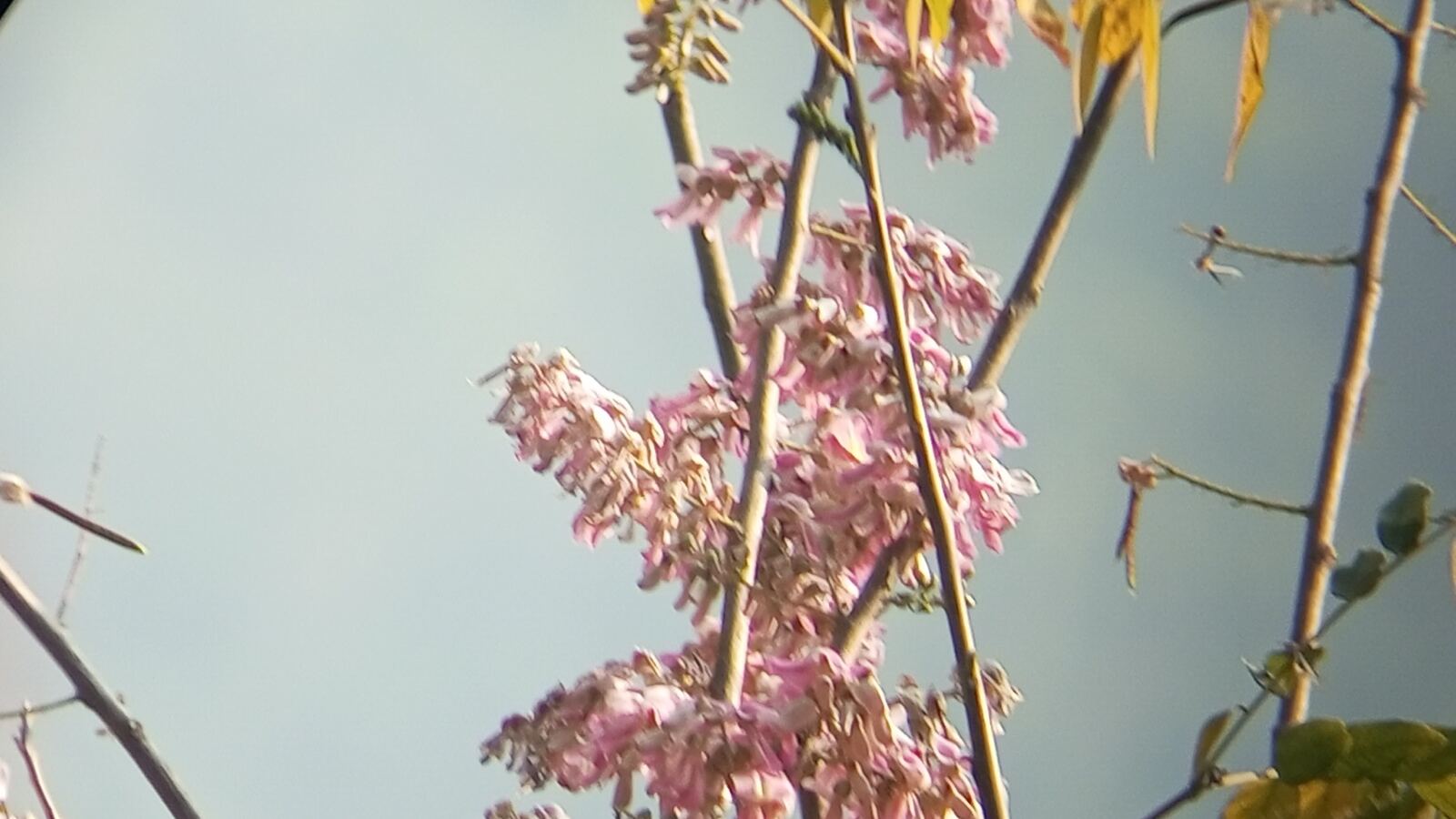
The workhorse fertiliser trees
Tropical agroforestry runs on a handful of fast-growing, nitrogen-fixing, cut-and-come-again trees, and these two are the most important. They are the trees that make alley cropping, tropical chop and drop, and smallholder soil fertility work without bought fertiliser.
Leucaena, Leucaena leucocephala, from Central America, and once promoted so enthusiastically it was called a miracle tree.
Gliricidia, Gliricidia sepium, also from Central America, and the more widely useful of the two.
Both are legumes, both fix nitrogen through rhizobial nodules — see nitrogen-fixing bacteria and nitrogen fixers — and both are grown to be cut, repeatedly, for the biomass and the nitrogen in their leaves.
How the cutting system works
The principle is the same across tropical fertility agroforestry, and it is worth stating because it is the whole point of these trees.
You grow the tree fast, then cut it back hard, several times a year, and spread the leafy prunings on the ground or dig them in. The tree resprouts from the stump and does it again.
Each cutting:
Delivers nitrogen-rich biomass to the crop as a green manure, releasing nutrients as it decomposes.
Triggers root dieback, so the tree sheds fine roots and root nodules underground, adding nitrogen and organic matter directly into the soil — the same hormonal response exploited in coppice rotation and syntropic agriculture.
Provides fodder, since the leaves are high in protein.
Removes the shade, letting light back to the crop between cuts.
In alley cropping, rows of these trees alternate with rows of crop, and the trees are cut back level with the crop several times a season. On tropical smallholdings they are grown as hedges, boundary plantings, and scattered trees, cut for the same purposes. The yield gains on poor tropical soils can be large and are achieved with no purchased input. See alley cropping.
Leucaena: the cautionary tale
Leucaena was promoted from the 1970s as a miracle tree — extremely fast, high-yielding, nitrogen-fixing, good fodder and fuel — and planted enthusiastically across the tropics.
Two problems emerged, and they are instructive.
Mimosine. Leucaena foliage contains mimosine, a toxic amino acid, and its breakdown product. Fed in quantity to livestock, it causes hair and wool loss, thyroid damage, poor growth, and reproductive failure. Ruminants in some regions carry a gut bacterium, Synergistes jonesii, that detoxifies it, and inoculating animals with it — even by transferring rumen fluid between animals — allows safe feeding. Where that bacterium is absent, leucaena fodder must be limited or the bacterium introduced. It is a genuinely strange piece of applied microbiology.
Invasiveness. The same vigour that made leucaena attractive made it one of the world's worst woody invaders. It seeds prolifically, establishes densely, and has formed impenetrable thickets across the tropics — it is on the list of the hundred worst invasive species. See invasive species.
The lesson is the recurring one in black locust, sea buckthorn, and eucalyptus: a fast, tough, useful tree is exactly the profile that becomes invasive, and "miracle tree" enthusiasm has a way of aging badly. Sterile and low-mimosine cultivars exist and are the responsible choice where leucaena is used at all.
Gliricidia: the versatile one
Gliricidia has fewer downsides and has become the more trusted tree of the two.
It fixes nitrogen, coppices vigorously, grows fast, and its foliage is good fodder — and crucially it has no mimosine problem, so it feeds livestock freely.
Its versatility is unusual:
Living fence posts. Gliricidia roots so readily from large cuttings — truncheons — pushed into the ground that it is planted directly as living fence posts, which then sprout and can be cut for fodder and mulch. Whole field boundaries across Central America and the tropics are living gliricidia fences. The name madre de cacao, mother of cacao, comes from its long use as a shade tree over cacao.
Shade and support. It shades cacao and coffee, supports climbing crops like vanilla and pepper, and nurses young timber trees.
Rat poison. Gliricidia means literally "mouse killer" — the bark and seeds, ground with cooked grain, are a traditional rodenticide, and the foliage is used as an insect repellent.
Green manure and biomass, the core use above.
Gliricidia is a genuine keystone of tropical smallholder agroforestry, doing for the wet tropics roughly what alder does for temperate riparian systems — fast nitrogen-fixing pioneer that improves the ground for everything around it.
The temperate parallel
A temperate reader without a tropical climate cannot grow these, but the principle transfers directly, and it is the reason they are worth knowing.
The cut-and-drop nitrogen-fixing tree is the tropical version of the temperate techniques already covered: alder and sea buckthorn as Frankia-fixing pioneers, clover and vetch cover crops, comfrey as a chop-and-drop biomass plant, and the coppice-for-mulch logic of coppice rotation.
The design idea — grow fertility on site with a fast woody legume you cut repeatedly, rather than buying it in a bag — is the same in a Sahelian alley crop and a temperate food forest. See nitrogen fixers and syntropic agriculture.
Growing them
Strictly frost-free tropical and warm-subtropical trees — both are killed by frost and want heat, and neither is a temperate crop.
Where the climate allows they are easy to the point of aggressive: fast, tolerant of poor and acid soils, drought-hardy once established, and propagated trivially — gliricidia from large cuttings, leucaena from its abundant seed.
Cut on a cycle of several times a year for biomass and fodder, and manage leucaena's seeding to prevent escape.
See also
- Alley Cropping the system these trees were made for
- Nitrogen Fixers the wider group of fixing trees
- Cacao and Coffee the crops gliricidia shades
- Chop and Drop the temperate garden version
- Invasive Species leucaena as a woody invader
- Nitrogen-Fixing Food Trees the fixing trees grown for food
- Tree of Heaven
- Silk Tree
- Coral Tree
- Inga
- Jatropha
- Ocotillo and Boojum
- Rain Tree
- Tagasaste
- Mombin and Ambarella
- Sesbania