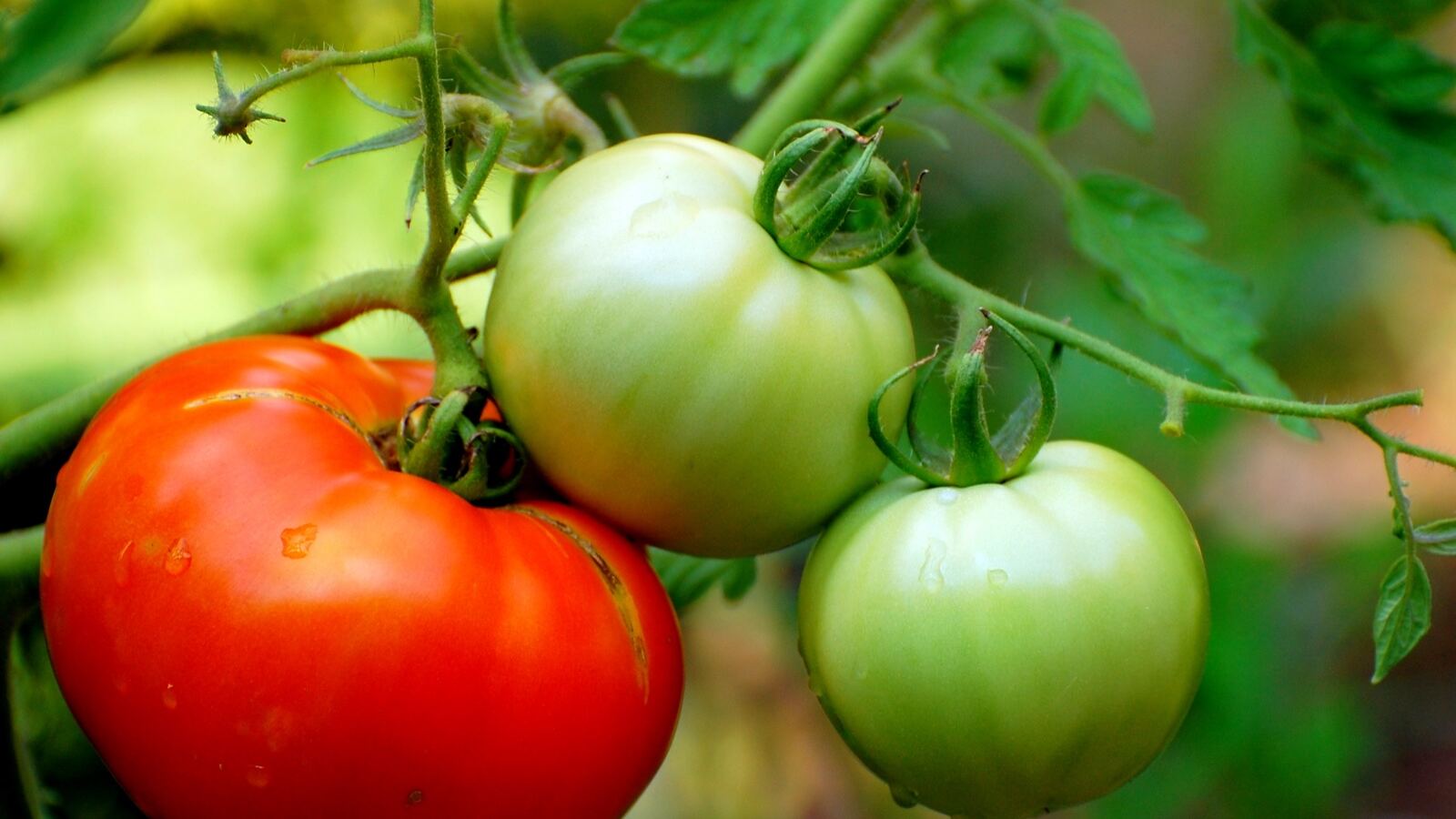
What it is
Solanum lycopersicum, a short-lived perennial from western South America grown everywhere as an annual. Same family as potatoes, peppers, and aubergine, which matters more than it sounds: they share diseases, so they share a slot in the rotation.
Domesticated in Mesoamerica, carried to Europe in the sixteenth century, and treated as ornamental and faintly suspect for two hundred years because the family includes deadly nightshade.
The one decision that shapes everything
Before anything else, find out whether your variety is determinate or indeterminate. It changes the spacing, the support, the pruning, and the harvest pattern.
Indeterminate, or cordon. Keeps growing from the tip indefinitely, flowering as it goes. Grown as a single stem up a string or cane, side shoots pinched out, stopped by the grower when it reaches the roof or the season runs out. Fruit ripens in sequence over months. Most greenhouse and heirloom varieties.
Determinate, or bush. Grows to a genetically fixed size, sets a terminal flower cluster, and stops. Fruit ripens in a short concentrated flush. Never pinch out the side shoots — those shoots carry the crop, and removing them removes the harvest. Suits containers, outdoor growing, and anyone who wants a glut for bottling.
Semi-determinate sits between the two.
Getting this backwards is the commonest tomato mistake: a bush variety stripped of its side shoots yields almost nothing.
Starting them
Sow indoors 6 to 8 weeks before the last frost. Earlier than that and you get leggy plants that sulk after transplanting.
Germination wants 20 to 25 C. A heat mat matters more than a windowsill.
Prick out at the first true leaves, handling by the seed leaves and never the stem, which bruises and rots.
Bury them deep. Tomatoes form adventitious roots along buried stem, so a leggy seedling planted up to its lowest leaves converts the whole buried length into root system. It is the one crop where deep planting is right, and the opposite of the rule in tree planting.
Harden off over 7 to 10 days before planting out. See frost protection — tomatoes have no frost tolerance at all.
Site, spacing, support
Full sun, shelter, and the warmest spot you have. Fruit set falls off below about 13 C at night and above about 30 C in the day, when pollen becomes unviable.
Rich, well-drained soil with plenty of organic matter. Cordons at 45 to 60 cm apart, bush types at 45 to 90 cm depending on vigour.
Support cordons before they need it. A string from an overhead wire, twisted around the stem as it grows, is the greenhouse standard and beats canes.
They grow well in containers given at least 20 to 40 litres per plant, and very well in wicking beds, which supply the steady moisture the next section is about.
Water evenly, and the rot goes away
Blossom end rot — a sunken leathery black patch at the base of the fruit — is the most misdiagnosed problem in growing.
It is a calcium deficiency in the fruit, but almost never because the soil lacks calcium. Calcium travels in the transpiration stream, and fruit transpires very little, so it gets whatever the water flow delivers. Irregular watering interrupts that flow and the fastest-growing tissue at the fruit tip fails.
The fix is consistent moisture, not calcium. Adding lime or eggshells to soil that already has plenty achieves nothing. Mulch, water deeply and regularly, and never let a plant wilt and then flood it. See nutrient deficiency and watering timing.
Erratic watering also causes splitting, when a dry plant suddenly takes up water and the fruit skin cannot keep pace.
Feeding
Tomatoes are hungry, and the requirement changes through the season.
Nitrogen while they build leaf, then a shift to high potassium once the first truss sets. Too much nitrogen later gives you an enormous dark green plant with little fruit.
Comfrey liquid feed is close to ideal for the fruiting phase, being naturally high in potassium. See chop and drop and compost tea.
Blight, and the clock you are racing
Late blight, Phytophthora infestans, is the same organism that took the potato crop in the Irish famine, and outdoors in a wet temperate summer it will find your tomatoes.
It needs warm humid conditions — the classic trigger is two consecutive days above 10 C with high humidity. Brown patches spread on leaves and stems, fruit develops firm brown marbling, and a plant can collapse in under a week.
There is no cure once infected. The strategy is avoidance:
Grow under cover. Blight spores need leaf wetness. A greenhouse or polytunnel with good ventilation is the single most effective protection.
Choose resistant varieties if growing outdoors in a wet climate. Modern blight-resistant varieties have made outdoor tomatoes viable again in places where they had become hopeless.
Space and ventilate. Remove lower leaves for airflow, water the soil rather than the foliage, and never water in the evening.
Rotate away from where potatoes or tomatoes grew. See crop rotation.
Destroy infected material. Do not compost it in a cold heap.
Other troubles: greenback and uneven ripening from heat and potassium shortage, whitefly in greenhouses (see whiteflies and spider mites), and aphids (see aphids). The general approach is in integrated pest management.
Harvest and keeping
Pick when fully coloured and slightly soft. Flavour develops on the plant, so anything picked hard and ripened indoors is a compromise.
Do not refrigerate. Below about 12 C the volatile compounds that make a tomato taste of anything are destroyed, and the texture goes mealy. This is irreversible.
At the end of the season, pick everything remaining and ripen it indoors alongside a banana, whose ethylene speeds the process. Green tomatoes make chutney.
For storage beyond the season the answer is processing — passata, bottling, drying, freezing whole. See harvest and storage.
Saving seed
Tomatoes are largely self-pollinating, so seed comes reasonably true from open-pollinated varieties. F1 hybrids will not.
Scoop the seed and gel into a jar with a little water and let it ferment for 2 to 4 days until a scum forms. That breaks down the germination-inhibiting gel coat and kills some seed-borne disease. Rinse, dry on a plate, and store cool and dry. Viable for 5 years or more.
See seed saving.
See also
- Potatoes the same family and the same blight
- Crop Rotation why solanaceae share a slot
- Nutrient Deficiency blossom end rot in context
- Container Growing tomatoes in pots
- Companion Planting Guide what to grow alongside
- Seed Saving the fermentation method
- Cucumbers
- Aubergine and Okra
- Tamarillo