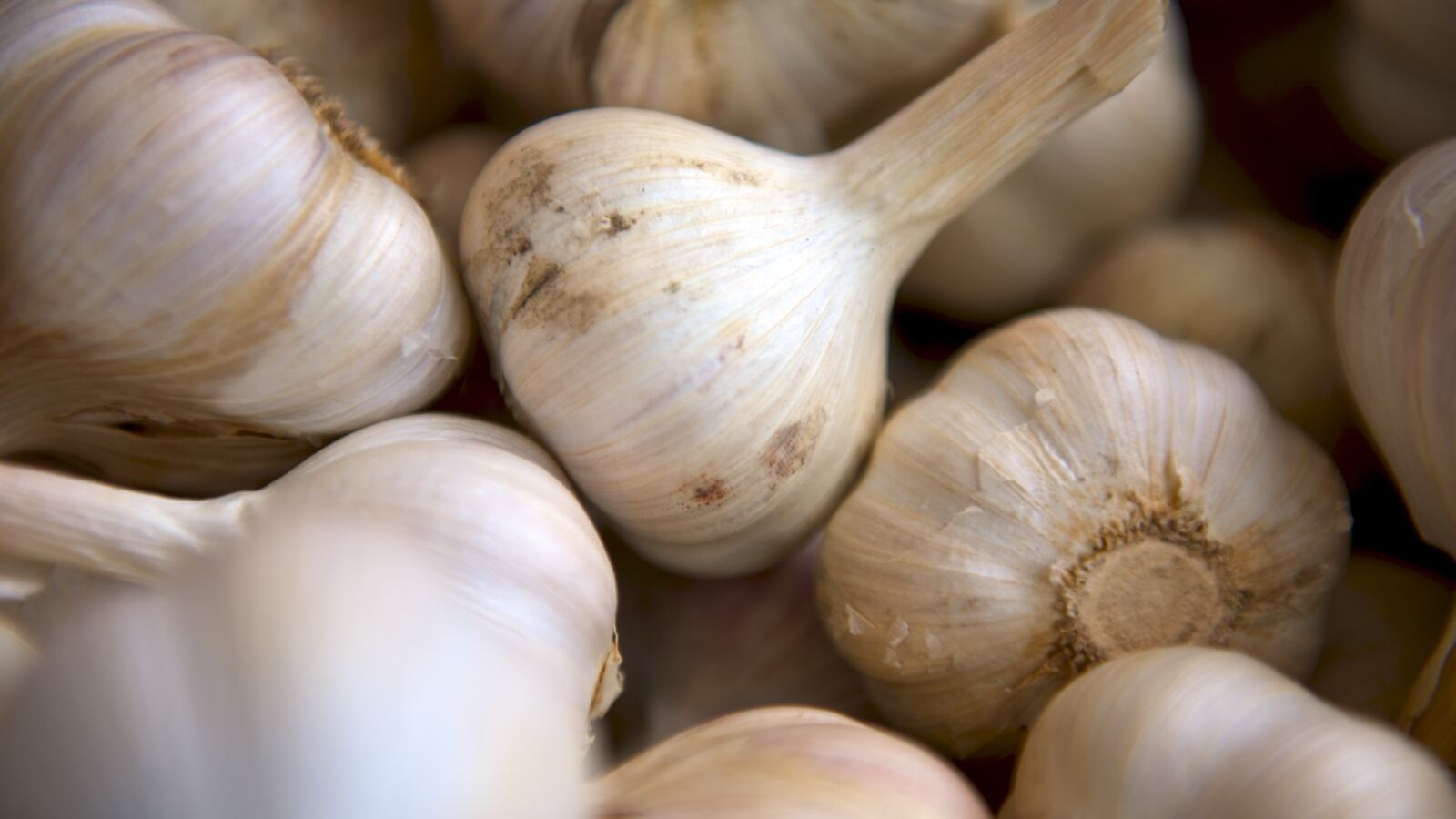
What it is
Allium sativum, from central Asia, cultivated for at least 5,000 years and used as food, medicine, and charm across almost every culture that met it.
Each clove is a complete bud that grows into a whole plant, and each plant produces a bulb of cloves. Cultivated garlic is effectively sterile and reproduces vegetatively, so every clove you plant is a clone — which means, as with banana, the genetics of a variety are fixed and you are propagating an individual rather than breeding.
Cold is the trigger, not day length
Where onions are governed by day length, garlic is governed by cold.
A clove needs a period of roughly 4 to 8 weeks below about 10 C — vernalisation — before it will split into a multi-clove bulb. Without it you get a round: a single undivided bulb like a small onion. Perfectly edible, and not what you planted for.
Which is why garlic is planted in autumn almost everywhere. It roots before winter, sits through the cold that triggers cloving, and races away in spring.
In mild-winter climates, growers refrigerate cloves for 6 to 8 weeks before spring planting to supply the cold artificially.
Autumn planting also gives the long season garlic needs. Spring-planted garlic in a cold climate produces smaller bulbs simply because it has less time.
Hardneck or softneck
Hardneck. Produces a rigid central flower stalk, the scape. Fewer, larger, more evenly sized cloves, stronger and more complex flavour, and much better cold tolerance. Keeps 4 to 6 months. Cannot be plaited.
Softneck. No scape, so the neck stays soft and plaitable. More cloves per bulb in irregular layers, milder, better adapted to mild winters, and the type sold in supermarkets. Keeps 8 to 12 months.
Elephant garlic is not garlic at all but a leek relative, A. ampeloprasum, with huge mild cloves.
Cold climates favour hardneck; mild climates and long storage favour softneck.
Planting
Use certified seed garlic, not supermarket bulbs. Imported garlic is frequently treated to suppress sprouting, may be a variety unsuited to your latitude, and can carry white rot and eelworm. This is the same logic as seed potatoes in potatoes.
Split bulbs into cloves the day you plant, not before — a split bulb dries out fast. Plant the largest cloves and eat the small ones; clove size directly determines bulb size.
Point up, 5 to 8 cm deep, 15 to 20 cm apart in rows 30 cm apart. Deeper in cold regions.
Free-draining soil above all. Garlic rots in wet winter ground. On heavy soil plant into raised ridges or beds.
Full sun, and no fresh manure.
Through the season
Garlic is a poor competitor with shallow roots, so keep it weed-free. See weed management.
Feed with nitrogen in early spring as growth accelerates, and stop by around the longest day. Late nitrogen delays maturity and hurts storage.
Water during spring bulking, then stop 2 to 3 weeks before harvest so the wrappers dry and the bulb cures cleanly.
Cut the scapes
Hardneck varieties send up a curling flower stalk in early summer.
Cut it once it makes one full curl. Removing it redirects energy into the bulb, and the yield difference is real — commonly quoted at 20 to 30 percent.
The scapes are one of the better vegetables of the year in their own right: mild garlic flavour, asparagus texture, good in stir-fries, and they make excellent pesto. They are rarely sold, which makes them a genuine reason to grow hardneck garlic.
Problems
White rot is the same catastrophe as in onions — soil-borne, with sclerotia surviving 15 to 20 years. Never move soil between plots, clean tools, and rotate hard. See crop rotation.
Rust, orange pustules on leaves, common in mild damp seasons. Rarely fatal but it cuts yield. Space for airflow.
Leek moth and allium leaf miner, both spreading in Europe. Fleece is the practical answer. See row covers and barriers.
Rot in store, almost always from incomplete curing or from bulbs lifted too late.
Garlic is otherwise remarkably trouble-free, and its sulphur compounds make it a classic companion plant — the basis of the garlic sprays discussed in organic sprays, and a component of many guilds. See companion planting guide and fruit tree guilds.
Harvest and curing
Timing is narrow and it matters. Harvest when roughly the lower third to half of the leaves have yellowed but several green ones remain.
Each green leaf corresponds to a wrapper layer around the bulb. Leave it too long and the wrappers rot away, the bulb splits open, the cloves separate, and it will not store at all. Too early and the bulb is small and immature.
Lift with a fork rather than pulling. Do not wash.
Cure for 3 to 4 weeks somewhere warm, dry, and airy, out of direct sun, with the tops left on. Hang in bunches or lay on racks. The necks should go fully dry and papery.
Then trim roots and tops, or plait softnecks, and store cool, dry, and airy — around 10 to 15 C. Not the fridge: cold storage around 4 C is exactly the vernalisation signal, and it makes garlic sprout.
Save your largest bulbs for replanting in autumn, and a variety will adapt to your ground over several years. See harvest and storage and seed saving.
See also
- Onions the same family, a different trigger
- Crop Rotation white rot and the long gap
- Harvest and Storage curing and keeping
- Companion Planting Guide garlic as a deterrent
- Row Covers and Barriers leek moth and leaf miner
- Organic Sprays garlic-based preparations