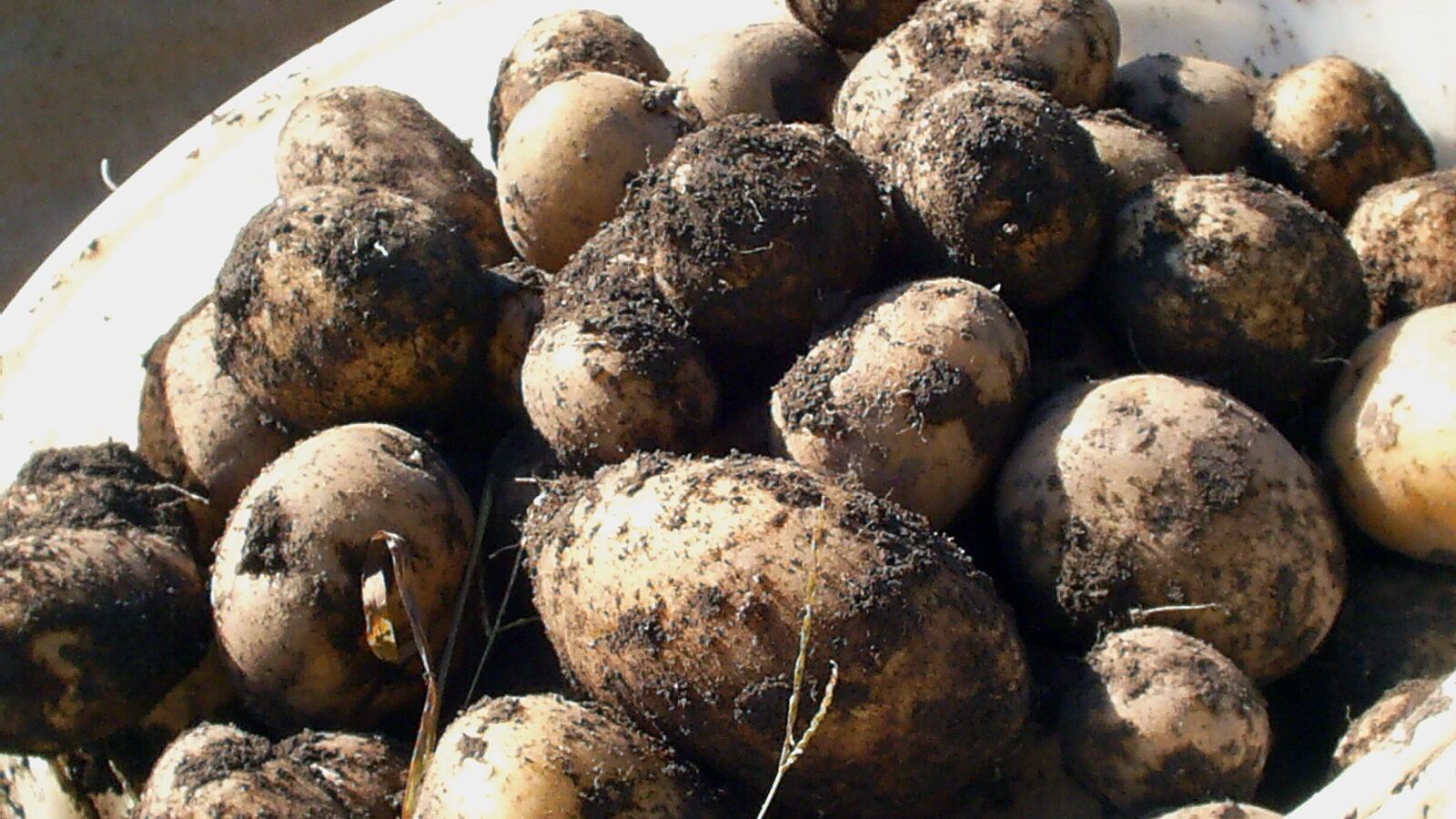
What it is
Solanum tuberosum, from the Andes, where thousands of landraces are still grown between 3,000 and 4,000 m. Same family as tomatoes, and sharing their diseases.
The tuber is a swollen underground stem, not a root. That is why it has eyes, which are buds, and why it turns green and produces solanine in light — it is behaving like a stem that has been exposed.
Europe adopted it slowly and then catastrophically completely. Ireland's dependence on a narrow genetic base, largely the Lumper variety, is what turned the arrival of Phytophthora infestans in 1845 into a famine that killed around a million people. It remains the clearest lesson in the encyclopedia about monoculture, and the argument is made generally in structural diversity.
Buy seed potatoes, not supermarket ones
Seed potatoes are certified virus-free and grown in regions where aphid pressure is low, which matters because the viruses that degrade potato crops are aphid-borne and accumulate generation on generation.
Supermarket potatoes are often treated with sprout suppressant, and carry whatever virus load they picked up. They will grow. They will yield poorly and may import disease.
This is one of the few crops where buying fresh stock each year is genuinely worth it.
The groups, and why they matter
Potatoes are sorted by how long they take, which decides both the harvest window and the blight risk.
First earlies, around 10 to 12 weeks. Lifted as new potatoes in early summer, before blight arrives. Small yields, best flavour, and effectively blight-proof by being finished in time.
Second earlies, 13 to 15 weeks.
Maincrop, 18 to 22 weeks. The big yields and the storage crop — and squarely in the path of blight in a wet summer.
Salad and waxy types cut across these groups and hold their shape when cooked.
If you have limited space or a wet climate, grow earlies. Maincrop is where the disease risk and the labour are.
Chitting
Standing seed potatoes in a cool, light, frost-free place for 4 to 6 weeks before planting, rose end up, until they produce short green sprouts 2 to 3 cm long.
It buys 2 to 3 weeks of growing season, which matters for earlies and for getting maincrop bulked before blight. Sprouts should be short, green and stubby — long white ones mean too dark and too warm, and they snap off on planting.
Chitting is worth doing for earlies and largely optional for maincrop.
Planting and earthing up
Plant when the soil has warmed to about 7 to 10 C, after the worst frosts. Emerging foliage is frost-tender and will be blackened, though the plant usually recovers.
Trenches or holes 10 to 15 cm deep. Earlies at 30 cm apart in rows 50 cm apart; maincrop at 40 cm in rows 75 cm apart.
Earthing up — drawing soil up around the stems as they grow, two or three times through the season — does three jobs, and only one of them is what most people assume.
It keeps developing tubers covered and in the dark, preventing greening and solanine. It suppresses weeds in the row. And it puts a physical barrier of soil between blight spores washing off the foliage and the tubers below.
It does not cause the plant to produce more tubers up the stem. That belief drives the tall tower and stacked-tyre methods, which reliably disappoint, because tubers form only in a zone near the original seed piece.
Potatoes are traditionally a break crop that cleans ground: dense foliage smothers weeds, and the digging disturbs perennials. That reputation is largely earned by the cultivation, not the plant. See weed management.
Blight again
Same organism as in tomatoes, and the same conditions: warm, humid, wet foliage.
Dark brown patches on leaves, often with a pale halo, spreading fast in muggy weather, then stems and finally tubers, which rot in store.
Managing it:
Grow earlies and be finished before it arrives.
Choose resistant varieties for maincrop. The Sárpo types in particular have made unsprayed maincrop realistic in wet climates.
Space widely and keep foliage dry.
Earth up well so spores cannot reach tubers.
Cut the haulm the moment blight appears — remove all foliage at ground level and take it off site. Then leave the tubers in the ground for 2 to 3 weeks before lifting, so spores on the soil surface die off and the skins set.
Never compost blighted haulm in a cold heap, and never leave volunteer potatoes or a discard pile, which is where blight overwinters. See composting methods.
Other troubles: scab, cosmetic and worse on limey dry soils, so avoid liming before potatoes and see soil pH; wireworm, common after grassland; eelworm, the real reason for rotation; and slugs in maincrop tubers, see slugs and snails.
Rotation is not optional
Potato cyst eelworm builds in the soil and persists for years, and it is the single strongest argument for crop rotation.
A four-year gap before potatoes or tomatoes return to the same ground is the standard, and on infested land longer.
Harvest and storage
Earlies: lift when the flowers open, or feel under the plant and steal a few. Eat within days — the sugars convert fast and the point of a new potato is freshness.
Maincrop: wait until the haulm yellows and dies back, then leave two more weeks for the skins to set. A potato whose skin rubs off under your thumb will not store.
Lift on a dry day, let them surface-dry for a few hours, and do not wash them. Soil is protective; washing invites rot.
Store in the dark at 4 to 10 C, in paper or hessian sacks, never plastic. Below 4 C starch converts to sugar and they go sweet and darken on cooking. Light causes greening.
Check monthly and remove any rotting. Keep them away from apples, whose ethylene triggers sprouting. See harvest and storage.
No-dig potatoes
Potatoes grow well under a thick mulch rather than in trenches: lay the seed on the soil surface, cover with 15 to 20 cm of straw or compost, and add more as they grow.
Harvest is a matter of pulling the mulch back rather than digging, the tubers are clean, and the soil structure is undisturbed. Yields are comparable, slug damage can be higher, and it fits the argument in no-dig.
See also
- Tomatoes the same family, the same blight
- Crop Rotation eelworm and the four-year gap
- No-Dig Gardening growing them under mulch
- Harvest and Storage keeping the maincrop
- Soil pH why not to lime before potatoes
- Structural Diversity the lesson of the famine
- Sweet Potatoes
- Jerusalem Artichokes
- Soil-Dwelling Pests
- Lentils and Chickpeas