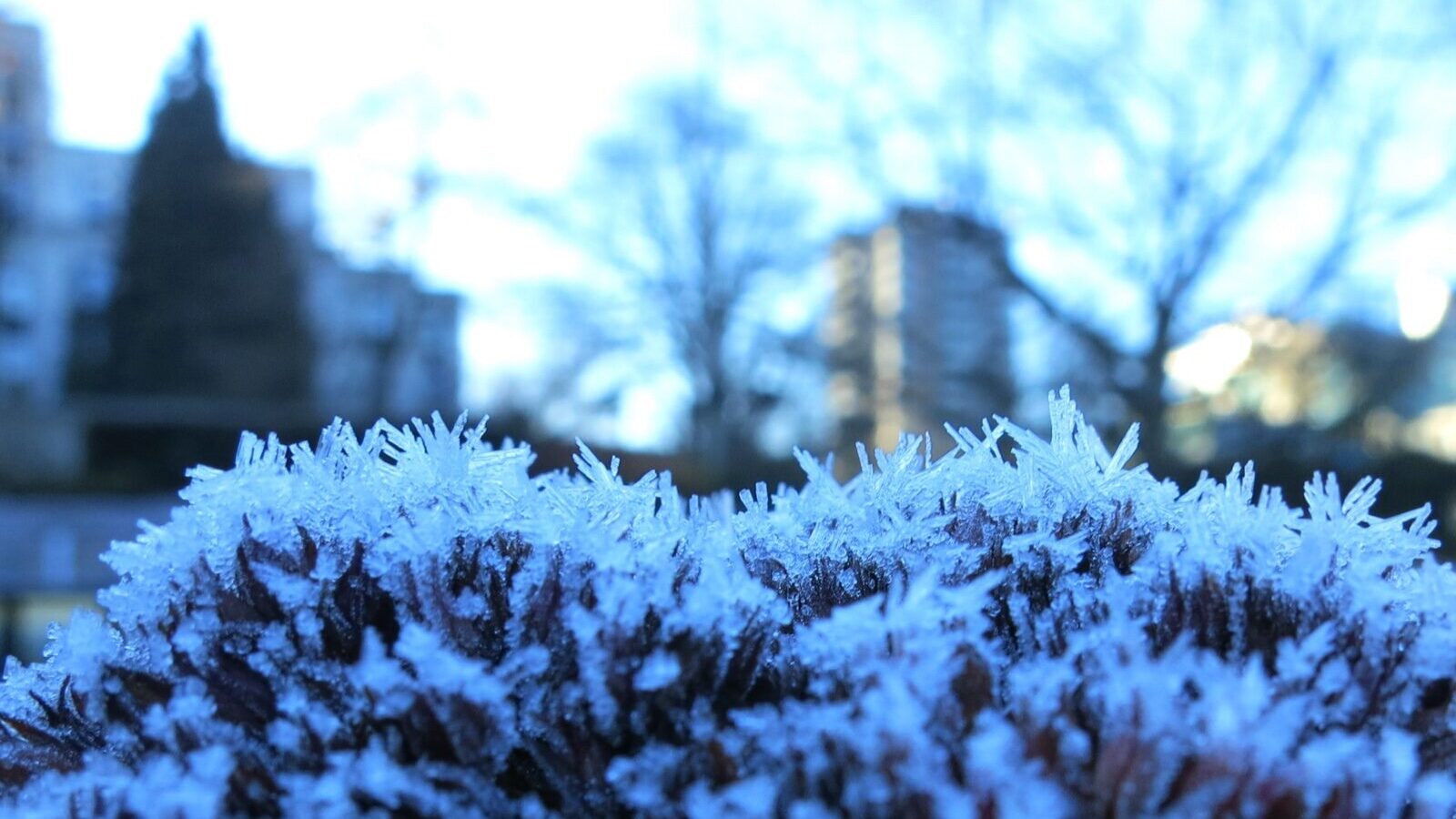
Two kinds of frost
They behave differently and only one of them can be managed cheaply.
Radiation frost. A clear, still night. The ground radiates heat to a cloudless sky, the surface cools below freezing, and cold air pools in low ground. Local, shallow, and often only a metre or two deep. This is the frost that protection works against, and it is the common type in spring and autumn.
Advection frost. A mass of freezing air moves in on wind. Deep, sustained, and unaffected by covers, thermal mass, or siting. A hard continental freeze is advection, and there is nothing a garden-scale intervention will do about it.
If a frost happens on a clear still night and burns the tops of plants while the ground under a tree stays clear, it was radiation frost. Everything below is aimed at that.
Cold air flows downhill
The most important thing to understand, and it is free to act on.
Cold air is denser than warm air and behaves like water. It flows down slopes, follows the ground, and pools in hollows and behind obstructions.
Which produces frost pockets: dips, valley bottoms, and the uphill side of any solid barrier across a slope. A dense hedge or wall running across a slope dams cold air and creates a frost pocket above it, sometimes several degrees colder than 20 m away.
Practical consequences:
Plant frost-tender things on slopes, not at the bottom. The mid-slope is the warm zone, often called the thermal belt. It is measurably better than either the hilltop, which is windy, or the valley floor, which is cold.
Do not dam the cold air. If a hedge is creating a frost pocket, a gap at the low point lets it drain away. Permeable barriers are better than solid ones here, which is the opposite of windbreak design.
Watch where frost lingers in the morning. That map is more useful than any thermometer, and it costs nothing but attention. See observation first and site reading.
This siting decision matters most for fruit. Pears and apricots flower early and lose their crop to late frost repeatedly if planted in a hollow. See apples and pears.
Why frost damages plants
Ice forms in the spaces between cells first, drawing water out of the cells. The cells dehydrate and the ice crystals damage membranes. On thawing, the tissue collapses, which is why frost damage often appears as blackened, water-soaked, limp growth the following day rather than during the freeze.
Slow thawing causes less damage than rapid thawing. Plants hit by early morning sun after a frost suffer more than the same plants in shade, which is a real argument for east-facing shade on frost-tender wall fruit.
Hardening off matters: plants acclimated gradually to cold tolerate several degrees more than the same plant brought straight from a warm greenhouse.
Covers
Horticultural fleece. The workhorse. Lightweight, permeable to light and water, gives roughly 2 to 4 C of protection depending on weight. Can be laid directly on hardy crops or supported on hoops. Doubled fleece gives more.
The mechanism is trapping radiated heat from the ground, so it must reach the soil at the edges. Fleece draped over a plant with gaps to the ground does very little, since the warm air escapes.
Cloches. Rigid covers over rows or individual plants. Glass, polycarbonate, or plastic. Better protection than fleece, plus a real daytime heating effect that warms the soil. Must be ventilated on sunny days or plants cook.
Polytunnels and greenhouses. Unheated, these shift the season by roughly four to six weeks at each end. Frost still occurs inside on cold nights, since an unheated structure is only a few degrees warmer than outside overnight, but the accumulated daytime warmth advances everything.
Double covering is the cheap trick that works remarkably well: fleece over crops inside a polytunnel gives a combined effect equivalent to moving several hundred kilometres south.
Mulch protects roots and crowns rather than tops. A thick layer over the crown of a perennial is what carries it through winter. See soil cover and mulching for moisture. Note the trade-off: mulch also insulates soil from daytime warming, so pulling it back in early spring lets the ground warm faster.
Thermal mass and water
Water releases substantial heat as it cools and freezes, which can be used deliberately.
Walls. A masonry wall absorbs solar heat during the day and releases it overnight, keeping the immediate surroundings a degree or two warmer. This is the entire logic of the walled garden and of espalier and training against a south wall.
Water containers in a greenhouse buffer the night temperature.
Wet soil holds more heat than dry soil. Watering before a frost night genuinely helps, since moist soil stores more daytime heat and releases it overnight. Counterintuitive, and effective.
Overhead irrigation through the frost is the commercial technique: continuously spraying water onto blossom releases latent heat as it freezes and holds tissue at around 0 C. It works, and it must run continuously until the thaw, since stopping partway makes things worse. Requires a lot of water and a reliable supply.
Extending the season
Frost protection is one half; the other is getting warmth earlier and holding it later.
Warm the soil before sowing. Cover ground with plastic or cloches two to three weeks before planting. Soil temperature, not air temperature, governs germination, and most seed simply sits in cold ground.
Choose varieties for the slot. Early and short-season varieties, and cold-tolerant crops for the shoulders.
Sow in modules and transplant. Grow the first weeks under cover and plant out established seedlings, which effectively buys three or four weeks.
Successional sowing. See succession planting and seasonal planning.
Overwinter hardy crops. Kale, leeks, and winter salads under fleece produce through the cold months in most temperate climates.
Raised beds warm faster in spring because they drain better and present more surface.
Frost is not only a problem
Many plants require it. Fruit trees and a great many perennials need a chilling requirement, a number of hours below about 7 C, before they will break dormancy properly. Insufficient winter chill causes erratic flowering and poor cropping, and it is becoming a real problem for stone fruit in warming regions. See climate adaptation.
Frost also kills pests and pathogens, breaks down heavy clay by freeze-thaw, and triggers germination in seeds that need stratification. See seed saving.
The risk is shifting in an unhelpful direction: warmer winters advance bud burst, and late frosts still occur, so the damaging combination of early growth followed by a hard frost is becoming more frequent even as average temperatures rise. Siting and variety choice matter more than they used to, not less.
See also
- Seasonal Planning working with the frost dates
- Observation First mapping your own frost pockets
- Espalier and Training using wall heat
- Windbreaks shelter, and where it creates cold pockets
- Climate Adaptation shifting chill and frost risk
- Succession Planting filling the extended season
- Sepp Holzer
- Tomatoes
- Peppers and Chillies
- Sweet Potatoes
- Magnolias
- Aubergine and Okra
- Katsura