Start with the position, not the colour
Almost every deficiency guide lists symptoms by colour, which is why almost everyone misdiagnoses. Half a dozen deficiencies produce yellow leaves.
The diagnostic question is where on the plant the symptom appears, because that tells you whether the nutrient can move within the plant.
Mobile nutrients can be withdrawn from old leaves and sent to new growth. Nitrogen, phosphorus, potassium, and magnesium. When these run short, the plant cannibalises its old leaves, so symptoms appear on the oldest, lowest leaves first.
Immobile nutrients cannot be relocated once fixed in tissue. Calcium, iron, sulphur, boron, and manganese. When these run short, existing leaves stay fine and symptoms appear on the newest growth, at the tips.
So: old leaves affected means a mobile nutrient. New leaves affected means an immobile one. That single split eliminates most of the possibilities before you look at anything else.
The mobile ones: damage starts at the bottom
Nitrogen. Uniform pale yellowing of the whole older leaf, veins included, progressing up the plant. Growth is stunted and spindly, and the whole plant looks thin and pale. The commonest deficiency by far.
Phosphorus. Older leaves go dark, dull green, often with purple or reddish tints on undersides and stems. Growth is stunted without obvious yellowing. Frequently a cold-soil symptom rather than a real shortage, since phosphorus uptake stops in cold ground and recovers as soil warms.
Potassium. Scorching and browning of the margins of older leaves, working inward, often with yellowing between the veins first. Weak stems, poor fruit, bad storage quality. Common on light sandy soils and in heavy-cropping fruit.
Magnesium. Interveinal chlorosis on older leaves: veins stay distinctly green while the tissue between goes yellow, sometimes red or purple. A very clear pattern once seen. Common on light acid soils, in containers, and where high potassium is blocking uptake.
The immobile ones: damage starts at the top
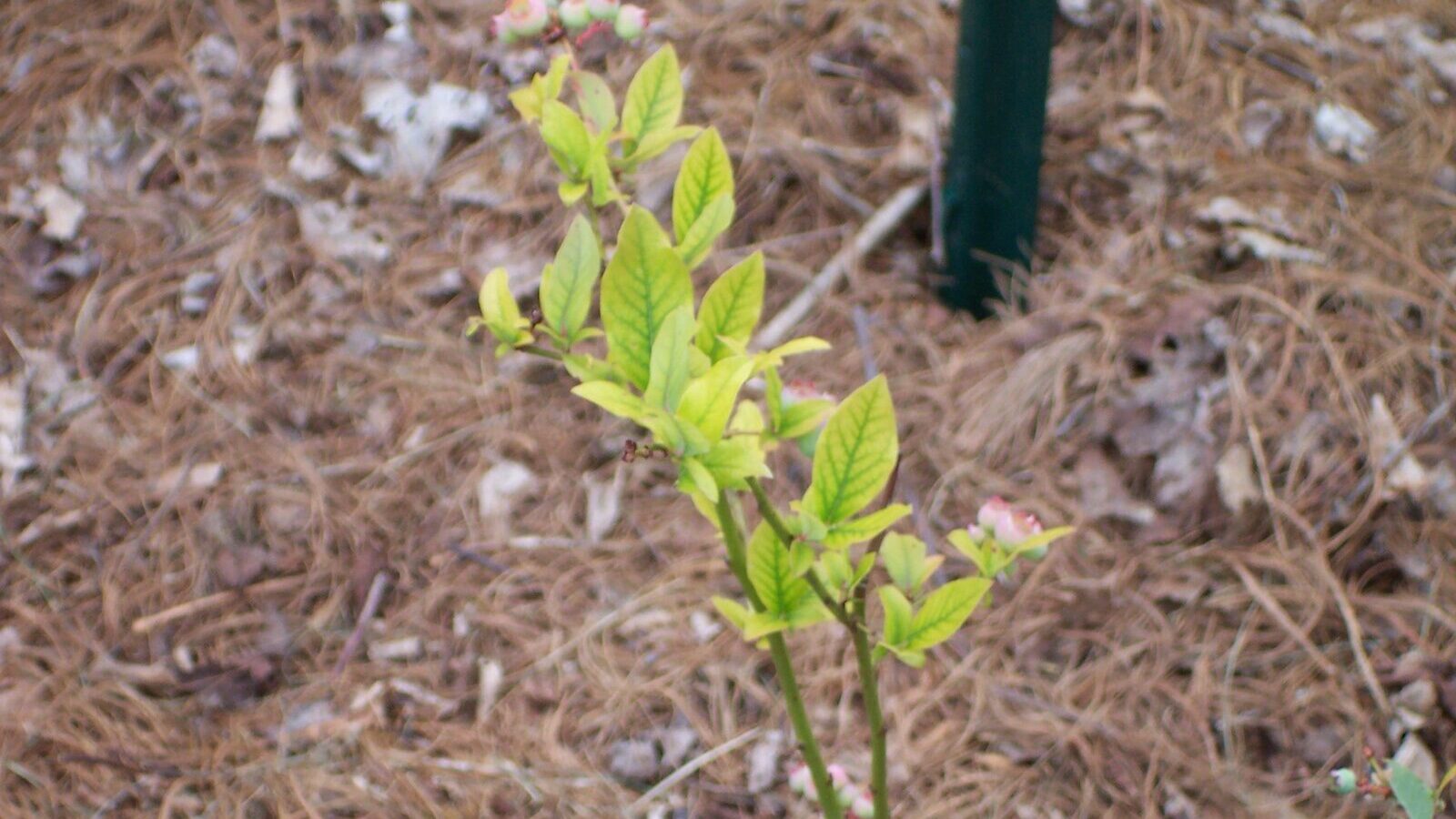
Iron. Interveinal chlorosis on the youngest leaves, with sharply green veins on pale yellow tissue. In severe cases new leaves come through almost white.
Iron deficiency is nearly always a pH problem rather than a shortage. Iron is abundant in most soils and becomes chemically unavailable above about pH 7. Adding iron to alkaline soil achieves little unless it is chelated. The real fix is pH. This is exactly why blueberries and acid shrubs fail on limey ground. See soil pH.
Calcium. Not usually a whole-plant symptom but a localised failure in the fastest-growing tissue: blossom end rot in tomatoes and peppers, tip burn in lettuce and cabbage, bitter pit in apples.
Calcium moves in the transpiration stream, so it goes where water goes. Fruit transpires little, so it gets little calcium. This means blossom end rot is almost always an irregular watering problem, not a calcium shortage, and adding calcium to soil that already has plenty does nothing. Water consistently instead. See deep watering and watering timing.
Manganese. Interveinal chlorosis on young leaves, similar to iron but with less sharply defined veins and often speckled. Also a high-pH problem.
Boron. Growing points die, stems become brittle and hollow, root crops develop internal browning and cracking. Uncommon, and easy to overdose to toxicity, so the margin between deficiency and poisoning is narrow. Never apply boron speculatively.
Sulphur. Uniform yellowing of young leaves, resembling nitrogen deficiency but at the top rather than the bottom.
It is usually not a missing nutrient
This is the most useful thing in the article. Most apparent deficiencies are availability problems, and adding the nutrient does not fix them.
pH is the master variable. Most nutrients are available in a band around pH 6 to 7. Below that, phosphorus locks up and aluminium and manganese can reach toxicity. Above it, iron, manganese, zinc, and boron become unavailable. A soil can be rich in a nutrient the plant cannot touch. Test pH before doing anything else. See soil pH and soil testing.
Roots that cannot function. Compaction, waterlogging, and severed roots all produce deficiency symptoms in fertile soil. Waterlogged roots cannot take up nitrogen and the plant goes yellow while standing in nutrient-rich mud. See decompaction.
Cold soil. Uptake of phosphorus and several others slows sharply in cold ground. Purple-tinged seedlings in spring usually green up without intervention.
Drought. Nutrients move to roots dissolved in water. Dry soil starves plants that are surrounded by nutrients.
Antagonism. Excess of one nutrient blocks another. High potassium suppresses magnesium uptake, which is a classic in heavily fed tomatoes. High phosphorus suppresses zinc and iron. Over-fertilising creates deficiencies.
Missing biology. Mycorrhizal networks substantially extend phosphorus and micronutrient access. Fumigated, heavily tilled, or high-phosphate soils have suppressed fungal networks and the plants are effectively foraging alone. See mycorrhizal fungi and soil food web.
Work through that list before buying anything.
Confirm before treating
Leaf symptoms are suggestive, not conclusive. Viruses, herbicide damage, root disease, and simple drought all mimic deficiencies.
Check the pattern across the plot. A single affected plant among healthy neighbours is a root or disease problem, not soil chemistry. A whole area affected uniformly points to soil.
Soil test for pH and major nutrients. Cheap and it prevents expensive guessing.
Leaf tissue analysis is the definitive answer for trees and high-value crops, measuring what the plant actually contains rather than what the soil holds.
Check the obvious first. Waterlogging, compaction, girdling ties, buried root flares, and drought account for more sick trees than all deficiencies combined. See tree planting.
Fixing it properly
The short-term fix is a foliar feed, which bypasses the soil entirely and shows results within days. Useful as a rescue and as a diagnostic confirmation, but it treats the symptom.
The durable fix is soil that supplies nutrients continuously:
Organic matter, which holds nutrients on exchange sites, feeds biology, and buffers pH. Composting, leaf mould, vermiculture, and organic matter building.
Correct the pH, which unlocks what is already there.
Cover and rotate. Cover cropping with deep-rooted species mines nutrients from the subsoil and returns them to the surface. Crop rotation spreads demand.
Fix the physical problem. Drainage and decompaction resolve more deficiency symptoms than fertiliser.
Dynamic accumulators. Comfrey for potassium, nettles for nitrogen, cut and used as mulch or liquid feed. See chop and drop.
Reaching for a bottled nutrient without checking pH, water, and roots is how people spend money treating the wrong thing for years.
See also
- Soil Testing knowing before amending
- Soil pH the variable that governs availability
- Mycorrhizal Fungi extending root reach
- Long-Term Soil Care building the reserve
- Container Growing where deficiencies appear fastest
- Compost Tea foliar feeding and biology together
- Celery and Celeriac
- Banksia and Grevillea