What it is
Allium cepa, domesticated in central Asia and among the oldest cultivated vegetables. Family includes garlic, leeks, shallots, chives, and a great many ornamentals.
The bulb is a compressed stem surrounded by swollen leaf bases. Each ring is the base of a leaf, which is why an onion is layered and why the leaves and the bulb are continuous tissue.
The thing that catches everyone: day length
Onions do not bulb because they are big enough. They bulb because the days reach a threshold length, and that threshold is genetic.
Short-day varieties bulb at about 10 to 12 hours of daylight. For latitudes roughly below 35°, and grown over winter in the southern United States, Mediterranean, and subtropics.
Intermediate-day at about 12 to 14 hours, for the middle latitudes.
Long-day at about 14 to 16 hours. For northern Europe, Canada, and the northern United States.
Get this wrong and the plant simply never bulbs, or bulbs prematurely while tiny. A long-day variety in Florida grows fine leaves and no onion; a short-day variety in Scotland bulbs almost immediately and gives you something the size of a marble.
None of this is a soil, water, or skill problem, and no amount of feeding fixes it. Buy varieties bred for your latitude. It is the single most important decision in growing onions, and it is invisible on most seed packets unless you look for it.
Once bulbing is triggered, the plant stops making new leaves. Every leaf it has by that point becomes a ring, so the size of the eventual bulb is decided by how much leaf it built beforehand. That is why early planting and unchecked early growth matter so much.
Sets or seed
Sets are small immature bulbs grown the previous season. Easier, faster, more forgiving of cold soil, and more resistant to onion fly. They cost more, offer far fewer varieties, and are prone to bolting, because a set that experiences cold after starting into growth reads it as a completed winter and runs to flower. Heat-treated sets reduce this.
Seed gives a much wider variety choice, better keeping quality, larger bulbs, and no bolting tendency. It needs a longer season and a warm start.
For most temperate growers: seed sown indoors in late winter for the main crop, or sets for reliability and simplicity.
Onion seed is notoriously short-lived — one year is realistic, two at a push. Buy fresh, and see seed saving for storage of the rest.
Growing them
Full sun, and no competition. Onions have sparse, shallow, unbranched roots and are poor competitors. Weeds cost yield directly and immediately. Keep them clean, especially early. See weed management.
Free-draining soil, not freshly manured. Fresh manure gives soft, thick-necked bulbs that will not keep. Manure the previous crop instead.
Firm soil. Onions dislike loose fluffy ground.
Spacing controls size. 5 to 8 cm apart gives small bulbs, 10 to 15 cm gives large ones. Total yield per square metre is similar either way, so choose the size you want to cook with.
Water evenly during bulb formation, then stop as the tops start to fall. Water late in the season delays ripening and shortens storage life.
Nitrogen early, none late. Late nitrogen produces thick necks that rot in store.
Problems
Onion white rot is the serious one — a soil fungus producing white fluffy mycelium and small black sclerotia at the base. Those sclerotia survive in soil for 15 to 20 years and there is no cure. Once ground is infected, alliums are finished there for a generation. This is the strongest possible argument for long rotation and for scrupulous hygiene about moving soil and tools between plots. See tool care and safety.
Downy mildew in wet seasons — pale patches and grey furry growth. Space widely for airflow.
Onion fly, whose larvae destroy the base. Sets are less susceptible than seedlings, and fleece keeps the fly off. See row covers and barriers.
Bolting from cold shock, as above. A bolted onion is still edible but will not store.
Leek rust crosses to onions in mild wet years.
Curing, which is what actually matters
More onion crops are lost in storage than in the ground, and nearly always because they were not cured properly.
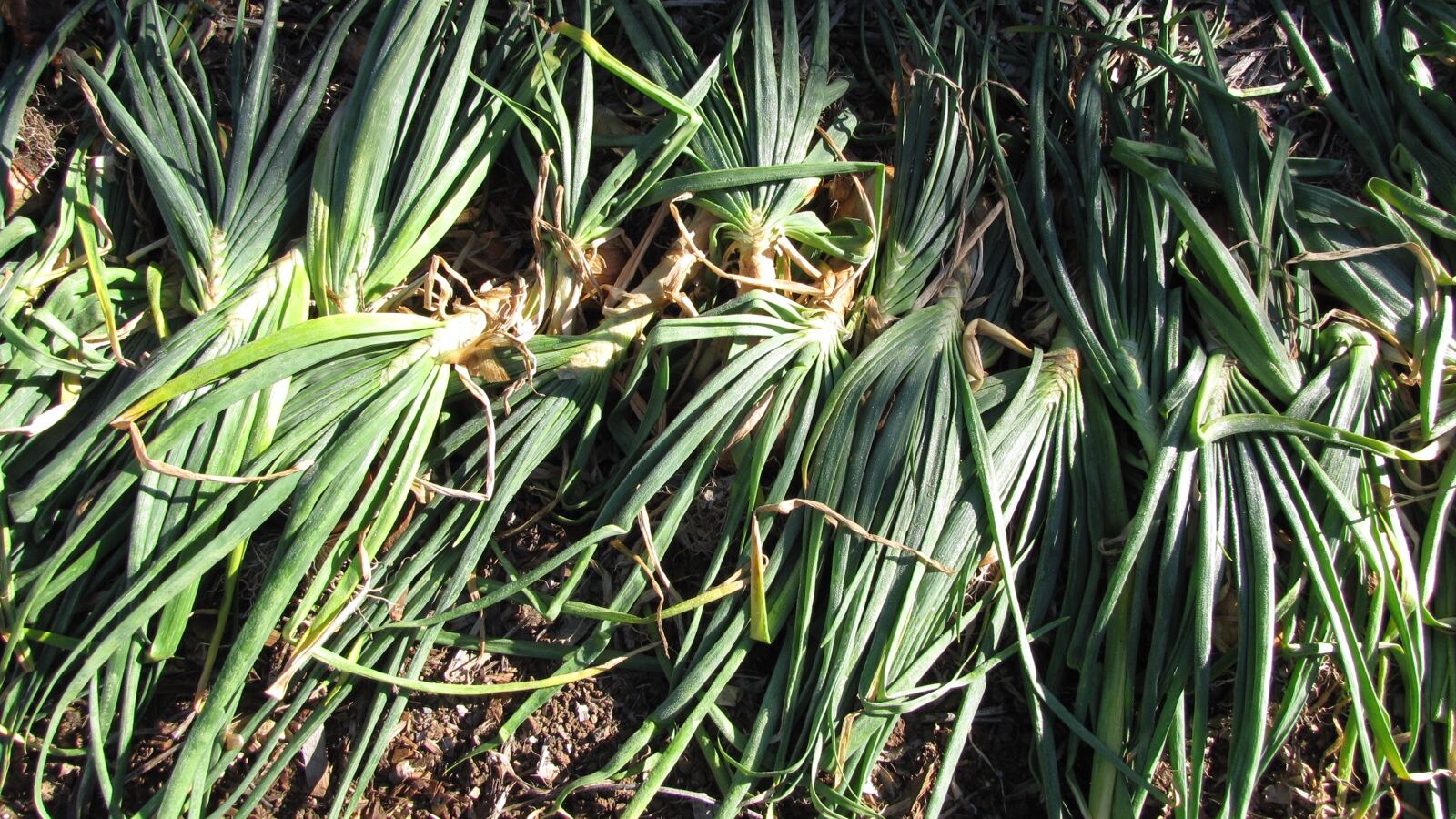
Harvest when the tops fall over naturally and start to yellow, at around 50 to 80 percent of the crop. Do not bend the tops down by hand to force it — that damages tissue and invites rot.
Lift and cure for 2 to 3 weeks somewhere warm, dry, and airy, out of rain. On the soil surface in a dry spell, or in a shed or greenhouse otherwise. The neck must go completely dry and papery, and the outer skins must rustle.
Leave the tops on during curing. They feed the bulb as they die back and seal the neck.
Then trim to about 2 cm of neck, or plait them, and store cool, dry, and airy — the opposite of the cold damp conditions root vegetables want. Nets or plaits, never plastic.
A well-cured long-keeping variety holds until spring. See harvest and storage.
The rest of the family
Shallots are the same species, planted as sets and multiplying into a clump. Milder, better keepers.
Spring onions are simply onions grown close and pulled young, and any variety will do at a pinch.
Overwintering Japanese types are autumn-sown for an early summer crop, filling the gap before the maincrop cures.
Leeks are A. porrum, blanched by earthing or deep planting, and far hardier — standing through winter in the ground, which is the best storage there is.
Alliums are a companion-planting staple, since their sulphur compounds confuse pests of other crops, notably carrot fly. See companion planting guide and garlic.
See also
- Garlic the close relative that needs cold, not day length
- Crop Rotation white rot and the long gap
- Harvest and Storage curing and keeping
- Weed Management onions lose to competition
- Companion Planting Guide alliums as pest confusers
- Row Covers and Barriers keeping onion fly off
- Leeks