What it is
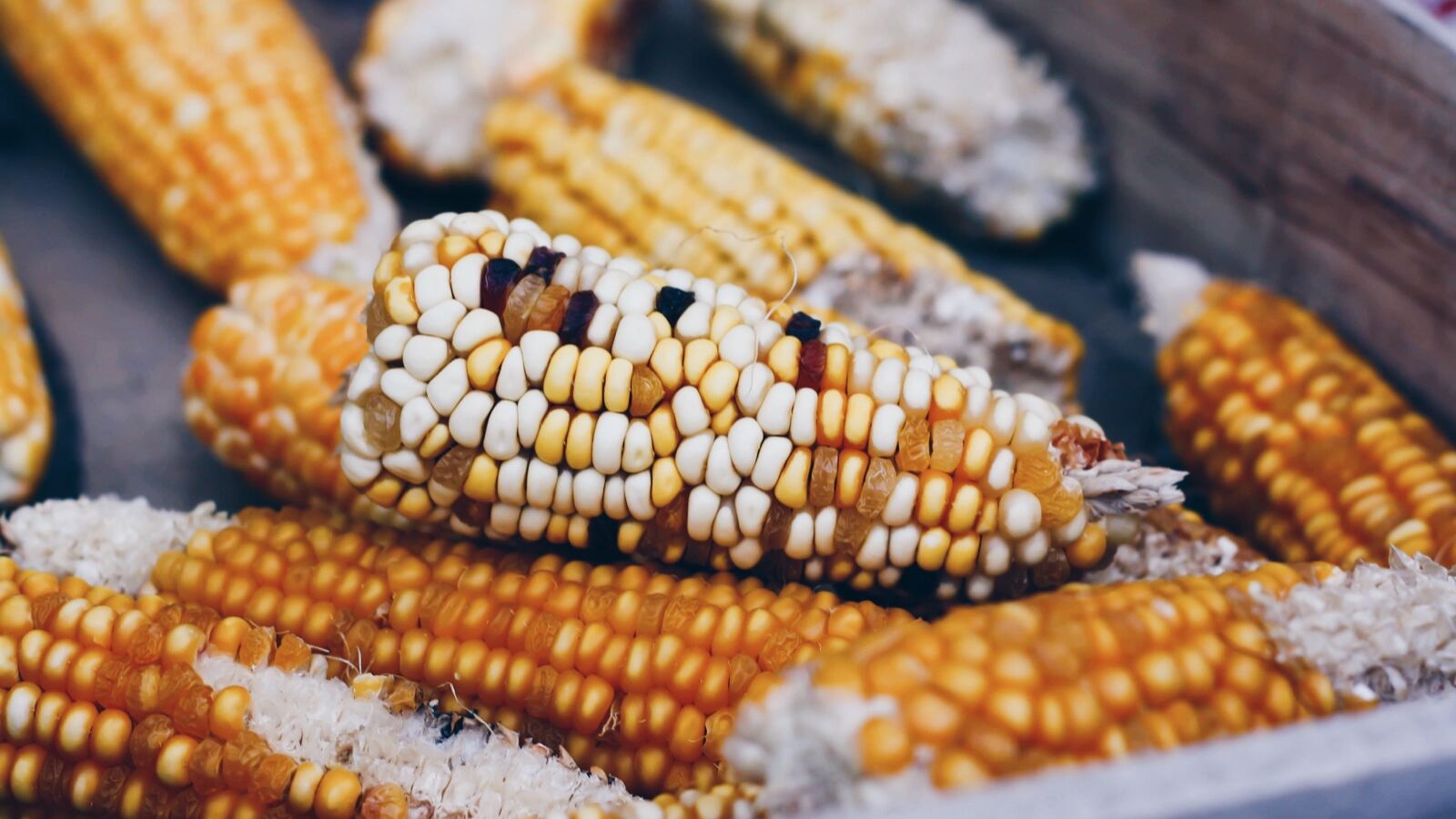
Zea mays, a giant grass, domesticated in southern Mexico from teosinte some 9,000 years ago. The transformation from teosinte — a straggly plant with a dozen hard seeds — into maize is among the most dramatic acts of selection in agricultural history.
Sweetcorn is maize carrying mutations that block the conversion of sugar to starch in the kernel, so it is harvested immature and eaten as a vegetable rather than dried as a grain.
Maize is now one of the three crops, with wheat and rice, that feed most of humanity.
Plant in a block
The single rule that decides whether you get full cobs.
Maize is wind-pollinated. The tassel at the top carries the male flowers; the silks emerging from each developing cob are the female styles. Every silk must catch a grain of pollen to make one kernel.
A cob with scattered kernels and gaps is not a disease or a feeding problem. It is incomplete pollination.
Wind carries pollen sideways and downward over short distances. In a single long row, most of it blows away into the garden. In a block, it falls on neighbours.
So: plant in a block of at least 4 rows by 4 rows, 30 to 45 cm apart each way. Never a single row, however long.
In a small planting, help it along by tapping the tassels on a still, dry morning when pollen is shedding, or cutting a tassel and brushing it over the silks.
Varieties that must not meet
Sweetcorn types cross-pollinate, and the result is immediate — it affects this year's kernels, not next year's seedlings, because the kernel is the offspring.
Standard sugary (su) — traditional flavour, converts to starch fastest. Sugar-enhanced (se) — sweeter, holds a little longer. Supersweet (sh2) — very sweet, holds for days, but the seed is shrunken and germinates poorly in cold soil.
Supersweet crossed with any other type produces starchy, tough kernels in both. If you grow more than one type, separate them by at least 8 to 10 m, or stagger sowing by two weeks so they shed pollen at different times.
Also keep sweetcorn away from flowering popcorn or field maize, for the same reason.
Growing it
Heat. Maize is a warm-season C4 grass and will not germinate below about 10 to 12 C — supersweet types want 15 C or more, and rot in cold wet soil. Sow indoors in modules 3 to 4 weeks before the last frost, or direct-sow once the soil has warmed.
Root disturbance sets it back, so use deep modules or biodegradable pots and plant out young.
Full sun and shelter. A tall plant catching wind on a shallow root system falls over. Earth up the stem bases as they grow, and note the plant produces prop roots from the lower stem — brace roots that anchor it. Earthing up helps them take hold.
Rich soil and steady water. Heavy feeder, especially of nitrogen. Water matters most from tasselling through cob fill; drought then gives short, poorly filled cobs.
The three sisters
Sweetcorn is the classic upper storey of the three sisters polyculture: maize as the pole, beans climbing it and fixing nitrogen, squash sprawling below to shade the soil and suppress weeds.
It is a genuinely good design and not merely folklore. The maize needs nitrogen and the beans supply it; the beans need support and the maize provides it; the squash covers ground that would otherwise be bare between widely spaced stems.
The practical caution is timing — sow the maize first and let it reach 15 to 20 cm before adding beans, or the beans swamp it. See peas and beans and squash and courgettes, and the wider argument in polyculture.
Problems
Poor pollination, as above. The commonest complaint by a wide margin.
Birds taking sown seed and ripening cobs. Start in modules; net or bag cobs as they fill.
Badgers, foxes, squirrels, and raccoons depending on where you are — all of which can strip a block the night before you planned to pick. A low electric fence is the usual answer where pressure is high.
Corn smut, grotesque swollen grey galls on the cob. Treated as a disaster in most of the world and as a delicacy — huitlacoche — in Mexico.
European corn borer and fall armyworm in warmer regions.
Wind flattening the block. Earth up, and shelter with a windbreak.
Harvest, and the reason to grow it at all
The whole case for growing sweetcorn is that its quality collapses faster than any other vegetable.
Once picked, the sugars begin converting to starch immediately. Standard sugary types lose a substantial share of their sugar within a day at room temperature. This is why shop sweetcorn tastes bland and why the old advice was to put the pot on before going out to pick.
Test for ripeness about three weeks after the silks appear: the silks go brown and dry, the cob feels full and rounded, and a kernel pierced with a thumbnail releases a milky — not watery, not doughy — liquid.
Pick, cook, eat. Then freeze whatever you cannot eat, blanched, on the same day. See harvest and storage.
After the crop
Maize leaves a large volume of tough, carbon-rich stalks. They are slow to break down and excellent for balancing a nitrogen-heavy compost heap, or chopped as mulch. See composting methods and chop and drop.
As a heavy feeder it takes a lot out, so follow it with a legume or a cover crop. See crop rotation.
Saving seed
Difficult to do well. Maize is wind-pollinated over long distances, highly cross-pollinating, and suffers real inbreeding depression, so a viable seed population needs many plants — 100 or more — to avoid decline. Most home growers buy fresh seed, and F1 hybrids will not come true regardless.
Open-pollinated flint and flour maizes are more practical to save, and are worth growing for grain rather than as a vegetable. See seed saving.
See also
- The Three Sisters maize as the support
- Peas and Beans the nitrogen partner
- Squash and Courgettes the ground layer
- Polyculture why the combination works
- Harvest and Storage picking and freezing the same day
- Crop Rotation following a heavy feeder
- Wheat