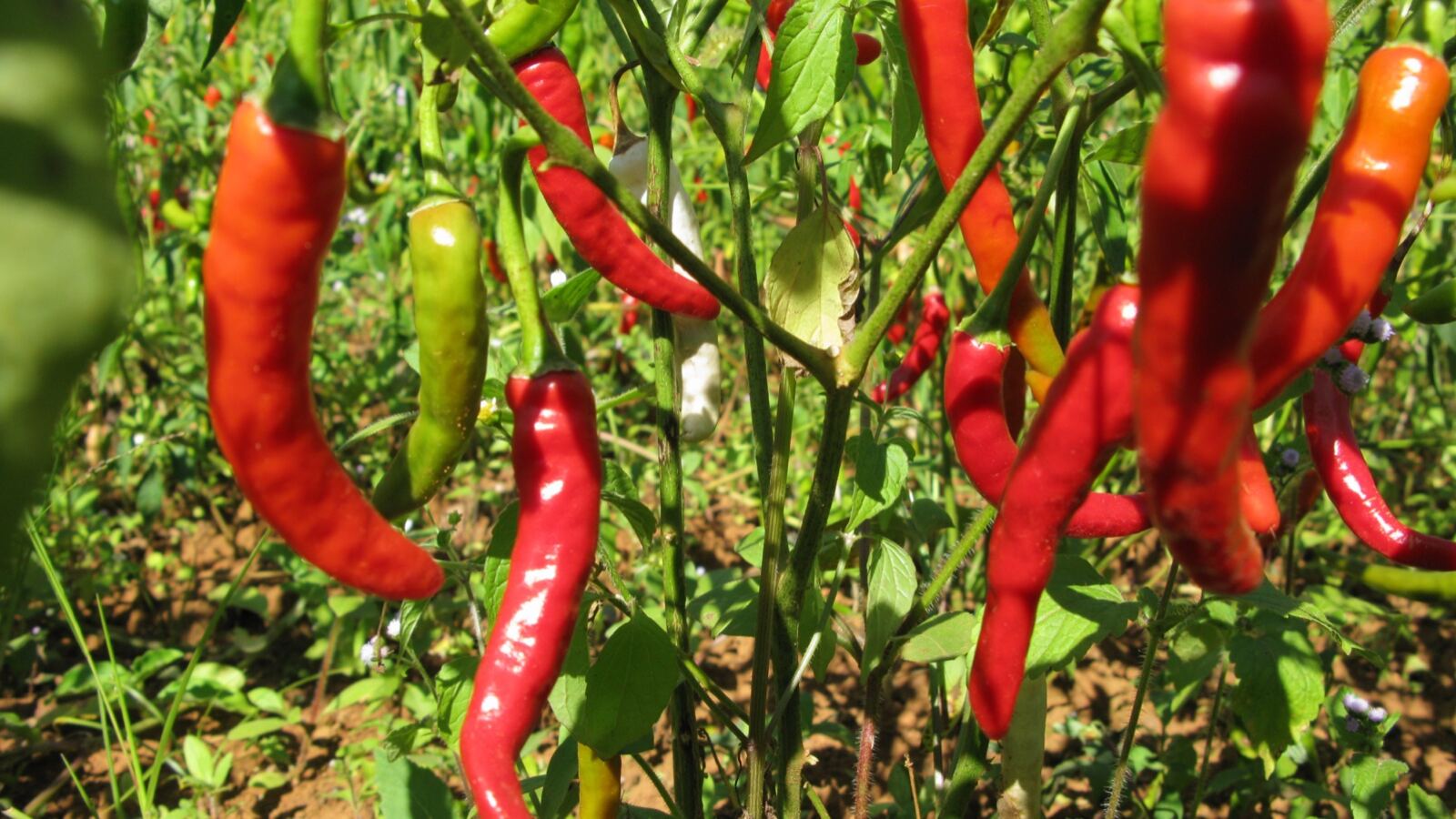
What they are
Capsicum, from Central and South America, and another member of the nightshade family alongside tomatoes and potatoes.
Sweet peppers and fiery chillies are frequently the same species, C. annuum. A bell pepper and a cayenne differ by a handful of genes controlling capsaicin production, not by species.
Five species were domesticated:
C. annuum — bells, jalapeño, cayenne, poblano, most of what is grown commercially. C. chinense — habanero, scotch bonnet, the superhots. Slowest to germinate and ripen. C. frutescens — tabasco. C. baccatum — the ají peppers of South America, fruity and distinctive. C. pubescens — rocoto, with black seeds and hairy leaves, unusually cold-tolerant.
Why they burn
Capsaicin is produced in the placental tissue, the white pith holding the seeds, not the flesh and not the seeds themselves. Deseeding a chilli reduces heat mainly by removing attached pith.
The evolutionary logic is selective defence. Capsaicin binds to a receptor in mammals that also responds to actual heat, which is why the sensation is burning. Birds lack that receptor entirely.
That is not an accident. Mammals chew, and their molars destroy seed. Birds swallow whole, fly further, and pass seed intact. The plant evolved a chemical that deters the bad disperser and not the good one — a targeted version of the relationship in seed-dispersing birds.
Heat is measured in Scoville units, from zero for a bell pepper to a few thousand for jalapeño, 100,000 to 350,000 for habanero, and over a million for the superhots.
Growing conditions matter: water stress and heat both raise capsaicin, so the same variety is hotter from a dry season.
They need more warmth than you think
This is the crop most often defeated by climate rather than skill.
Germination wants 25 to 30 C, and it is slow — 1 to 3 weeks for C. annuum, and up to 6 for C. chinense. A heat mat is close to essential. Cold compost simply rots the seed.
Sow early. 8 to 10 weeks before the last frost, and earlier again for superhots, which need a long season.
Fruit set fails outside a narrow band. Below about 15 C at night or above about 32 C in the day, flowers drop without setting. In cool temperate summers this is why outdoor peppers flower abundantly and fruit poorly.
In anything but a warm climate, grow them under cover. A greenhouse, polytunnel, or a warm sheltered wall makes the difference between a token crop and a real one.
They are excellent in containers, which lets you move them into warmth, and they respond well to the wall-heat trick described in espalier and training and frost protection.
Growing them
Rich, free-draining soil, plenty of sun, shelter from wind.
Space at 45 to 50 cm. Stake taller varieties, since a loaded plant snaps.
Pinch the growing tip at around 20 to 30 cm to encourage branching, which gives more fruiting sites on a sturdier plant.
Feed as for tomatoes: nitrogen while building leaf, then high potassium once flowering starts. Over-feeding nitrogen gives a large plant and few fruit.
Water consistently. Peppers get blossom end rot for the same reason tomatoes do, and the fix is the same — even moisture, not added calcium. See nutrient deficiency.
Pollination is mostly self, helped by wind or a gentle shake. Under cover with still air, tapping the plants daily measurably improves set.
Problems
Aphids, especially under cover, and they carry viruses. See aphids. Whitefly and red spider mite in greenhouse conditions — see whiteflies and spider mites. Spider mite in particular thrives in the hot dry air peppers like. Blossom drop from temperature extremes, not disease. Sunscald on exposed fruit in intense sun, so retain some leaf cover.
Peppers are less blight-prone than their relatives, but they belong in the same rotation slot. See crop rotation and integrated pest management.
Harvest
Every pepper is green first and ripens to red, yellow, orange, purple, or brown depending on variety. Green is unripe.
Ripe fruit is sweeter, far higher in vitamin C, and hotter in chillies. Picking green gives a larger total yield, because the plant keeps setting; leaving fruit to ripen gives better flavour and fewer fruit.
Cut rather than pull, since the brittle branches snap.
Preserving: thin-walled chillies air-dry well on a string. Thick-walled ones need a dehydrator or they mould. Freezing works without blanching. Fermenting into hot sauce, and preserving in oil or vinegar, both work well. See harvest and storage.
Wear gloves with hot varieties, and keep your hands away from your eyes for hours afterwards. Capsaicin is not water-soluble — milk or oil removes it, water spreads it.
Perennial, if you let them
Peppers are perennial in their native range and only annual because frost kills them.
Overwintered indoors — cut back hard, kept barely moist, above about 10 C and in decent light — a plant will survive and crop earlier and heavier the following year. Rocoto in particular does this well and can live for years.
Expect leaf drop and check for spider mite and aphid, which thrive on stressed indoor plants.
Saving seed
Peppers are largely self-pollinating but cross readily via insects, so isolate or bag flowers if you want true seed — a sweet pepper crossed with a neighbouring chilli produces offspring you will discover the hard way.
Take seed from fully ripe fruit, dry thoroughly, store cool and dark. Viable 2 to 5 years. See seed saving.
See also
- Tomatoes the same family and feeding regime
- Container Growing moving them into warmth
- Frost Protection extending a marginal season
- Seed-Dispersing Birds why birds ignore the heat
- Crop Rotation the solanaceae slot
- Seed Saving isolating to avoid crosses
- Aubergine and Okra
- Tamarillo
- Sichuan Pepper
- Mountain Pepper