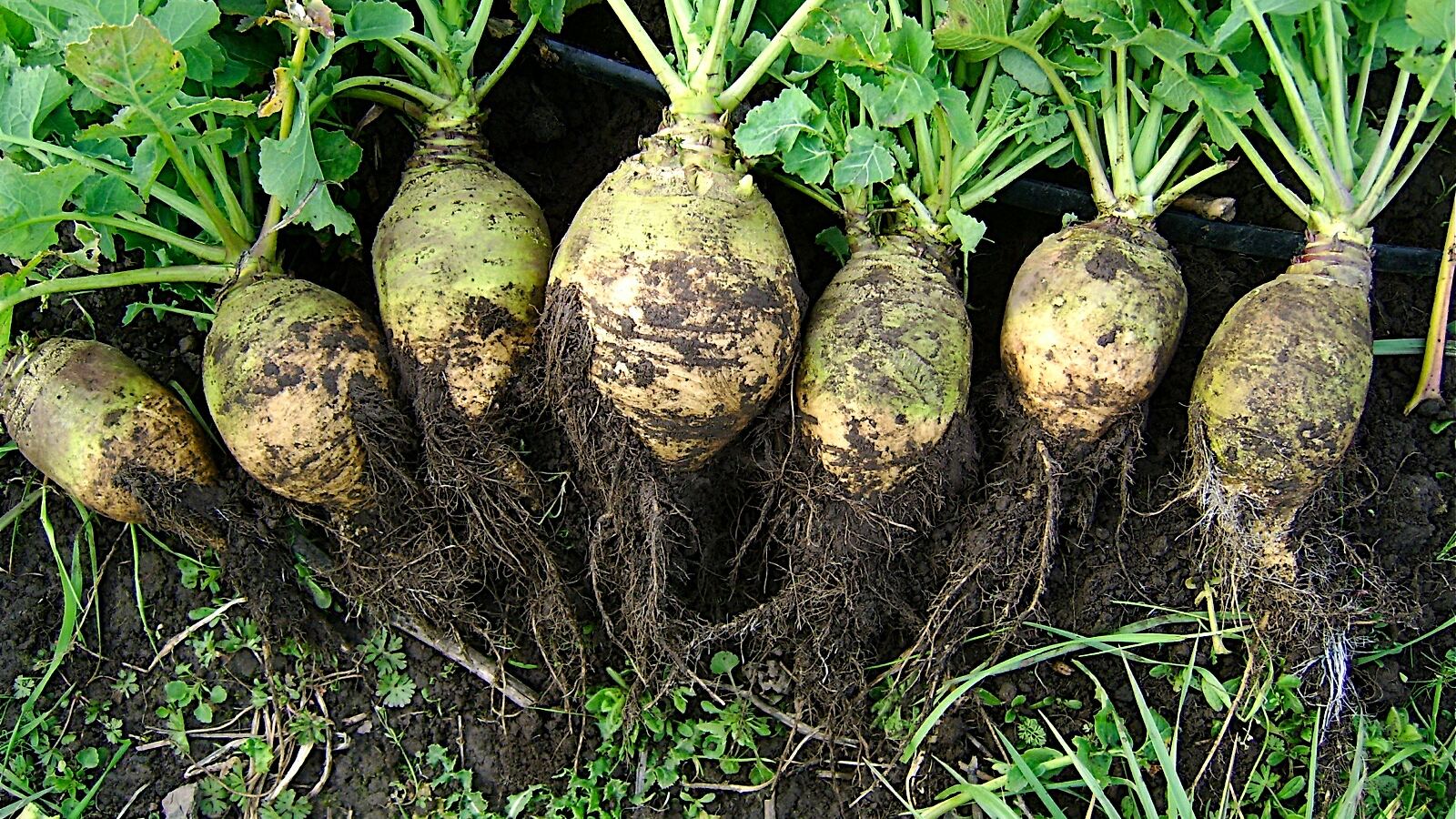
Two different plants
Frequently confused, and genuinely different species.
Turnip — Brassica rapa. Smaller, faster, white or white-and-purple flesh, milder, ready in 6 to 10 weeks. The same species as pak choi, mizuna, and turnip rape.
Swede — Brassica napus, also called rutabaga or neep. A natural hybrid between turnip and cabbage, larger, slower at 20 to 26 weeks, yellow-fleshed, sweeter, and considerably hardier.
Both are brassicas, so both carry clubroot and the family's pests, and both belong in the brassica slot of the rotation — a point often missed because they are handled as root vegetables.
The crop that changed farming
Turnips deserve more credit than they get. Their introduction into European arable rotations in the seventeenth and eighteenth centuries was one of the changes that ended the medieval fallow system.
Before that, a share of arable land sat idle each year, and most livestock were slaughtered in autumn because there was nothing to feed them through winter.
Turnips, grown as a field crop and fed to sheep and cattle, provided winter fodder. That allowed animals to be overwintered, which meant more manure, which meant higher cereal yields — and, in the Norfolk four-course rotation of wheat, turnips, barley, and clover, no fallow year at all.
It is a good demonstration of the argument in crop rotation: the gain came from the sequence rather than from any single crop, with the legume fixing nitrogen and the root crop breaking pest cycles and cleaning the ground.
Growing turnips
Fast and cool. Turnips are a spring and autumn crop; midsummer sowings go woody and bolt.
Direct sow, thinning to 10 to 15 cm. They resent transplanting.
Grow them fast. A checked turnip is a woody, hot turnip. Steady moisture and moderate fertility are the whole recipe.
Pull young — golf ball to tennis ball. Large old turnips are coarse and strong-flavoured, which is most of the reason the vegetable has a poor reputation.
Sow in succession every few weeks in spring and again in late summer. See succession planting.
Turnip tops are a crop in their own right — sown thickly and cut as spring greens, they were a traditional hungry-gap vegetable and are excellent.
Growing swedes
Sow once, in early summer, direct, thinning to 23 to 30 cm. They need the whole rest of the season.
Sowing too early causes bolting and increases mildew and pest exposure; too late gives small roots.
Consistent moisture matters more than for turnips because of the long season. Drought followed by rain causes splitting.
Frost improves them. Swede is genuinely hardy and the flavour sweetens after cold, so it is left in the ground and lifted as needed through winter — the in-ground storage argument again from harvest and storage.
Problems
Clubroot, the big one, with soil spores persisting up to 20 years. Lime to pH 6.5 to 7, improve drainage, rotate long, and use resistant swede varieties, several of which are good. See soil pH.
Flea beetles on seedlings, which can destroy a sowing outright in dry spring weather. Fleece from sowing, and keep the soil moist. See flea beetles and row covers and barriers.
Cabbage root fly, whose larvae tunnel the roots. Collars or mesh.
Powdery mildew on swede in dry late summers.
Boron deficiency causes brown heart — a discoloured, corky, bitter centre in swede. More likely on alkaline or over-limed ground. Confirm with a soil test before treating, since boron is easy to overdose. See nutrient deficiency and soil testing.
Splitting from irregular watering.
Harvest and keeping
Turnips: pull young and use fresh. They store for a few weeks cold and damp but are not a long-keeping crop.
Swedes: leave in the ground into winter under a light mulch, or lift, twist off the tops, and store cold and damp in sand — 0 to 4 C at high humidity, as for carrots and beetroot. They keep for months.
Do not wash before storing, and do not store damaged roots.
Still a fodder crop
Both remain important as livestock feed, and stubble turnips and fodder swedes are widely grown for outwintering sheep and cattle, strip-grazed in the field.
They also work as a fast cover crop: sown after a cereal, they produce bulk quickly, hold nitrogen over winter, and their roots break surface compaction. Do not use brassica cover crops where clubroot is a concern, since they host it. See cover cropping and rotational grazing.
Saving seed
Both are biennial and insect-pollinated, and both cross readily within their own species — turnip with pak choi and mizuna, swede with oilseed rape and some kales — so isolation is needed for true seed.
Overwinter the roots, replant, and let them flower. The flowers are a useful early nectar source. See seed saving and native bees.
See also
- Brassicas the family, clubroot, and the pests
- Crop Rotation the Norfolk four-course and why it worked
- Carrots the other main storage root
- Harvest and Storage leaving swedes in the ground
- Flea Beetles the seedling threat
- Cover Cropping stubble turnips as green manure
- Barley
- Wheat