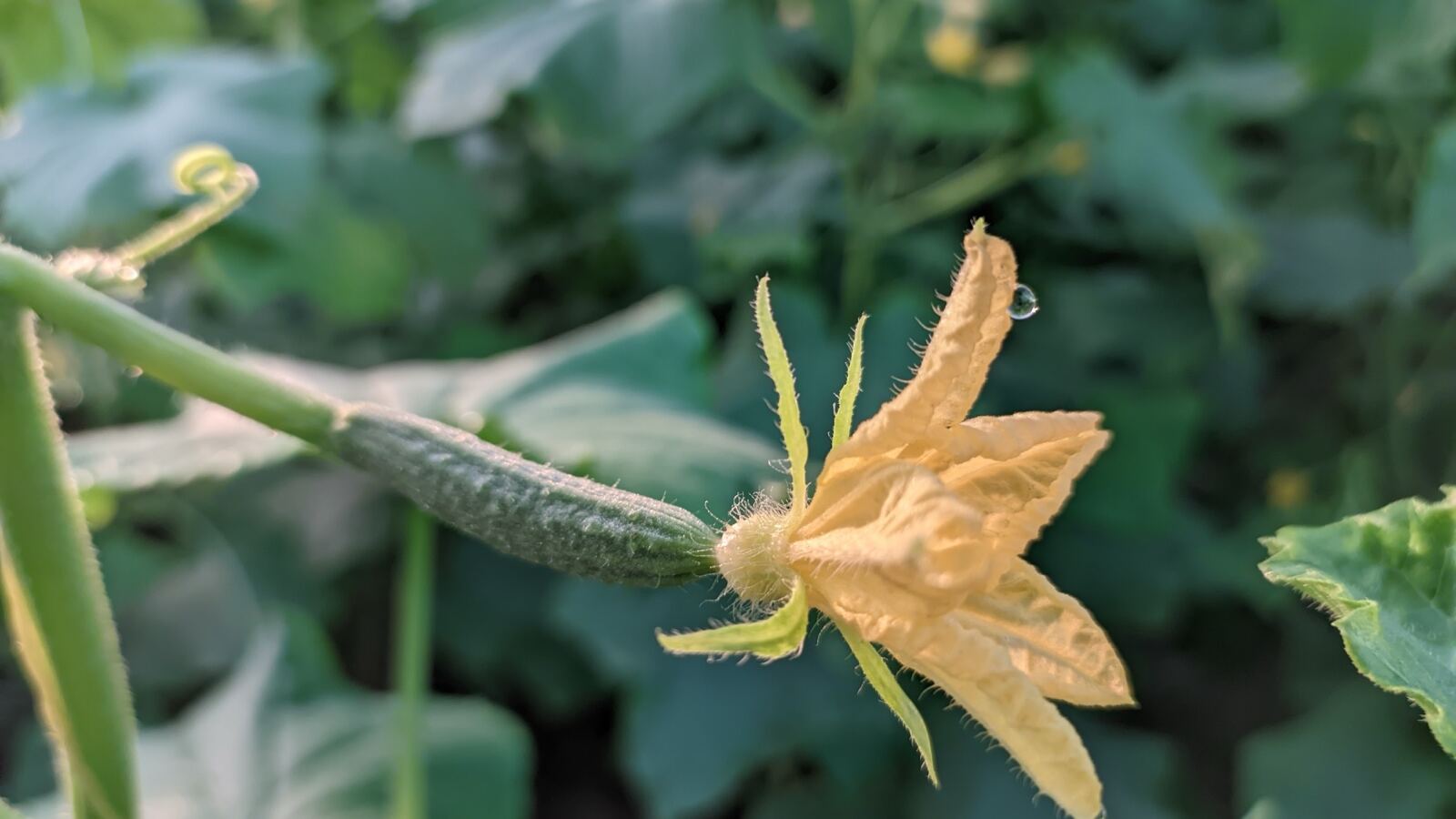
What it is
Cucumis sativus, from the Indian subcontinent, cultivated for over 3,000 years. A cucurbit, so it shares a family and most of its habits with squash and courgettes, melons, and gourds.
Botanically the fruit is a berry, and it is around 95 percent water — which explains both its thirst while growing and its inability to keep once picked.
Two kinds, and they are not interchangeable
The commonest cucumber failure is growing the wrong type for the conditions.
Greenhouse or indoor types. Long, smooth-skinned, thin-skinned, and gynoecious — they produce only female flowers, and they are parthenocarpic, setting fruit without pollination.
These must be grown away from pollinating insects. If a male flower pollinates them, the fruit becomes swollen at one end, bitter, and full of hard seeds. That is why they are grown under cover, and why any male flowers appearing on them are removed.
Ridge or outdoor types. Shorter, rougher, tougher-skinned, hardier, and monoecious — separate male and female flowers on the same plant, requiring insect pollination exactly as squash do.
Grow these outdoors, and leave the bees to it.
Mixing them up produces the classic disappointment: an indoor variety planted outdoors, pollinated, and bitter.
There are also all-female outdoor hybrids that combine the two advantages, and these are usually the easiest choice for a beginner.
Bitterness
Cucumbers contain cucurbitacins, the bitter defensive compounds of the family. Modern varieties are bred to have very little, but stress brings it back.
The triggers are consistent: irregular watering, temperature swings, drought, and poor soil. Bitterness concentrates at the stem end and just under the skin, which is why peeling and cutting off the end often rescues a mildly bitter fruit.
The fix is not a treatment; it is even growing conditions. A cucumber that never checks is a cucumber that never turns bitter.
The same compounds are a genuine caution when saving seed, since crosses with ornamental gourds can produce dangerously bitter fruit. See the warning in squash and courgettes.
Growing them
Heat. Germination wants 20 to 25 C and the plants want 18 to 30 C. They are frost-tender and sulk in cold soil. Sow indoors 3 to 4 weeks before planting out, seeds on edge to reduce rot.
Do not disturb the roots. Cucurbits resent transplanting. Use deep modules or biodegradable pots and plant out young, before they become pot-bound.
Water, constantly and evenly. The single biggest factor in yield and quality. A 95-percent-water fruit needs a steady supply, and drought stress causes bitterness, misshapen fruit, and mildew. Mulch heavily. See mulching for moisture and deep watering.
Water the soil, never the foliage — wet leaves invite mildew.
Feed richly. Plenty of organic matter, and a high-potassium feed once fruiting starts, as for tomatoes.
Grow them upward. Trained up strings, netting, or canes, cucumbers take almost no ground space, produce straighter fruit, get better airflow, and are far easier to pick. For indoor types this is standard; outdoor types climb happily too.
For greenhouse cordon training: tie the main stem up a string, pinch out side shoots two leaves beyond a developing fruit, and remove the growing tip at the roof.
Problems
Powdery mildew, nearly universal late in the season. Space widely, water at the base, ventilate, remove the worst leaves, and choose resistant varieties.
Red spider mite, the classic greenhouse cucumber pest, thriving in hot dry air. Damping down the floor and raising humidity discourages it. See whiteflies and spider mites.
Aphids and whitefly under cover. See aphids.
Slugs on young plants outdoors. See slugs and snails.
Cucumber mosaic virus, spread by aphids, causing mottled distorted leaves and stunted plants. No cure — remove affected plants, and control aphids.
Bitter or misshapen fruit, which is a growing-conditions problem as above, not a disease.
The general approach is in integrated pest management, and under cover the biological controls — predatory mites against spider mite, Encarsia against whitefly — work particularly well because the environment is enclosed. See predator-prey balance.
Harvest
Pick young, and pick constantly. This is the whole trick. A cucumber left to swell signals the plant that it has reproduced, and production slows sharply. Picking every day or two in high summer keeps a plant cropping for months.
Cut with a knife rather than pulling, which damages the brittle vine.
Fruit is best in the morning while still cool and full of water.
Storage is short. A few days in the fridge, though below about 10 C they suffer chilling injury and go slimy — the salad drawer rather than the coldest shelf.
The traditional answer to a glut is pickling, and small ridge types and gherkins are bred for exactly that. Fermented dill pickles need no equipment beyond a jar and salt. See harvest and storage.
Saving seed
Only worth doing from open-pollinated ridge varieties. Cucumbers cross readily with other cucumbers, though not with melons or squash, which are different species.
Leave a fruit on the plant well past eating size until it goes fat and yellow or brown, then scoop the seed, ferment it in water for a few days as for tomatoes, rinse, and dry. Viable 5 years or more.
Gynoecious hybrids will not come true. See seed saving.
See also
- Squash and Courgettes the same family and pollination logic
- Tomatoes the same greenhouse regime and feeding
- Mulching for Moisture keeping the supply even
- Whiteflies and Spider Mites the greenhouse pests
- Harvest and Storage pickling a glut
- Integrated Pest Management biological control under cover
- Melons