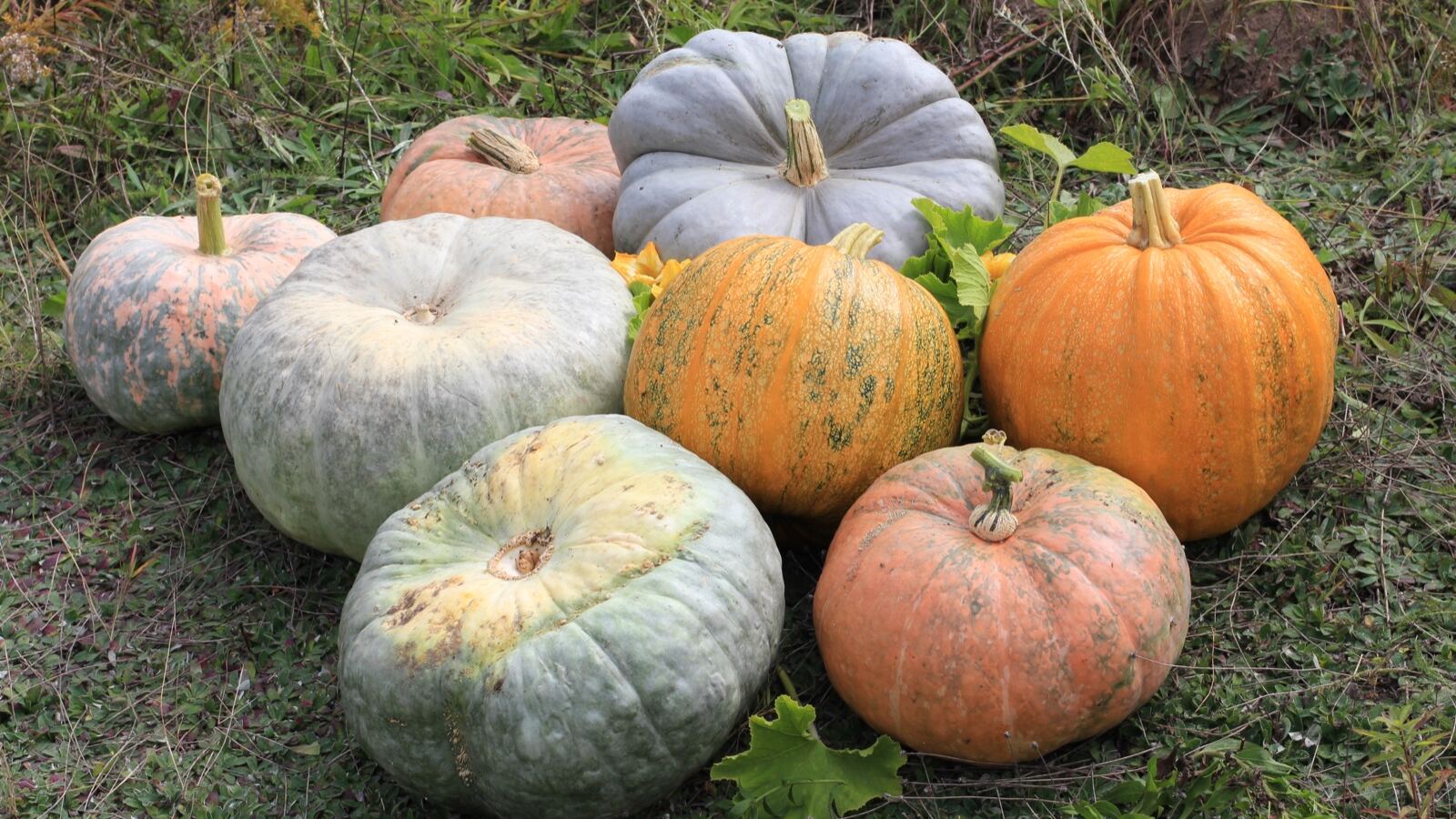
What they are
Cucurbita, from the Americas, and among the oldest cultivated plants in the New World — squash seeds in Mexican caves date back around 10,000 years, predating maize and beans.
Four domesticated species matter:
C. pepo — courgettes, marrows, most summer squash, acorn squash, many pumpkins, spaghetti squash. C. maxima — the giant pumpkins, Hubbard, Crown Prince, Kabocha. Generally the best flavour and the best keepers. C. moschata — butternut, Musquée de Provence. Needs more heat; excellent storage and good disease resistance. C. argyrosperma — cushaw, mostly grown in Central America.
Species matters for seed saving: they cross freely within a species and rarely between, so a courgette and an acorn squash will cross, while a courgette and a butternut generally will not.
The broader cucurbit family also holds cucumber, melon, watermelon, and gourds, which share most pests and diseases.
Summer against winter
Not a growing season distinction — a maturity one.
Summer squash, including courgettes, are picked immature with soft edible skin. They crop continuously for months, keep for days, and are the crop most likely to overwhelm you.
Winter squash are left to full maturity, develop a hard rind, are cured, and store for months. One harvest, then food through winter.
Both are usually sown at the same time. The difference is when you pick.
Male and female flowers, and why fruit rots
Cucurbits are monoecious: separate male and female flowers on the same plant. The female is unmistakable, with a miniature fruit already formed behind the petals; the male sits on a plain stem.
Plants produce males first, often for a week or two before any females open. New growers regularly conclude something is wrong. Nothing is — wait.
Each flower opens for a single day, usually a morning. Pollen must move from male to female in that window, and insects do it.
Which explains the commonest complaint: small fruit that yellow, shrivel, and rot at the tip. That is not disease. It is an unpollinated female aborting.
Causes and fixes:
Not enough insects. Cold, wet, or windy mornings keep pollinators in, and a garden with no flowers other than the crop has nothing resident. This is a direct, visible return on pollinator habitat and native bees.
Hand-pollinate. Pick a male, strip the petals, and dab the pollen onto the female's stigma, in the morning. Completely reliable, and worth doing under cover or in a poor summer.
Too few males or females. Extreme heat or heavy nitrogen skews the ratio.
Male flowers are themselves a delicacy, stuffed or fried, and picking a few costs nothing.
Feeding a very hungry plant
Squash are among the greediest crops in the garden, and they want three things in quantity.
Rich soil. The traditional method is to plant on a heap of half-rotted manure or compost, and it works. They are one of the few crops that genuinely thrive on fresh muck.
Water, constantly. Enormous leaf area means enormous transpiration. Water deeply at the base rather than over the leaves, which invites mildew. A mulch is close to essential. See mulching for moisture and deep watering.
Space. Trailing varieties run 2 to 3 m in every direction. Bush types need around 90 cm. Crowding causes mildew and disappointment.
The classic solution to the space problem is to grow them through something else — the squash of the three sisters, sprawling beneath maize and beans, where the big leaves shade the soil and suppress weeds. Or train climbing types up a strong frame, supporting heavy fruit in slings.
They are frost-tender and need warm soil. Sow indoors 3 to 4 weeks before the last frost, or direct-sow once the soil is warm. Sow seed on its edge to reduce rot.
Problems
Powdery mildew — a white dust on leaves, nearly universal by late summer. Rarely fatal, and delayed by wide spacing, watering at the base, and removing the worst leaves. Some varieties resist it well.
Slugs on young plants, which can remove a seedling overnight. See slugs and snails.
Squash vine borer and cucumber beetle in North America, both serious. Fleece until flowering excludes them; after that the plants need pollinators, so it must come off. See row covers and barriers.
Blossom end rot occasionally, and as in tomatoes the cause is irregular watering rather than a lack of calcium. See nutrient deficiency.
Fruit rotting on wet soil. Slip a tile, board, or straw pad under developing winter squash.
Harvest
Courgettes: pick at 10 to 20 cm, and pick every day or two in high summer. A courgette becomes a marrow in about 72 hours of inattention. Constant picking is what keeps the plant producing; leave one to mature and flowering slows markedly.
Winter squash: leave until the rind is hard enough to resist a fingernail, the stem is corky, and the colour is full. Harvest before the first hard frost.
Always cut with a good length of stem attached. A squash without its stem plug rots at the shoulder within weeks. Never carry one by the stem, which can snap it off.
Curing, which decides storage
The step that separates squash keeping until spring from squash rotting by November.
Cure winter squash for 10 to 14 days at 25 to 30 C in a dry airy place — a greenhouse, a sunny windowsill, an airing cupboard. The rind hardens and small wounds heal over.
Then store at 10 to 15 C, dry, not touching, with air circulating. Warmer and drier than the cold damp conditions that suit root crops.
Acorn types (C. pepo) are the exception and keep better without a warm cure.
Well-cured C. maxima and C. moschata hold for 6 months or more, and their flavour genuinely improves over the first month or two as starch converts to sugar. See harvest and storage.
Saving seed
Easy in principle: scoop, rinse, dry, store. Viable for 4 to 6 years.
The catch is crossing within a species, which is enthusiastic and insect-driven. Unless you isolate or hand-pollinate and bag, seed from a garden with several C. pepo varieties will produce something unpredictable next year.
Squash also cross with ornamental gourds, and the resulting fruit can be bitter and genuinely toxic. Taste a small piece of any home-saved squash before cooking a quantity; if it is bitter, discard it. See seed saving.
See also
- The Three Sisters squash as the ground layer
- Pollinator Habitat why fruit sets or aborts
- Harvest and Storage curing winter squash
- Composting Methods the manure heap they love
- Mulching for Moisture keeping up with their thirst
- Seed Saving crossing within a species
- Cucumbers
- Melons