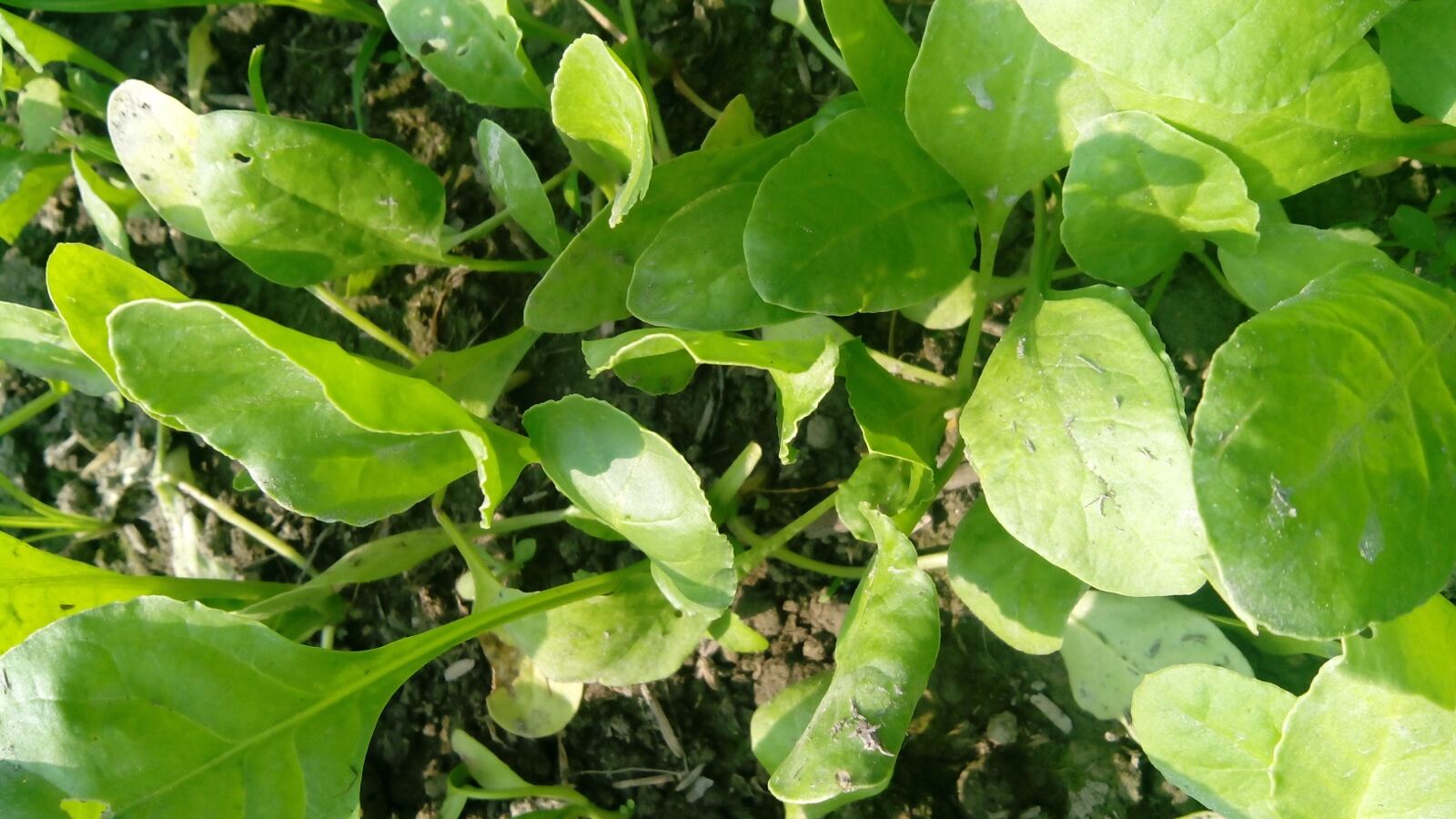
What it is
Spinacia oleracea, from Persia, in the amaranth family alongside beetroot, chard, and quinoa.
A cool-season annual with a short life and a strong urge to flower. Understanding that urge is essentially all of spinach growing.
Why it bolts
Spinach is a long-day plant. Once daylength passes roughly 13 to 14 hours, it switches from making leaves to making a flower stem, and the leaves go small, thin, and bitter.
Note that the trigger is daylength, not temperature. Heat and drought accelerate it, but a spinach plant in a cool June will still bolt because the days are long. This catches people out repeatedly: nothing was done wrong, the calendar simply ran out.
So the whole strategy is to grow spinach when the days are short:
Sow in late summer and autumn for the best crops, cropping into winter under a cloche and again in early spring.
Sow in very early spring for a fast crop before the days lengthen.
Do not bother with a midsummer sowing. It will bolt.
Bolt-resistant varieties buy weeks, not months.
Beyond daylength: keep it moist, keep it growing fast, and pick young. Any check — drought, root disturbance, crowding — brings bolting forward. See succession planting.
Growing it
Rich, moisture-retentive soil. Spinach is a fast leafy crop and wants nitrogen and water in steady supply.
Direct sow 2.5 cm apart, thinning to 15 cm for large plants, or leave dense for baby leaf. It transplants poorly.
Cool soil for germination. Spinach seed germinates badly above about 25 C, so late-summer sowings often fail on hot ground. Sow in the evening, water the drill first, and shade it.
Partial shade helps in warm weather.
pH 6.5 to 7.5. Spinach is notably intolerant of acid soil and will sulk and yellow on it, which is often misread as a nitrogen problem. See soil pH.
Pick outer leaves rather than cutting the whole plant, and it keeps producing for weeks.
The summer substitutes
Because true spinach will not stand summer, several unrelated plants are grown for the same purpose — this is a case where the sensible answer is a different species rather than a better technique.
Chard and perpetual spinach (Beta vulgaris) — the closest and most useful substitute, standing all summer and often all winter. Covered in beetroot and chard.
New Zealand spinach (Tetragonia tetragonioides) — unrelated, thrives in heat and drought, sprawls, and crops all summer. Pick the tips continuously.
Malabar spinach (Basella alba) — a tropical climber, needs real warmth, thick succulent leaves.
Amaranth leaf (Amaranthus species) — a hot-climate staple, extremely productive, and doubles as a grain crop.
Orach (Atriplex hortensis) — an old European leaf vegetable, tall, colourful, and slow to bolt.
A garden that grows spinach in spring and autumn and chard or New Zealand spinach through summer has cooked greens all year, which is what most people actually want when they say they want spinach.
Oxalic acid
Spinach is high in oxalates, which give it the characteristic dry, tooth-coating mouthfeel and bind calcium and iron in the gut.
This is the source of the persistent myth about spinach and iron. Spinach does contain iron, but the oxalates make much of it poorly absorbed — so it is a decent iron source, not the exceptional one of popular belief. (The often-repeated story of a misplaced decimal point in a nineteenth-century analysis is itself largely apocryphal, but the absorption point stands.)
Cooking and discarding the water reduces oxalates substantially, and pairing with a calcium source helps. Younger leaves and cooler growing conditions mean lower levels; stressed, bolting, mature plants have more.
Beetroot, chard, and sorrel share this chemistry, being close relatives.
Problems
Bolting, as above, and by a wide margin the main issue.
Downy mildew — yellow patches above, grey mould beneath, thriving in crowded damp conditions. Space widely, avoid overhead watering, and grow resistant varieties, of which many exist because the disease is so common.
Leaf miner, tunnelling between leaf surfaces, shared with beetroot and chard. Squash the larvae or remove leaves.
Slugs, especially on autumn and winter sowings. See slugs and snails.
Birds on seedlings.
Aphids in the crowns. See aphids.
Spinach has no major soil-borne disease requiring a long rotation, but it still belongs in a rotation with its relatives beetroot and chard.
Harvest and keeping
Pick in the morning, when leaves are full of water. Spinach wilts faster than almost any leaf and does not recover well.
Wash, spin dry, and store in a sealed box with kitchen paper — a few days at most.
It freezes very well after blanching, and since it collapses to a fraction of its volume when cooked, freezing is the practical answer to a spring glut. Blanch briefly, squeeze hard, and freeze in portions. See harvest and storage.
Saving seed
Spinach is dioecious — separate male and female plants — and wind-pollinated, so you need a population of both and real isolation from other spinach.
Male plants bolt first and die back; females carry the seed. Straightforward once you have several plants, but crossing is easy and seed is cheap, so most growers buy it. Viable 3 to 5 years. See seed saving.
See also
- Beetroot and Chard the close relative that stands summer
- Salad Leaves spinach in a cutting mix
- Succession Planting sowing for short days
- Soil pH why acid ground stunts it
- Harvest and Storage blanching and freezing a glut
- Frost Protection cloching an autumn sowing
- Buckwheat, Quinoa and Amaranth