What it is
Daucus carota, an umbellifer, related to parsnip, celery, fennel, parsley, dill, and the wild carrot of chalk grassland — and to hemlock, which is a good reason to be careful foraging in this family.
Biennial: it builds a storage root in year one and flowers in year two. We harvest at the end of year one, which is why bolting is a failure rather than a feature.
Orange is recent. Domesticated carrots were purple, yellow, and white; the orange types were selected in the Netherlands from the sixteenth century and now dominate so completely that the older colours are sold as novelties.
Direct-sow, always
Carrots have a taproot that resents disturbance absolutely. Transplant one and it forks or stalls.
So they are direct-sown, which means dealing with slow, erratic germination in open ground — 2 to 3 weeks, and longer in cold soil.
Sow thinly. The single most useful habit. Carrot seed is tiny and it is very easy to sow a thick ribbon that then needs thinning, and thinning is what attracts the pest in the next section.
Keep the surface moist until germination. A board or fleece laid over the row holds moisture and comes off at emergence.
Station sowing or pelleted seed both help avoid thinning altogether.
Sow from spring through midsummer for a succession. See succession planting and seasonal planning.
Why carrots fork
A forked or stumpy carrot is almost always one of three things, and none of them is bad luck.
Stones and clods. The taproot hits an obstruction and divides. Deep, stone-free, finely worked soil is what long varieties need — or grow short, stump-rooted, or round varieties, which are perfectly good and far less fussy on heavy or stony ground.
Fresh manure or over-rich soil. High nitrogen and lumps of undecomposed organic matter cause forking and hairy roots. Grow carrots on ground manured for a previous crop, never freshly manured. This is a standard reason carrots take a particular slot in crop rotation.
Compaction. A pan below the surface stops the root. See decompaction.
On difficult ground, raised beds or deep containers filled with a sieved open mix solve it entirely. See container growing.
Carrot fly
Chamaepsila rosae. The adult lays at the base of the plant and the larvae tunnel through the root, leaving rusty brown galleries. It is the defining pest of the crop and it is entirely preventable.
The key fact: the fly finds carrots by smell, and it flies low — generally below about 60 to 75 cm.
That gives several practical defences:
A physical barrier is the best answer. Fine insect mesh over hoops, sealed at the edges, for the whole crop's life. Or a vertical barrier of mesh 75 cm high around the bed, which the low-flying adults will not cross. See row covers and barriers.
Do not thin, or thin carefully. Crushed foliage releases the scent that attracts them from a long way off. If you must thin, do it on a still evening, remove every thinning from the site, and water afterwards to settle the soil.
Interplant with alliums. Onions, garlic, and chives mask the scent, and this is one of the better-supported companion planting claims. See companion planting guide.
Time the sowings. There are two main generations. Sowing after late spring and harvesting before autumn dodges much of the pressure.
Rotate, since pupae overwinter in the soil.
Resistant varieties exist and reduce but do not eliminate damage.
Other problems
Splitting from irregular watering — a dry spell followed by heavy rain. Even moisture, and mulch. See watering timing.
Green shoulders where the crown is exposed to light. Earth up lightly.
Bolting from cold shock after early sowing, or from drought stress. Use bolt-resistant varieties for the earliest sowings.
Slugs on young seedlings. See slugs and snails.
Aphids and the viruses they carry. See aphids.
Harvest and storage
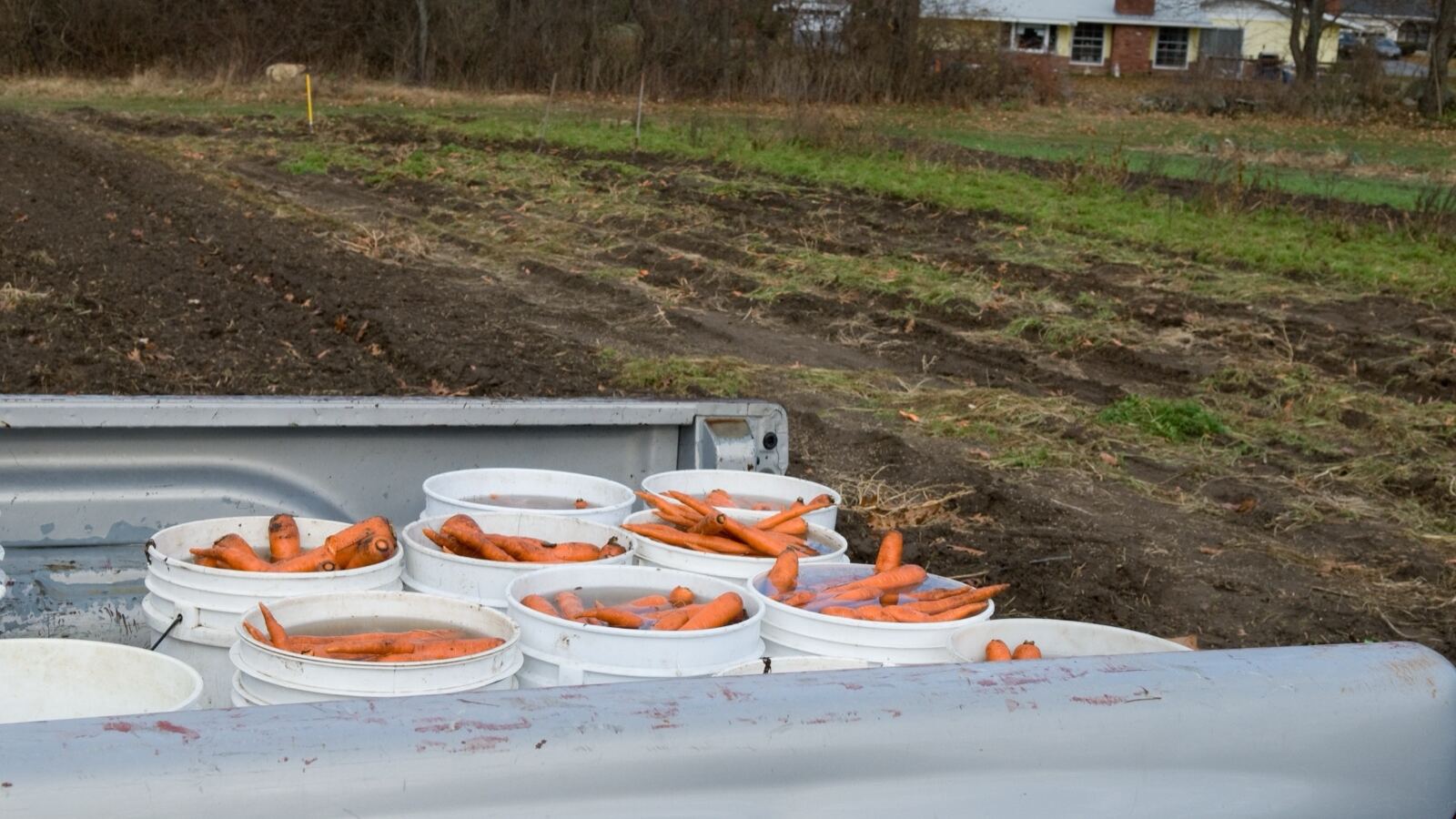
Pull when the shoulders reach the size you want — there is no other reliable signal. Water first if the ground is hard, or they snap.
In mild climates, leave them in the ground. Straw or fleece over the row, and lift as needed through winter. Flavour improves after frost as starch converts to sugar. The limits are ground freezing solid and slug damage. This is the best storage available and it costs nothing.
Otherwise store cold and damp: 0 to 4 C at 90 to 95 percent humidity. Cut the tops off — leaving them draws moisture out and the roots go limp. Layer in damp sand in boxes, which is what a root clamp does. They keep for months.
Do not store next to apples; ethylene makes carrots bitter. See harvest and storage.
The rest of the family
Parsnips are grown almost identically, need a longer season, and are markedly improved by frost. Their seed is very short-lived — buy fresh each year.
Umbellifer flowers are among the best nectar and pollen sources for hoverflies, parasitic wasps, and other predators, which is why letting a few carrots, parsnips, or fennel run to flower is worth doing deliberately. See hoverflies and pollinator habitat.
Saving seed
Biennial, so you must overwinter the root and let it flower in year two. It crosses readily with wild carrot and with other carrot varieties, so isolation is needed for true seed. See seed saving.
See also
- Row Covers and Barriers the fix for carrot fly
- Crop Rotation why carrots follow, not precede, manure
- Companion Planting Guide alliums as scent masking
- Harvest and Storage sand boxes and clamps
- Succession Planting spreading the sowings
- Hoverflies what the flowers feed
- Celery and Celeriac
- Beetroot and Chard
- Soil-Dwelling Pests
- Fennel and Chicory