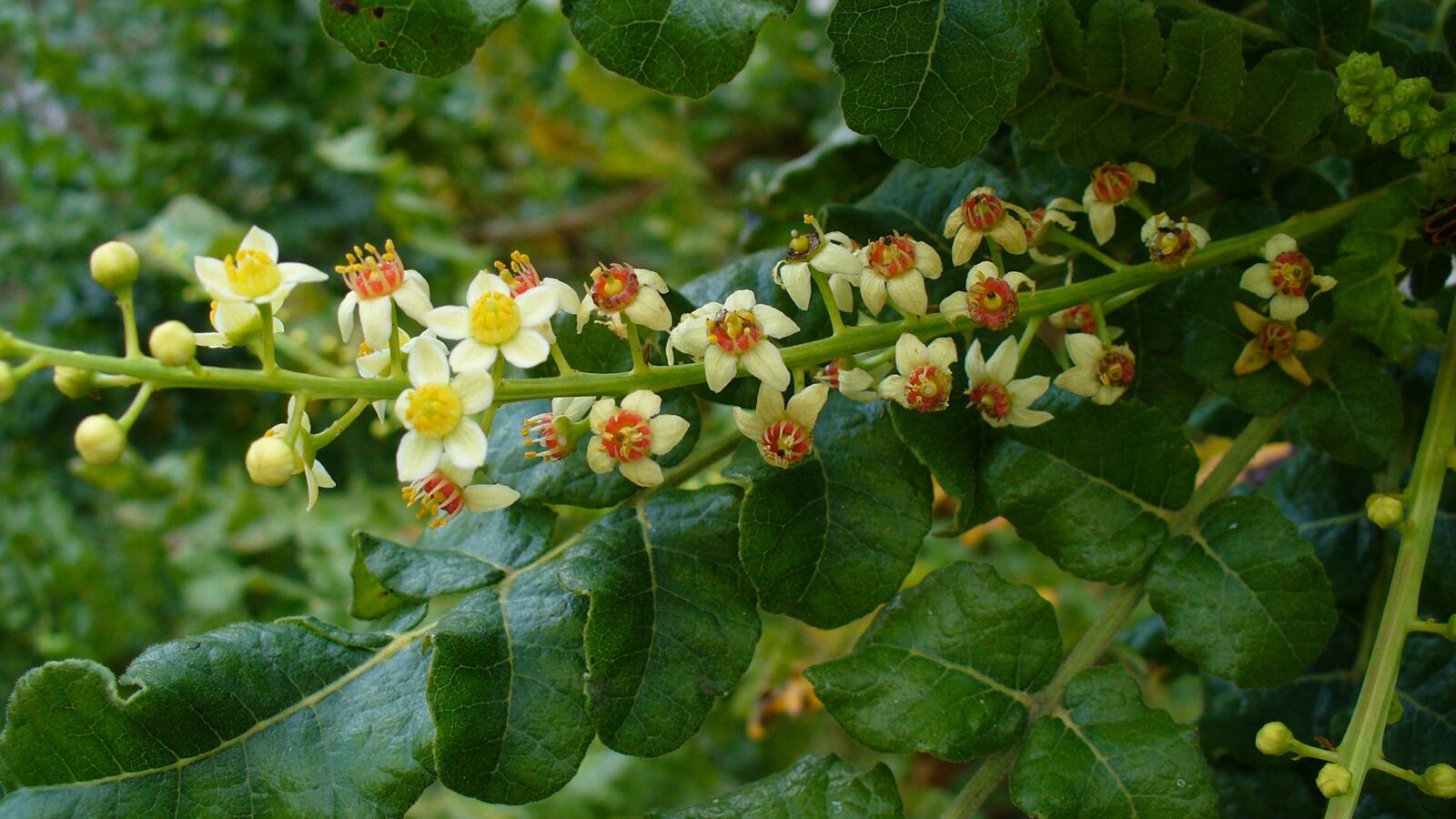
What they are
Two groups of small, gnarled, drought-hardy trees of the dry country of the Horn of Africa and southern Arabia, both in the torchwood family, Burseraceae, and both grown for the fragrant resin they exude when wounded:
Frankincense, from Boswellia trees (B. sacra, B. carterii, B. papyrifera and others), which produce the pale, lemony-piney incense resin;
Myrrh, from Commiphora trees, which produce a darker, bitterer, more medicinal resin.
Both are tough, often stunted, thorny or peeling-barked trees that cling to rock and thrive in some of the hottest, driest, most barren country on Earth — the same extreme-dryland niche as the baobab and the dragon tree, whose red "dragon's blood" is another such traded resin.
Resin as a defence, turned into treasure
The resin these trees are prized for is, to the tree, a wound response. When the bark is cut or damaged, the tree exudes a sticky gum-resin that hardens on contact with air, sealing the injury against infection and insects and drying into brittle "tears" — the same self-defence that produces pine rosin and amber.
Humans learned to exploit this by deliberately tapping the trees: making careful incisions in the bark, letting the resin bleed and harden for a couple of weeks, then collecting the tears and repeating. The dried tears are burned as incense — releasing their fragrance as they smoulder — and used in medicine, perfume, and embalming.
Worth more than gold
Frankincense and myrrh were among the most valuable commodities of the ancient world, and the trade in them shaped history.
Burned in vast quantities in the temples and funerals of Egypt, Mesopotamia, Greece, and Rome, and used in embalming, medicine, and perfume, the resins commanded enormous prices, and the incense trade routes carrying them north from southern Arabia across the desert to the Mediterranean built the wealth of a string of caravan cities and kingdoms — the "Incense Road" was as important as the Silk Road. That frankincense and myrrh appear as gifts fit for a king in the Nativity story reflects their real standing: they were treasures on a par with gold, the luxury goods of their age. Myrrh in particular was valued as a medicine and a wound-dressing, uses that modern research into its anti-inflammatory compounds has partly borne out, as it has for frankincense's boswellic acids.
Trees in trouble
The ancient trade continues — frankincense and myrrh are still tapped, traded, and burned, and demand has grown with the market for essential oils and aromatherapy — but the wild trees are now in decline, and the reasons are a cautionary tale about over-harvesting a slow desert plant.
Studies of Boswellia populations have found that over-tapping stresses the trees, reducing the seed they set and the vigour of their resin, while grazing by goats and cattle destroys the seedlings, fire and land clearance remove habitat, and beetle attack kills weakened trees. The result, as with the dragon tree, is an ageing population with little regeneration — old trees still bleeding resin but few young ones coming up to replace them, so the resource is being mined rather than harvested. Conservationists now argue for resting trees between tapping, protecting seedlings from browsing, and sustainable-harvest certification, because a frankincense tree pushed too hard for its resin slowly kills itself and its future. See dryland restoration, drought-tolerant species, and seed banking.
Growing them
Hot, dry, and frost-free: these trees want intense sun, heat, and extremely sharp drainage on poor, rocky soil, and they are adapted to survive long drought by storing water and dropping their leaves. They rot instantly in wet or cold conditions.
They are grown by specialist collectors and in botanic collections as curious, characterful bonsai-like plants (the swollen-based Boswellia and Commiphora are prized succulent-tree subjects), and in their native regions for resin. Slow, and propagated from seed (often difficult and low-viability, part of the regeneration problem) and cuttings. See propagation and erosion control for their role holding thin desert soils.
See also
- Dragon Tree another desert tree tapped for a fabled resin
- Baobab the fellow water-storing giant of dry Africa
- Dryland Restoration regenerating over-tapped, over-grazed desert trees
- Tamarind and Carob other economically vital dryland trees
- Seed Banking conserving declining wild resin trees
- Olive another ancient, long-lived Mediterranean economic tree
- Clove, Nutmeg, and Allspice
- Rosewood and Sandalwood
- Silverbell and Snowbell
- Sal Tree
- Padauk
- Cedar of Lebanon
- Pili Nut