What it is
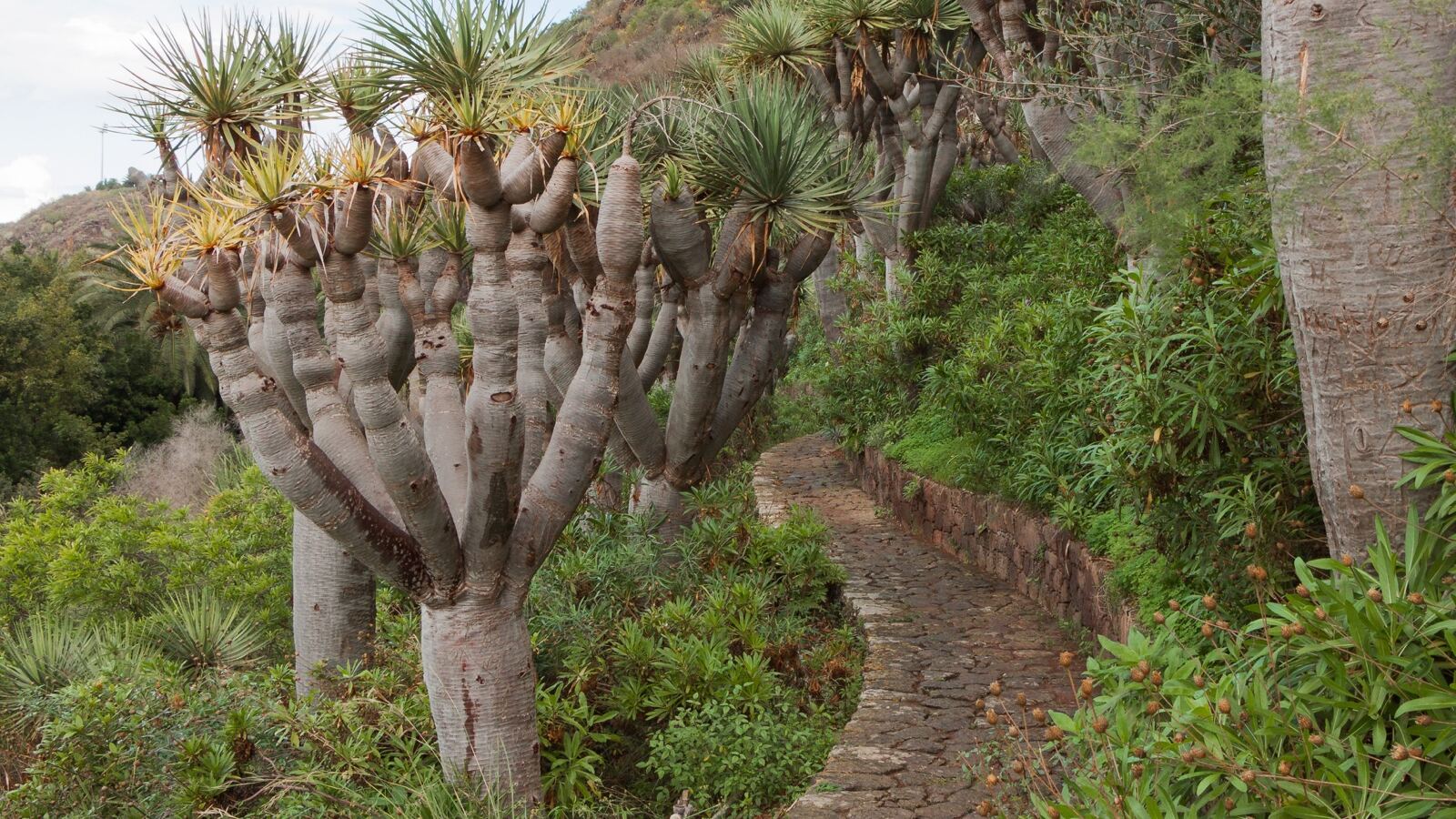
Dracaena, the dragon trees — most famously the Socotra dragon tree (Dracaena cinnabari) of the Yemeni island of Socotra, and the Canary Islands dragon tree (Dracaena draco) of Macaronesia — are among the strangest-looking trees on Earth, with a dense, upturned-umbrella or mushroom crown of stiff sword-shaped leaves held on repeatedly forking branches.
Like the palms, the yuccas, and the bananas, the dragon tree is not a "tree" in the ordinary sense at all: it is a monocot, a relative of the lilies and asparagus, with no true wood, no annual rings, and none of the normal machinery of a broadleaf or conifer trunk. That it grows into a massive, long-lived, tree-shaped organism at all is one of the surprises of the plant world.
Growing by forking
Because it lacks normal wood and cannot simply thicken and branch like an ordinary tree, the dragon tree grows in a peculiar, stepwise way that gives it its shape.
A young dragon tree grows for years as a single unbranched stem. Then it flowers for the first time, and the act of flowering causes the growing tip to divide — the stem forks into a whorl of new branches. Each of those grows on, unbranched, until it flowers and forks again. Over a very long life this repeated flowering-and-forking builds up the dense, domed, many-branched umbrella crown, and the number of branchings is a rough guide to the tree's age, since there is no other way to date a treeless of rings. The result is a living structure of extraordinary geometry and great age — the oldest are thought to be many centuries, and one famous Canary specimen was reputed (extravagantly) to be a thousand years old or more.
Dragon's blood
The tree's name and fame come from its sap. Cut or wound the bark and it exudes a deep red resin that dries to a dark crimson — "dragon's blood."
This blood-red resin has been a prized trade good since antiquity, gathered on Socotra and traded across the ancient world for use as a dye, varnish, medicine, and incense, and as a pigment — it coloured varnishes for violins and was used by alchemists and apothecaries. The dramatic red sap gave rise to the "dragon" legends and made the Socotra dragon tree one of the emblematic plants of the incense-and-resin trade that also carried frankincense and myrrh. Dragon's blood is still collected and sold.
An island tree in trouble
The Socotra dragon tree is the living symbol of Socotra, an island so isolated and biologically unique it is called the "Galápagos of the Indian Ocean," and the dragon tree is central to its otherworldly landscape and to its historical ecology.
But it is in serious decline, and its plight is a lesson in how a long-lived tree can be "the living dead." The old trees survive, but almost no young ones are establishing in the wild. Centuries of grazing by introduced goats eat the seedlings, and a drying climate is reducing the mist and monsoon moisture the tree depends on (its dense crown famously combs moisture from cloud and drips it to its own roots, a form of fog capture). So the population is ageing, with a canopy of ancient giants and no replacements — a forest of old individuals that is functionally failing to reproduce, and will collapse as those elders die unless seedlings can be protected. Fencing seedlings from goats and nursery propagation are the main hopes. See drought-tolerant species and seed banking.
Growing it
Warm, dry, and frost-tender: the dragon trees want full sun, sharp drainage, and dry, poor, rocky soil, and they are superbly drought-tolerant, storing water in their fibrous trunks. They rot in wet ground and dislike hard frost, though D. draco takes a touch.
Extremely slow-growing and effectively permanent, they make spectacular architectural specimens for hot dry gardens and large pots, and are widely grown as such well beyond their native islands. Propagated from seed (slow) and cuttings. A dragon tree is a plant to pass down generations. See propagation.
See also
- Frankincense and Myrrh the other resin trees of the same ancient trade
- Joshua Tree and Yuccas the other tree-forming desert monocots
- Palms the fellow monocots that grow tree-sized without true wood
- Fog Nets the cloud-moisture capture the dragon tree performs naturally
- Drought-Tolerant Species the dragon tree's water-storing survival
- Baobab another iconic, water-storing, long-lived dryland tree
- Quiver Tree
- Ocotillo and Boojum
- Travellers Palm