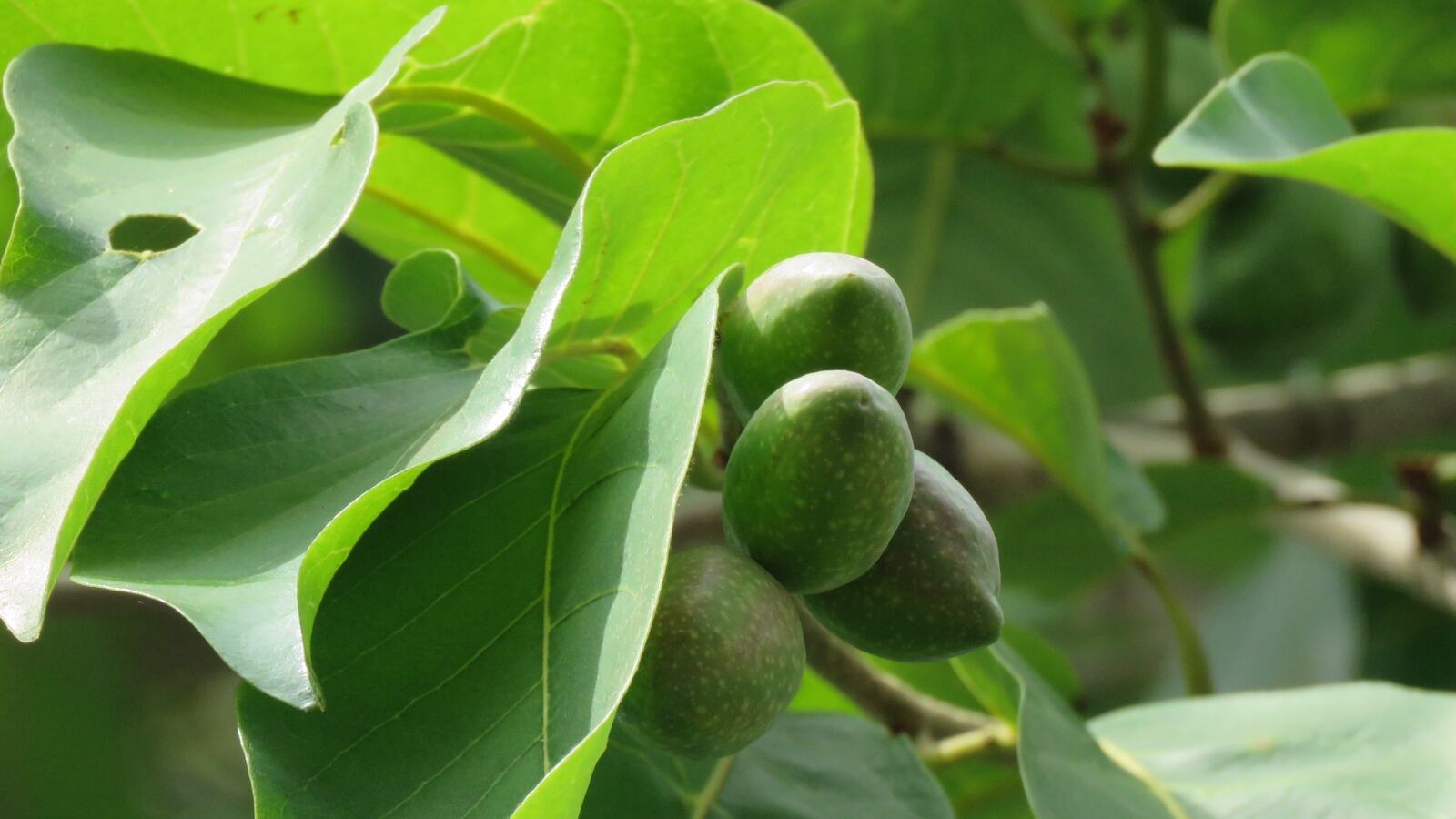
What it is
Terminalia chebula, the chebulic myrobalan or haritaki — a medium-to-large deciduous tree of the forests of South and Southeast Asia, bearing small, hard, ribbed, plum-like fruit that dry to a wrinkled brown, and one of the most revered medicinal plants of the Indian subcontinent.
It belongs to the genus Terminalia, which makes it a close relative of the arjuna (the heart tree) and the tropical almond — a family of trees whose fruit and bark are extraordinarily rich in tannins, and whose chemistry has given India some of its most important medicines and dyes. (The related T. bellirica, beleric myrobalan or bibhitaki, is its constant partner.)
The king of medicines
In Ayurveda, myrobalan is not merely a useful herb — it is often called the "king of medicines," among the most valued and widely used of all healing plants, and it is one of the three fruits (with the amla and the beleric myrobalan) that make up triphala, the most famous of all Ayurvedic formulas.
Haritaki is prized above all as a gentle, regulating remedy for digestion and elimination (a mild laxative and tonic for the gut), and as a rasayana — a rejuvenating, longevity-promoting tonic — used across an enormous range of complaints. It is so esteemed that in Buddhist tradition the Medicine Buddha is often depicted holding a sprig or fruit of myrobalan, the very emblem of healing. The fruit is intensely astringent and bitter, rich in tannins and other compounds that modern research has examined for antioxidant, antimicrobial, and digestive effects, and it remains one of the most-used herbs in South Asian traditional medicine. See historical ecology.
Ink, dye, and leather
The same tannin-rich fruit that made myrobalan a great medicine made it a great industrial material, and here its reach extended across the world.
Myrobalan fruit is exceptionally high in tannins, and it was a major source of:
- Tannin for leather — myrobalan was a significant vegetable-tanning material, exported in quantity, in the way quebracho and oak and sumac were used;
- Dye — it gives a range of yellow, khaki, black, and (with iron) grey and black dyes, long used for cotton and silk, and it is one of the classic natural dyes of Indian textiles;
- Ink — its tannins, combined with iron salts, make a durable black iron-gall-type ink, in the same chemistry as the oak-gall ink that wrote much of the manuscript record of the world.
So a single Indian forest fruit served as medicine, tannin, dye, and ink — a remarkable concentration of usefulness in one hard little drupe, and a mainstay of trade and craft for centuries.
Growing it
Tropical to subtropical, and reasonably hardy for a tropical tree (it grows from the plains well into the foothills), myrobalan is a tough, adaptable tree of dry and moist deciduous forest, wanting warmth, a seasonal climate, and a range of soils, and tolerating some drought and poor ground once established. It is a large, long-lived, deciduous tree with a spreading crown.
It is grown from seed and is an important tree in Indian forestry, agroforestry, and restoration, valued for its fruit (medicine, tannin, dye), its timber, and its role in dry forest. The flowers feed bees. As a medicinal-and-industrial tree of the first rank, revered and useful in equal measure, the myrobalan deserves its title. See propagation.
See also
- Amla its partner in triphala, the great Ayurvedic formula
- Arjuna and Tropical Almond its Terminalia relatives
- Quebracho and Sumac and Smoke Tree other great tannin sources
- Native Oaks whose oak galls make the same iron-gall ink
- Historical Ecology myrobalan as medicine, dye, and ink
- Bael and Ashoka Tree other revered medicinal Indian trees
- Kakadu Plum