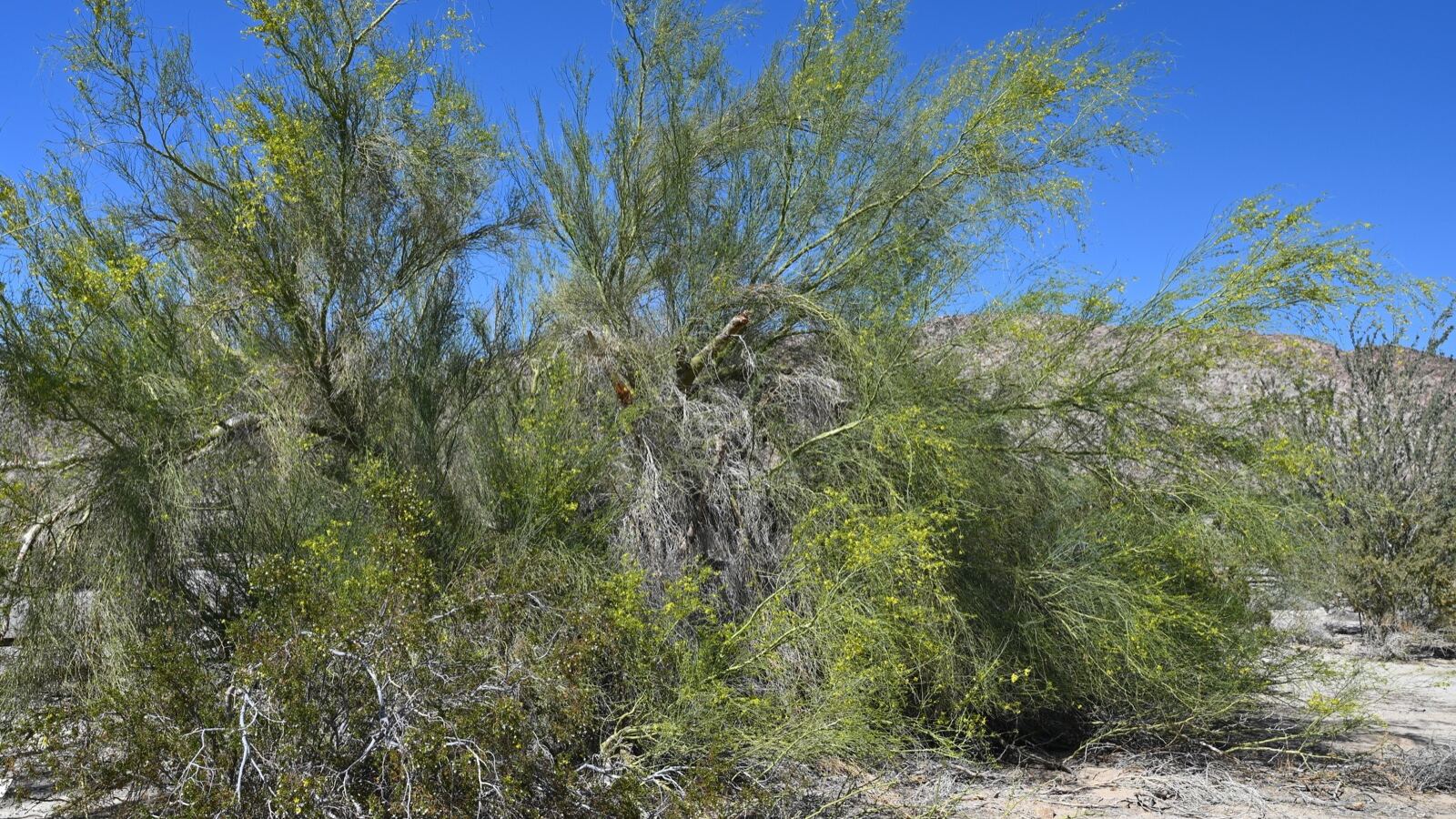
What it is
Parkinsonia (and the closely related Cercidium), the palo verdes — small, spiny, yellow-flowered leguminous trees of the deserts of the American Southwest and Mexico, of which the blue palo verde and foothill palo verde are the best known. The name is Spanish for "green stick," and it describes the tree exactly.
Palo verde is the state tree of Arizona and one of the defining plants of the Sonoran Desert, drought-adapted in a way that shows on its very surface.
Photosynthesis in the bark
Palo verde's signature adaptation is that its trunk, branches, and twigs are green and photosynthetic.
In the desert, leaves are a liability: they present a large surface to the drying air, and a tree loses precious water through them. Palo verde's answer is drastic. It carries only tiny leaves, and it drops them entirely in drought, standing leafless through the hardest, driest months — and yet it keeps photosynthesising, because chlorophyll is embedded in the green bark of the stems themselves. The tree effectively moves its food-making from the vulnerable leaves to the water-thrifty trunk, so it can keep growing while shedding the leaves that would bleed it dry. It is one of the most elegant water-saving designs in any tree, a companion strategy to the deep taproot of the mesquite and the water-storing trunk of the baobab. After rain it flushes fresh leaves and, in spring, drenches itself in bright yellow blossom that turns whole desert hillsides gold.
Nurse of the saguaro
Palo verde has a famous ecological partnership: it is the principal nurse tree of the giant saguaro cactus.
A saguaro seedling is tiny, slow, and desperately vulnerable to sun, frost, drought, and being eaten. Almost the only way one survives its first decades is to germinate in the shade of a "nurse" plant — most often a palo verde — whose canopy shelters it from extreme sun and cold, whose roots and litter enrich and cool the soil, and whose thorns hide it from grazers. Under that protection the saguaro slowly establishes, and over a century or two it may outlive and even overtop its nurse. This "fertile island" effect — a tough pioneer creating the shaded, enriched microhabitat that lets other species establish — is the same mechanism at the heart of dryland restoration and desert succession, and palo verde is its classic example. As a legume it is also a nitrogen fixer, enriching the poor desert soil around it, which is part of why so much germinates in its shelter.
In the desert garden
Palo verde is widely planted as an ornamental and shade tree in hot, dry cities — Phoenix and Tucson especially — precisely because it asks for almost no water once established, flowers spectacularly, and casts a light, filtered shade that suits a desert garden. Hybrid cultivars ('Desert Museum' is the famous one) combine the best flowering, a thornless habit, and vigour. It is a model tree for low-water urban landscaping (xeriscaping) in the hot arid Southwest, doing there what tough drought-tolerant species do everywhere the water runs short. See urban forestry and drought-tolerant species.
Growing it
Full sun and heat; poor, sandy, rocky, well-drained desert soil. It wants aridity and resents rich soil, shade, humidity, and above all wet or poorly-drained ground and hard frost.
Fast for a desert tree once its roots are down, spiny (choose thornless cultivars for gardens), and reasonably long-lived. Water deeply but very infrequently to build the deep root system; overwatering makes soft, weak, short-lived growth. Grows readily from scarified seed. A relative, Parkinsonia aculeata (Jerusalem thorn), is a pantropical species that has become an invasive weed of rangelands in Australia and Africa, the usual caution for a tough seed-heavy legume — so check which species suits which place. See propagation.
See also
- Mesquite the deep-rooted desert legume it grows beside
- Nurse Trees palo verde nursing the saguaro
- Nitrogen Fixers its soil-enriching role in the desert
- Dryland Restoration fertile islands and desert succession
- Drought-Tolerant Species palo verde for low-water planting
- Baobab another tree built around saving water
- Ocotillo and Boojum
- Silk-Floss Tree
- Desert Ironwood
- Chinese Parasol Tree