What it is
Bixa orellana, the annatto or achiote tree — a small, fast-growing evergreen tree or shrub of tropical America, grown throughout the tropics for the vivid orange-red dye coating its seeds.
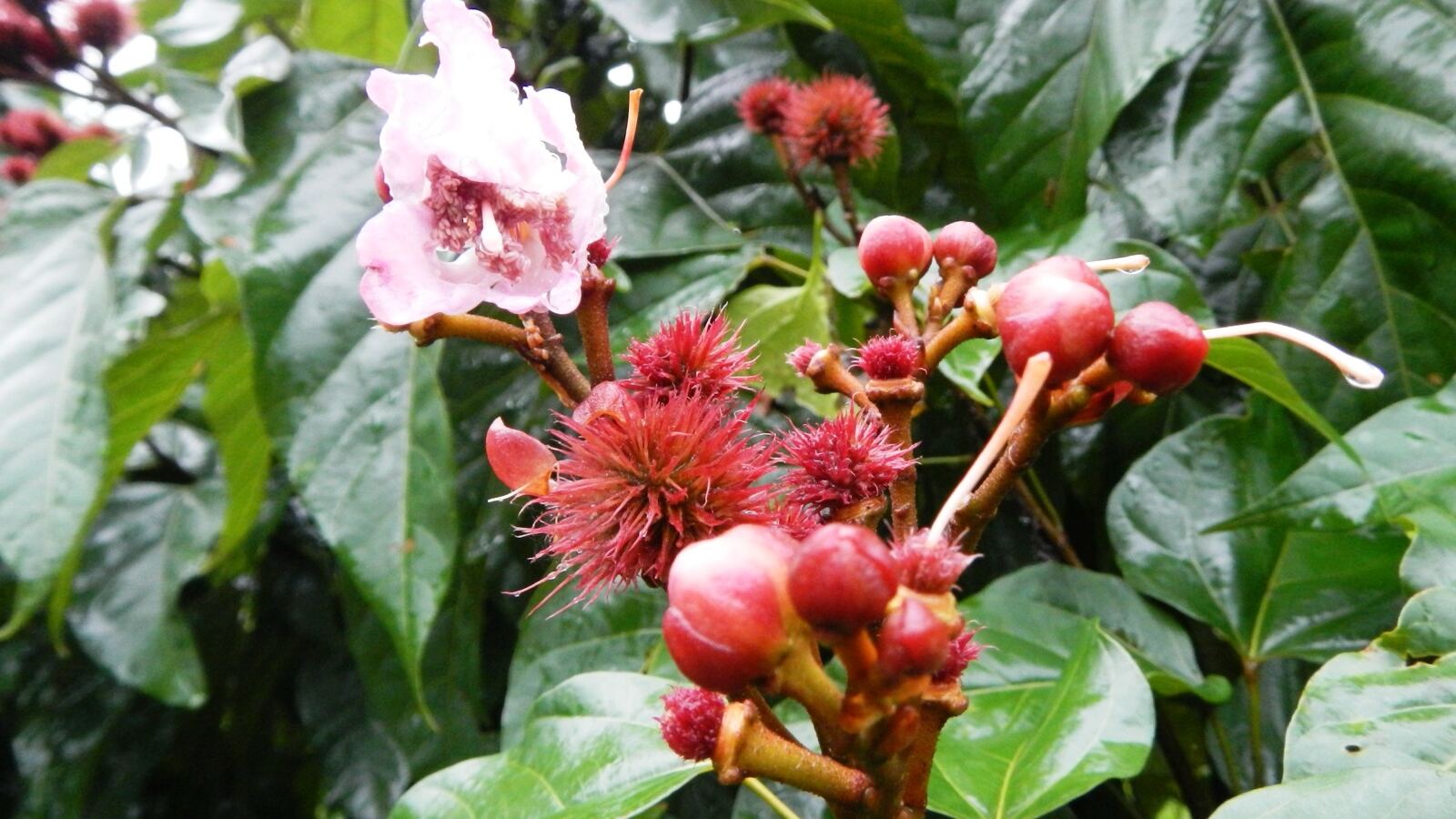
The tree bears clusters of pretty pink flowers followed by spiny, heart-shaped red or brown seed pods, and when a pod splits it reveals dozens of small seeds each thickly coated in a bright, brick-red, waxy pigment (mostly the compound bixin). That pigment is the whole point of the tree, and it has coloured food, bodies, and cosmetics across the Americas for thousands of years.
From body paint to lipstick
For the Indigenous peoples of tropical America, annatto — achiote, urucum — was, and is, far more than a dye. The red seed paste was used as body and face paint, for decoration, ritual, and identity, and as a practical insect repellent and sunscreen smeared on the skin; some Amazonian peoples are known for their striking red-painted bodies, coloured with annatto. It dyed textiles, feathers, and pottery, and it flavoured and coloured food.
This cosmetic use gave the tree one of its common names: the "lipstick tree." Annatto was, in effect, one of the world's original lipsticks and rouges, and — coming full circle — bixin from annatto is still used today as a natural colourant in lipstick, cosmetics, and soaps, a red pigment safe enough to put on skin and in food. See historical ecology.
The colour in your fridge
Annatto's biggest modern role is as a natural food colouring — one of the most widely used of all, and quite possibly in your kitchen right now, giving foods their warm orange-yellow hue without an artificial dye.
It is the traditional colouring of cheese — the orange of many cheddars, Red Leicester, Mimolette, and the rind of Edam is annatto (the cheese itself is naturally pale; the colour is added) — and of butter and margarine, of smoked fish (kippers, smoked haddock), of the golden Latin American and Filipino rice and stew dishes (where achiote is a foundational flavouring, not just a colour), of custards, snack foods, and countless processed products. Listed as E160b, annatto is prized because it is a natural, plant-derived colour that is generally very well tolerated (though, like anything, a rare few are sensitive to it), which has made it increasingly popular as manufacturers move away from synthetic dyes. So a spiny red pod from a small tropical tree quietly colours a large share of the world's cheese, butter, and rice.
Growing it
Tropical to warm-subtropical and frost-tender, annatto is fast, tough, and easy: it wants full sun and well-drained soil and tolerates a wide range of conditions, heat, and some drought, cropping young and heavily. It is a handsome ornamental in its own right — glossy leaves, pink flowers, and showy red pods — as well as a useful dye and spice plant, and it makes a good small tree or hedge for a tropical garden or food forest.
It is grown very easily from seed (which is also, of course, the product) and from cuttings. The seeds are harvested from the ripe pods and used whole, ground, or steeped in oil or water to extract the colour. As a fast, pretty, useful, and globally important little tree, annatto is one of the most rewarding of tropical dye-and-spice plants. See propagation and tropical fruit trees.
See also
- Logwood and Brazilwood the great tropical timber-dye trees
- Cinnamon and Camphor and Clove, Nutmeg, and Allspice other tropical spice-and-colour trees
- Historical Ecology annatto as body paint and dye
- Food Forest Design annatto as a fast, useful small tree
- Tropical Fruit Trees the wider warm-climate tree palette
- Propagation raising annatto from its dye-coated seed
- Genipap