What it is
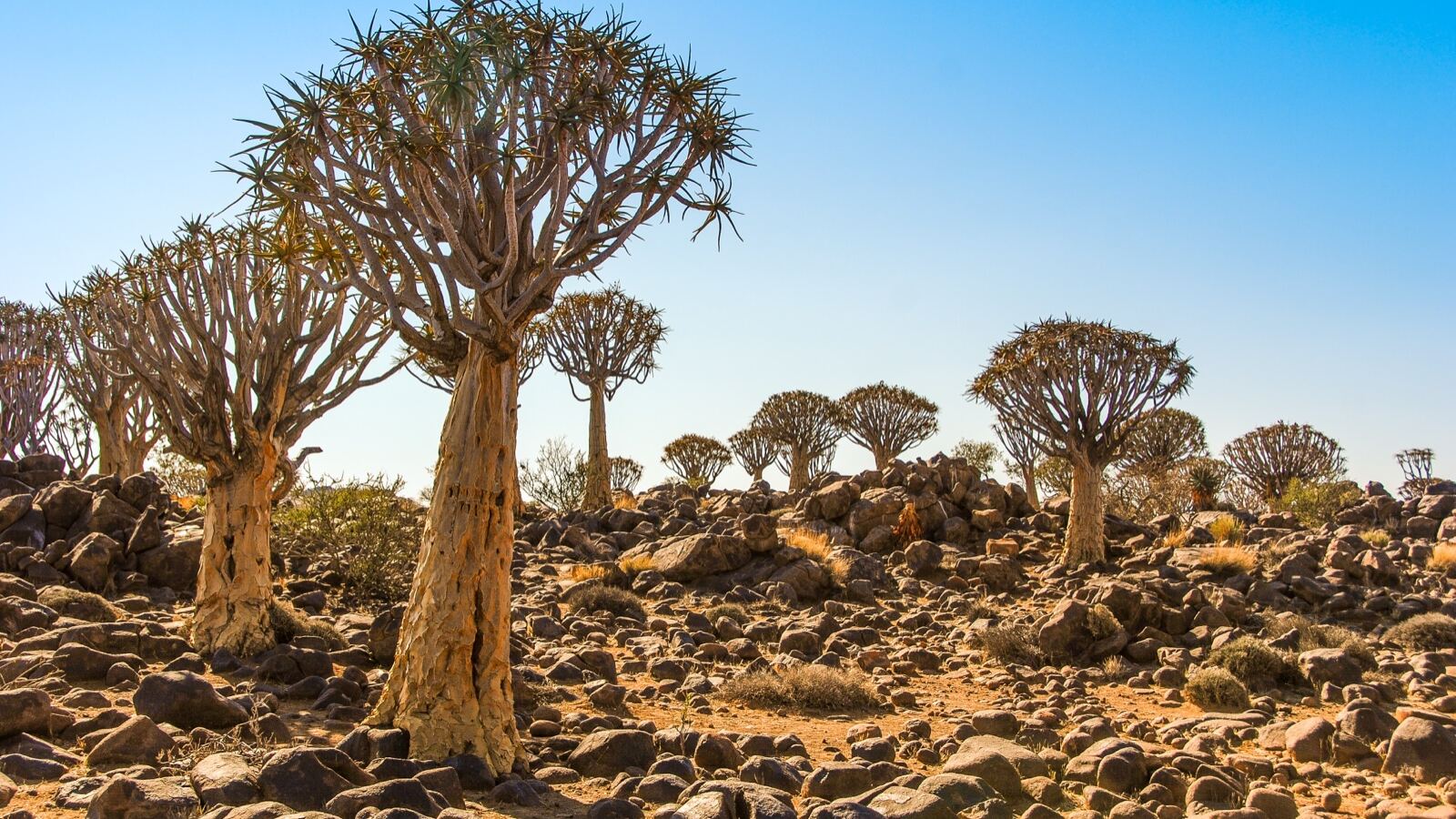
Aloidendron dichotomum (long known as Aloe dichotoma), the quiver tree or kokerboom, a tree-sized aloe of the arid Northern Cape of South Africa and southern Namibia — one of the iconic plants of the southern African desert, and the national plant of Namibia.
Like the dragon tree, the yuccas, and the palms, it is not a "tree" in the conventional sense but a giant succulent monocot — a member of the aloe family grown to tree size, with no true wood, a thick water-storing trunk covered in beautiful golden peeling bark, and a crown of stout branches each tipped with a rosette of fleshy, blue-green aloe leaves. Its name dichotomum refers to the way the branches repeatedly fork in two (dichotomous branching) to build the rounded crown, the same forking growth as the dragon tree.
The quivers, and survival in the desert
The quiver tree earns its name from a practical use: the San (Bushmen) people traditionally hollowed out the tubular, fibrous, pithy branches to make quivers for their arrows — the light, hollow branch making a natural case — which is also the source of the Afrikaans name kokerboom ("quiver tree").
The tree is superbly adapted to its brutally hot, dry environment. It stores water in its thick trunk and leaves to ride out long drought; its white, powdery, reflective bark helps deflect the fierce desert sun and reduce water loss; it can shed branches to survive extreme drought; and its winter flowers — bright yellow, rich in nectar — feed birds (sunbirds and weavers), baboons, and insects at a lean time of year, making it a keystone desert food source. Weaver birds famously build their huge communal nests in its branches. These are the classic desert-survival traits of a drought-tolerant succulent tree, shared with the baobab and dragon tree. Old quiver trees, growing very slowly, may be centuries old.
A tree walking from the heat
The quiver tree has become one of the most-cited living indicators of climate change, because it is visibly dying at one edge of its range and spreading at the other — a tree, in effect, on the move.
Long-term studies across its range have found that quiver tree populations in the hotter, drier, equator-ward (northern) parts of its range are dying off — the adult trees perishing in the intensifying heat and drought, with too few seedlings surviving to replace them — while populations toward the cooler, pole-ward (southern) edge are faring better and, in places, expanding. In other words, the species' viable zone is shifting southward as the climate warms, and the trees are being killed off behind the advancing edge faster than they can colonise ahead of it, because they grow and disperse so slowly.
This makes the quiver tree a textbook, and poignant, real-world example of a species' range shifting under climate change — the same pressure threatening the Joshua tree in the Mojave — and of the danger for a slow-growing, slow-dispersing plant that cannot move fast enough to keep pace with a warming world. Watching where the quiver trees live and die has become a way of watching the climate change. See dryland restoration.
Growing it
Strictly a desert plant: the quiver tree wants intense sun, heat, and extremely sharp drainage on poor, rocky, sandy soil, and it will rot almost instantly in wet, humid, or cold conditions — it is grown successfully only in hot, dry climates and in specialist succulent collections, where it is a prized architectural plant.
It is very slow-growing, long-lived, and effectively permanent, and it is grown from seed (slow) and, with difficulty, from cuttings. Water it very sparingly, especially in winter, and never let it sit wet. Like the dragon tree, it is a plant to grow for a lifetime and beyond, and a living emblem of the desert. See propagation and drought-tolerant species.
See also
- Dragon Tree the other great forking, succulent "tree" of dry lands
- Joshua Tree and Yuccas another desert plant on the move from the heat
- Baobab the fellow water-storing African desert giant
- Climate Adaptation ranges shifting as the world warms
- Drought-Tolerant Species the quiver tree's desert survival
- Palms more tree-sized monocots without true wood
- Kurrajong and Bottle Trees