What it is
Canarium ovatum, the pili — a tall tropical forest tree of the Philippines (especially the Bicol region) and Southeast Asia, grown for its rich, delicious nut.
It belongs to the torchwood family, Burseraceae — the same family as the frankincense and myrrh trees — and, like them, it is aromatic and resinous: the pili and its relatives yield a fragrant resin (elemi) used in varnishes, incense, and perfume, so the tree gives both a fine nut and an aromatic gum. It is a large, handsome, evergreen tree, notably wind-firm — an important virtue on the typhoon-battered coasts where it grows.
One of the finest of nuts
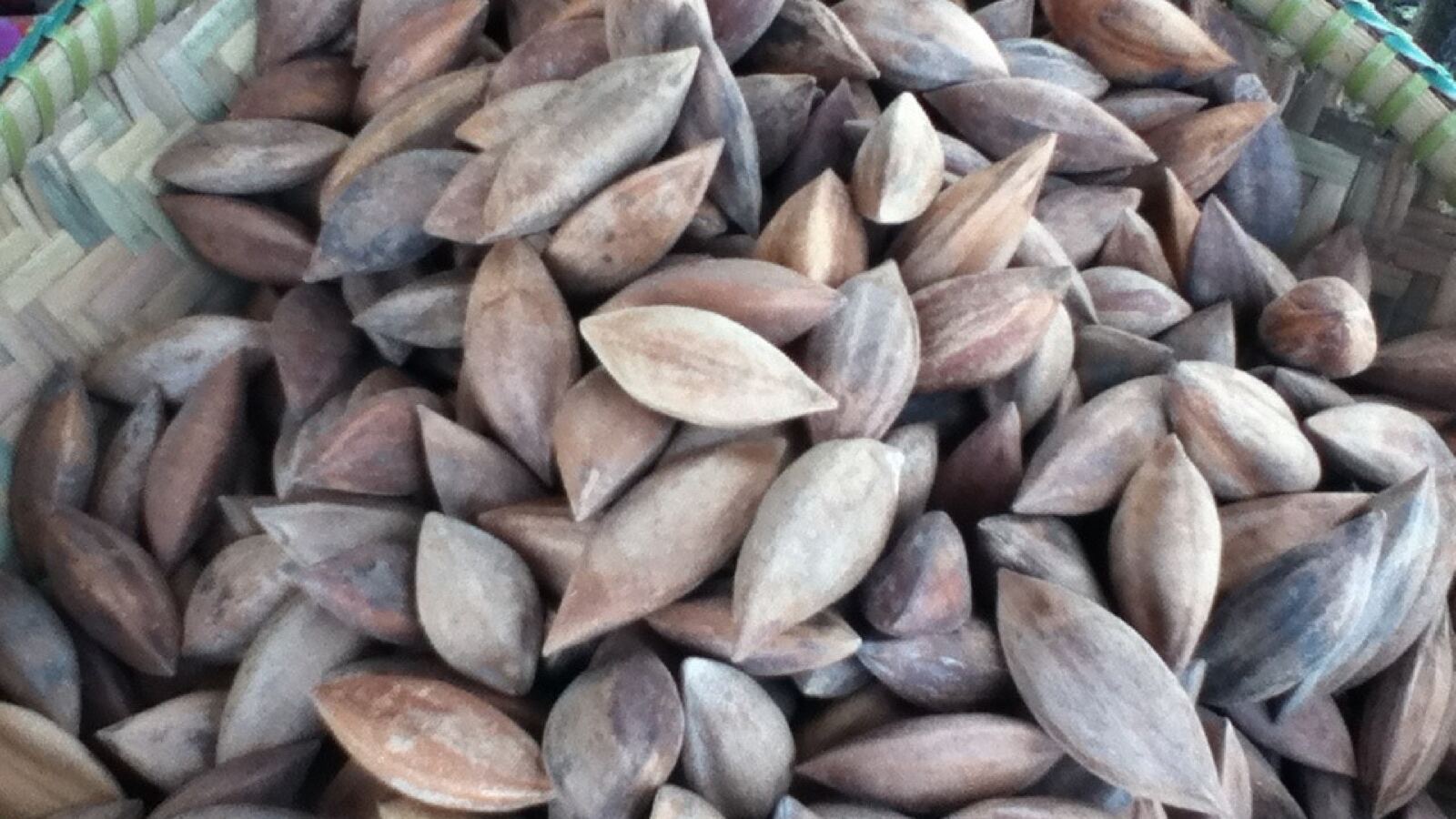
The pili nut is, by the reckoning of many, one of the richest and most delicious of all edible nuts. Inside a hard, black, pointed shell (which is tough to crack — the main obstacle to the nut's wider fame) sits a kernel that, raw, is soft and reminiscent of a mild sunflower seed, and, roasted, becomes wonderfully buttery, sweet, and nutty — richer than an almond, tender and melting, widely considered superior to the almond in flavour.
Pili is a beloved specialty of the Bicol region, where the roasted nuts, and the sweets and pastries made from them (pili brittle, pili tarts, candied pili), are a signature product. The kernel is exceptionally high in fat and calories, and this — plus its fine flavour — has driven a recent surge of international interest in the pili nut as a gourmet and "keto"/low-carb superfood, sold roasted, sprouted, and as pili oil and pili butter. It is a rare case of an obscure regional forest nut breaking onto the world specialty market. Beyond the kernel, the fruit's thin flesh (the "pili pulp") is eaten cooked, the young shoots are eaten, and the resin is tapped — a thoroughly useful tree. See restoration economics and macadamia and tropical nuts.
Growing it
Tropical, frost-tender, and a tree of the hot, humid, lowland tropics, the pili wants heat, high rainfall, humidity, and deep, rich, well-drained soil; it is intolerant of drought and cold but notably tolerant of strong wind and typhoons, deep-rooted and wind-firm, which suits it to the storm-prone coasts of its home and makes it a good, sturdy shade and orchard tree there.
It is a large, slow-to-moderate, long-lived tree, dioecious or polygamous (so both sexes are needed for a good nut crop), and grown from seed (which must be sown fresh) and by grafting for superior, earlier-bearing types. As a source of one of the world's finest nuts, an aromatic resin, and sturdy typhoon-resistant shade, the pili is one of the most valuable and underused of tropical nut trees, and a natural component of a Southeast Asian food forest. See propagation and grafting.
See also
- Macadamia and Tropical Nuts the pili among the wider tropical nuts
- Frankincense and Myrrh its aromatic, resin-yielding family relatives
- Brazil Nut another rich forest nut of the tropics
- Tropical Fruit Trees the wider warm-climate tree palette
- Restoration Economics a regional nut on the global specialty market
- Food Forest Design the pili as a nut-and-shade tree