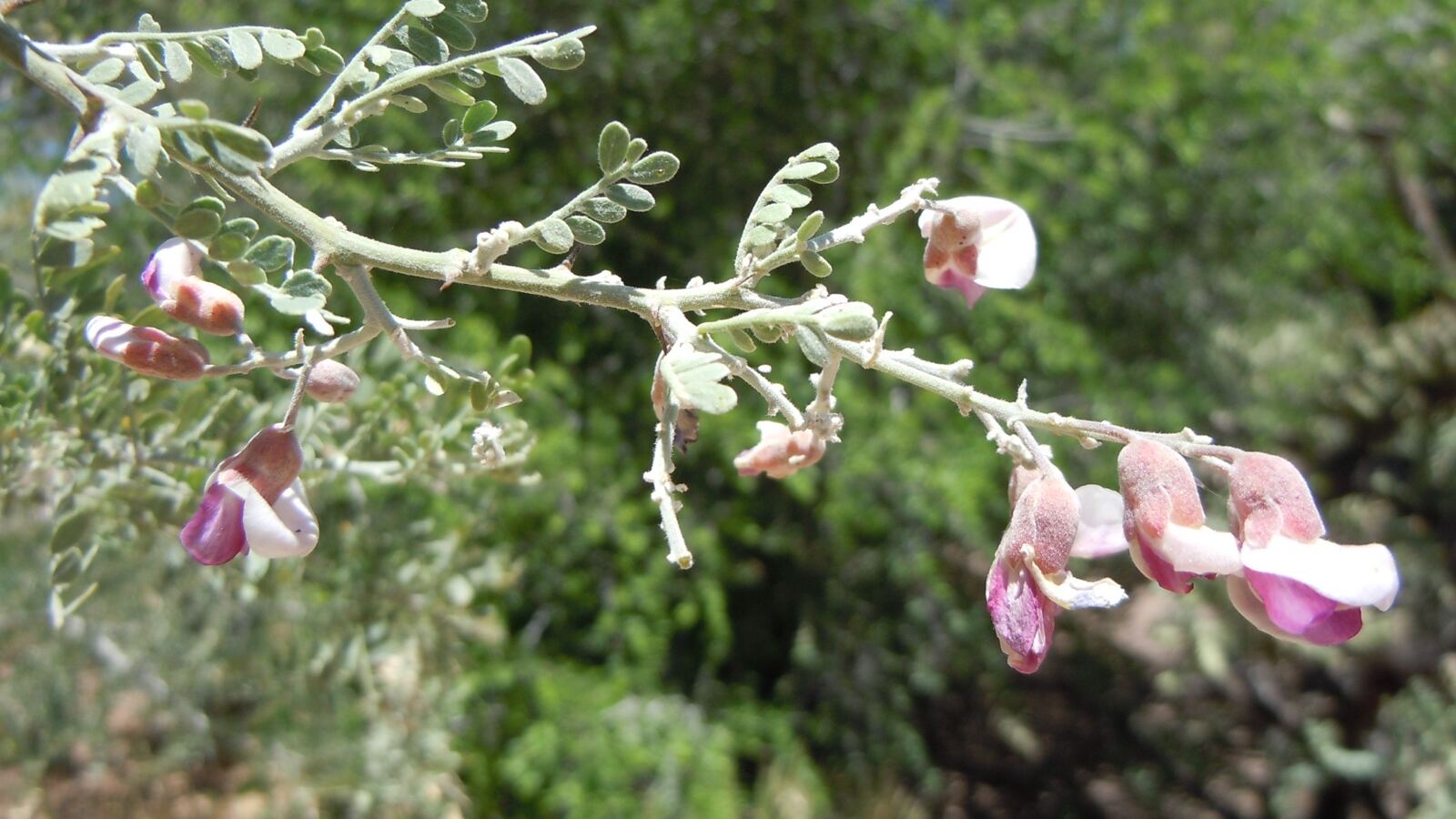
What it is
Olneya tesota, the desert ironwood — a small, slow-growing, evergreen leguminous tree found only in the Sonoran Desert of Arizona, California, and northwestern Mexico, and one of the keystone trees of that ecosystem.
It is the sole species in its genus, a legume like the mesquite and palo verde it grows among, and — as its name promises — it grows one of the densest, hardest woods of any desert tree, dense enough to sink in water, one of the many unrelated trees around the world called "ironwood," in the company of the hop-hornbeam and lignum vitae.
Nurse of the desert
The desert ironwood's great ecological role is as a nurse tree — perhaps the most important in the Sonoran Desert. Its dense, evergreen canopy casts deep shade and shelter, and beneath it the conditions are transformed: cooler in the fierce sun, warmer on cold desert nights, moister, richer in nutrients (it is a nitrogen fixer, and its litter builds soil), and hidden from grazers.
Under that protection, the seedlings of a great many other desert plants — including the giant saguaro cactus and dozens of others — germinate and survive their vulnerable early years, exactly as they do under the palo verde. A single old ironwood becomes a "nurse plant" sheltering a whole community of species in its shade, a fertile island in the desert, and studies have found far greater plant and animal diversity beneath ironwoods than in the open desert around them. This makes the desert ironwood a genuine keystone species, and its slow, long life — individual trees may live over 1,500 years, among the oldest desert plants — means each one shelters generations of other plants. See dryland restoration, keystone species, and structural diversity.
The wood, the carvings, and the charcoal
The extraordinary density and rich, dark, figured grain of ironwood have made its wood prized for carving. The Seri (Comcaac) people of the Sonoran coast of Mexico are famous for their beautiful ironwood carvings — sleek animals and sea creatures polished from the hard, heavy, dark wood — which became an important art form and source of income, later widely (and more crudely) imitated.
But the wood's value has also been the tree's danger. Because ironwood is so dense it makes superb, hot, long-burning charcoal, and it has been cut illegally on a large scale for charcoal and firewood, especially in Mexico — killing slow, ancient, keystone trees for fuel, and with them the nurse-plant communities they shelter. The loss of an ironwood is not the loss of one tree but of a whole small ecosystem, and its slow growth means it cannot quickly be replaced. This has made ironwood conservation a real concern, and the establishment of the Ironwood Forest National Monument in Arizona and protections in Mexico reflect the tree's ecological importance. See restoration economics and woodland management.
Growing it
Strictly a Sonoran Desert tree: desert ironwood wants intense sun and heat, extremely sharp drainage, and dry, poor, alkaline desert soil, and it is very frost-sensitive (its distribution is limited by cold, marking the frost-free heart of the Sonoran Desert) and intolerant of wet or humid conditions.
It is extremely slow-growing and very long-lived, and where the climate suits it is grown as a tough, drought-proof, nitrogen-fixing desert shade and specimen tree, valued for its grey-green evergreen canopy and its pale lilac pea-flowers, which feed bees. It is grown from seed (scarified). To plant a desert ironwood is to plant a nurse for the desert and a tree for the centuries. See propagation and drought-tolerant species.
See also
- Palo Verde the other great Sonoran nurse tree
- Mesquite the deep-rooted desert legume it grows among
- Nurse Trees the sheltering role at the heart of desert life
- Keystone Species the ironwood as a desert keystone
- Lignum Vitae and Hop-Hornbeam other dense "ironwoods"
- Dryland Restoration fertile islands in the desert